Atish Davda wanted to buy an engagement ring. He had worked in finance, moved into startups and accumulated equity along the way. On paper, there was something to celebrate. At the point of purchase, there was a problem. A stake in a private technology company is a peculiar thing to take shopping. It can make its owner feel prosperous while remaining stubbornly unavailable for the occasion.
Davda had exchanged the cash of a hedge-fund career for the possibilities of startup ownership. Now he and his girlfriend were making plans. An engagement, a wedding, a home: life was producing expenses on a schedule that had very little interest in the timing of a corporate exit.
“Unfortunately, banks don’t like to take startup stock for currency,” he observed. The line has the weary precision of someone who has already tried explaining the situation. The difficulty helped inspire EquityZen, which he co-founded in 2013 with Phil Haslett and Shriram Bhashyam.
A quant learns a different kind of arithmetic
Long before the ring, there was a move across continents. Davda has described arriving in America from India at twelve, eager to learn and build. At the University of Pennsylvania, he assembled an education that let him approach a problem from both ends: computer science and engineering, economics at Wharton, and a mathematics minor. He graduated summa cum laude in 2008.
The combination would become useful in a business where a promising interface is only one part of the job. A financial product needs an economic reason to exist and a working mechanism beneath it. Davda’s subsequent jobs put him in contact with both.
At AQR Capital Management, he worked as a research analyst on a small team responsible for the firm’s $4 billion Global Stock Selection strategy. In his recollection, an early assignment involved translating an institutional investing approach into a mutual fund that an individual with a much smaller account could use. The question of access was there before EquityZen had a name.
He also had a memorable introduction to market behavior. Davda had interned at Lehman Brothers; he began at AQR in 2008. He has joked about having had nothing to do with the crisis, then recalled the sharp equity-market moves of his first week. A financial education can acquire a practical component rather abruptly.
Entrepreneurship eventually drew him toward Ampush, the advertising technology company where he became vice president of product and launched its New York office. He wanted to learn how to build a business. Startup work supplied the lesson, along with compensation whose usefulness depended on a future transaction.
The company gets a chair
When Davda tried to sell private shares, the problem continued even after he found a buyer. Documents, transaction costs and the practical machinery of a sale stood between agreement and cash. The experience gave him an unusually specific customer perspective. He understood why someone might believe in a company and still want to sell part of a holding.
That distinction matters. An employee’s wish to buy a home need not be a referendum on the employer’s prospects. A person can remain committed to the work while wanting to use some of the value already earned. An IPO, meanwhile, proceeds according to a company’s circumstances. Neither party’s calendar is obliged to accommodate the other.
EquityZen developed around that gap, connecting private-company shareholders seeking a sale with accredited investors seeking access. Davda describes it as a marketplace with three participants. Alongside the buyer and seller sits the issuer, the company whose shares are changing hands. Its approval belongs inside the process.
“We need to give companies a seat at the table,” Davda has said. His reasoning is practical: a private company can block a transaction. Leaving it outside the conversation creates a market that may look lively until the moment something needs to close. Listening to the issuer becomes part of making the product work.
In 2025, he was also discussing a larger problem: a fragmented market, with intermediaries and overlapping structures making supply, demand and pricing harder to connect. The original shareholder’s frustration had expanded into a question about market organization. More participants do not automatically make a transaction easier.
“We need to give companies a seat at the table.”
Atish Davda
Notes of cherry, hints of customer acquisition
Davda’s public writing offers some relief from the vocabulary of private placements. In a 2014 essay about wine and entrepreneurship, he recalled sitting outside in California, drinking Pinot Meunier and debating its finish with a friend. Somewhere between the tasting notes, his attention turned to EquityZen’s paid customer-acquisition strategy. Even a glass of wine could apparently be summoned to a product meeting.
He treated wine discovery as an exercise in asking questions, comparing options and taking notes. Different drinkers could encounter the same glass and reach different conclusions. For an engineer accustomed to orderly inputs and outputs, that was a useful reminder about managing people.
The essay is playful, but its interest in other people’s perceptions is specific. Taste requires listening. So does finding out whether a customer needs the thing you have built. Davda even reassured readers that he did not keep a wine refrigerator in the office.
His inbox received more regimented treatment. In another 2014 piece, he described using labels, filters, archives and scheduled replies, including two half-hour blocks a day for answering deferred messages. The software names place the advice firmly in its period. The impulse is recognizable: work should arrive in some order, rather than dictate every minute by arriving.
Other details round out the picture without requiring much interpretation. His public biographies mention travel and tennis. His LinkedIn profile lists Hindi, Gujarati and Python as languages. A computer engineer has certain loyalties.
Always ask for the denominator
Davda has devoted a considerable amount of writing to the employee at the other end of a startup offer. In 2014, he laid out questions candidates should ask about equity: what form it takes, how many shares exist, how vesting works, what valuations mean and which restrictions govern transfers. A handsome number of options can conceal a great deal of missing context.
His focus on the total share count is especially revealing. An employee may be told the number of options being offered without the information needed to calculate an ownership percentage. The numerator has arrived at the meeting. The denominator is still somewhere down the corridor.
A year later, he examined dilution, drawing on EquityZen data covering close to 500 financings across more than sixty companies. The point was to distinguish an employee’s percentage from the potential dollar value of the stake. A smaller share of a more valuable business can be worth more. It can also remain difficult to sell.
These explanations bring the reader back to his own predicament. Understanding equity is work in itself. Turning it into money is another process. Davda’s career has occupied the space between the offer letter, the ownership calculation and the eventual sale.
Thirteen years later, a different sort of deal
By 2020, EquityZen was on the World Economic Forum’s list of Technology Pioneers. The company’s announcement then described more than 11,000 completed private placements and over 200 private companies served. Recognition attached to a business tackling the unglamorous mechanics of ownership, rather than the next thing an investor might hope would go public.
At its tenth anniversary in 2023, Davda wrote that more than 600,000 people had joined the marketplace. He used the occasion to discuss a new visual identity, including a logo inspired by balance and a mathematical symbol of equivalence. Even the branding had found room for the mathematically inclined.
On October 29, 2025, Morgan Stanley announced an agreement to acquire EquityZen. The announcement recorded more than 800,000 registered users and over 49,000 transactions across more than 450 private companies since inception. Those are dated measures of the platform, rather than a count of people who had all bought an investment.
Morgan Stanley completed the acquisition on January 27, 2026. The buyer brought a network spanning workplace services, wealth management and investment banking. For Davda, whose business had depended on connecting parties with different needs, the combination put EquityZen inside an institution with several ways to reach those parties.
A concrete change followed on February 19. Morgan Stanley announced that standard buy-side and sell-side fees would fall from 5% to 2.5% for most EquityZen transactions, with the $5,000 minimum continuing. The announcement also extended the reduction to Express Deals, through which eligible existing fund investors can sell a fund interest to another platform investor.
The purchase that started the question
The people around the work remain part of Davda’s public conversations. In late 2025, he sat down with Nat Disston, EquityZen’s former first employee and an operating partner at Atomic, to discuss trust and early hiring. He also spoke with former EquityZen product executive Ketan Bhalla about developing products in regulated industries. The company’s history includes colleagues who can discuss the decisions from inside the room.
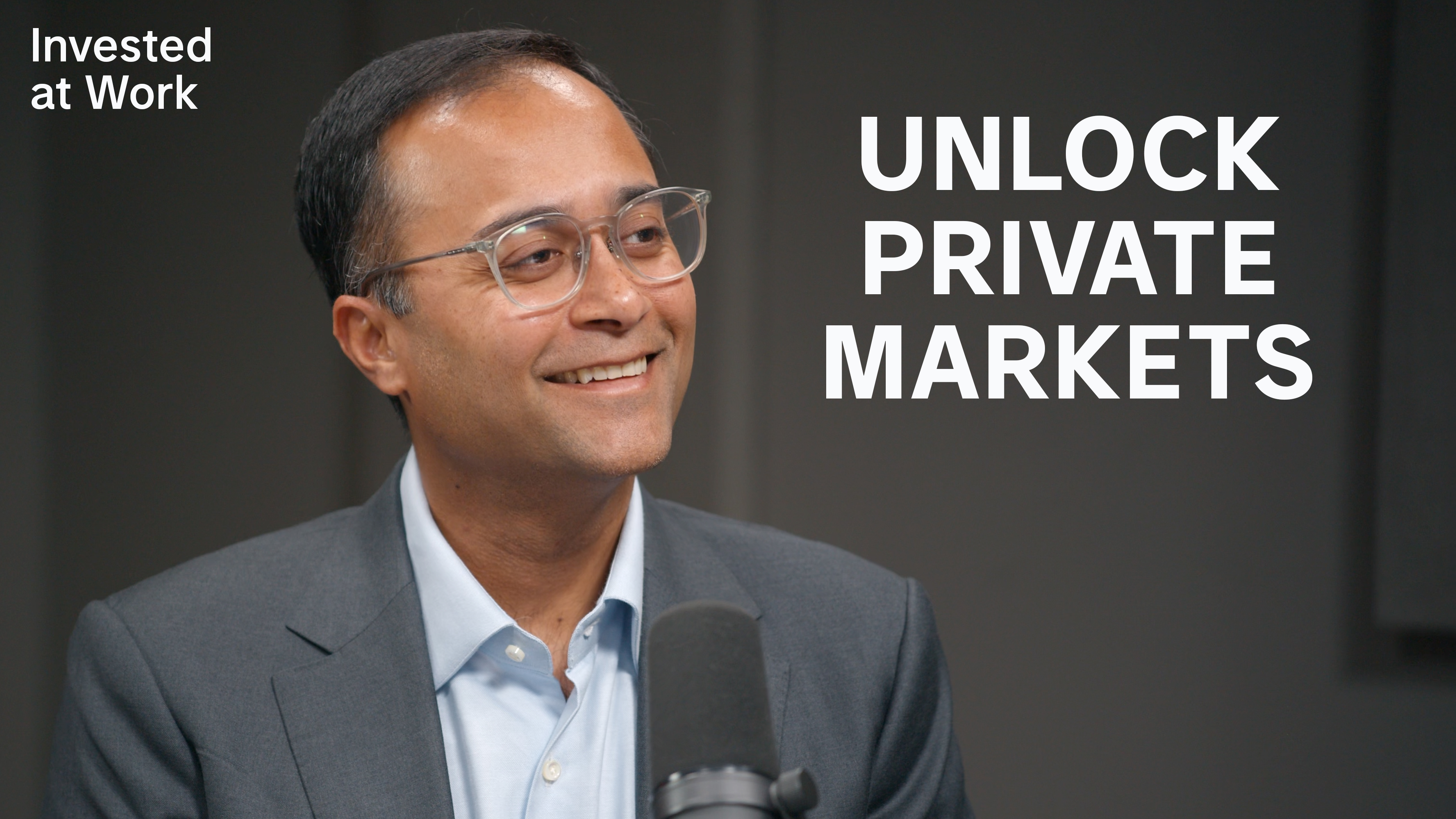
In interviews highlighted by EquityZen in September 2026, he discussed employee liquidity and leadership, including the retention risks of keeping paper wealth locked away. The conversation had moved from one founder’s purchase to a problem employers must consider when they compensate people with ownership.
There is a satisfying footnote to the origin story. Davda eventually bought the ring. He has said so himself. The detail is worth keeping because an account of a financial marketplace can become so absorbed in the mechanism that it forgets the purchase, the person and the reason anyone wanted the transaction in the first place.