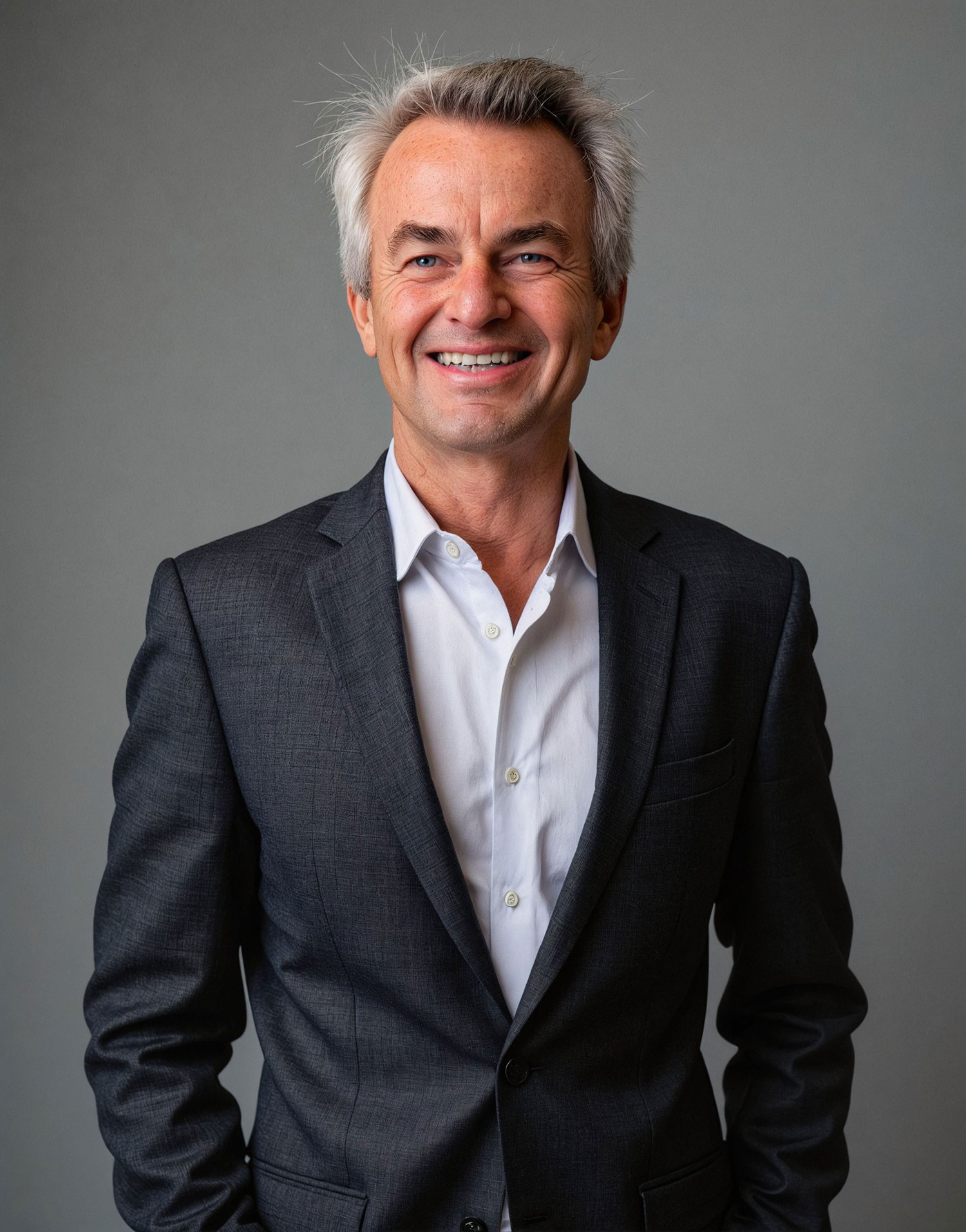
A coworker at a folding-door factory in Indiana kept getting stuck. She had to type the same order into screen after screen, and it made her miserable. Fred Luddy, seventeen years old and already obsessed with computers, wrote a program so she wouldn't have to. That is the whole company, decades early. Remove the drudgery. Put a smile on someone's face. He has been doing the same thing ever since.
Today Luddy is the founder of ServiceNow, a cloud platform that quietly runs the digital plumbing of large organizations - the requests, approvals, and workflows that used to live in email threads and paper forms. It is worth well over a hundred billion dollars. He no longer runs it day to day; he sits on the board and spends his attention on spreadsheets, on science, and on rare genetic diseases in children. But the place to understand Luddy is not the size of the company. It is the moment he almost didn't build it.
The wipeout
Before ServiceNow there was Peregrine Systems, where Luddy spent roughly thirteen years as chief technology officer building asset-management software. Then, in 2004, Peregrine collapsed in an accounting fraud. Luddy was not the fraudster - he was the engineer - but the failure took his money with it. A net worth of about $35 million evaporated. He was 49 years old and effectively starting again from zero.
Most people, handed that result at that age, retreat. Luddy did the opposite, and he was honest about why. He set himself a strange, almost superstitious deadline.
"I couldn't wait, because there was something psychologically that said I couldn't start a company at 50."
- Fred Luddy, on founding ServiceNow
So he founded the company two weeks before his 50th birthday. He gave it the unglamorous name Glidesoft and built it the way he had built everything: alone, at a desk in his house, on a laptop. The first version was modest - software to replace the clunky help desk. The genius was not in the ambition. It was in the restraint.
Make it so simple it escapes IT
Luddy's bet was that if you made the tool simple and flexible enough, people would adapt it for things you never imagined. They did. A help-desk product became a platform for HR onboarding, finance approvals, facilities requests - any workflow that could be dragged out of email and into something structured. The company renamed itself ServiceNow. It became, by its own account, the fastest-growing enterprise software company to reach more than $10 billion in annual revenue organically. No giant acquisition to fake the number. Just the same idea, applied over and over: take the pain out, watch it spread.
"My drive has never been about money. My drive has always been about putting a smile on someone's face because their lives got a little less painful."
- Fred Luddy
Hiring your own replacement
Luddy was CEO from 2004 to 2011. Then he did the rarest thing a founder can do: he stepped aside on purpose. He brought in Frank Slootman to scale the company and moved himself to where he was happiest - product. In 2016 he shifted again, to an advisory role, and later chaired the board from 2018 to 2022. The arc is unusual precisely because it lacks drama. No boardroom coup, no founder forced out. Just a man who knew which part of the job he was built for and which part he wasn't.
The dropout who got a school
There is a tidy irony in Luddy's biography. He enrolled at Indiana University and left early - he was spending all his time programming instead of going to class. In 2019 he gave the university $60 million to launch an artificial intelligence initiative, with an early focus on digital health. The university renamed its entire computing school the Luddy School of Informatics, Computing, and Engineering. He had earlier funded Luddy Hall, named not just for him but for the many Luddys who actually finished their degrees there - his mother, father, sister, and two brothers among them. The man who left without a diploma now has his name over the door.
What he does now
Recognition arrived in the usual forms: Ernst & Young Entrepreneur of the Year in 2011, Indiana University's Bicentennial Medal in 2020, the Horatio Alger Award in 2023, a net worth estimated around $1.2 billion. But Luddy's later attention has drifted away from software empires. He owns a piece of professional tennis - majority owner of the San Diego Aviators since 2015, and part of the group that bought World TeamTennis from Billie Jean King in 2017. In early 2025 he joined the board of trustees of the Salk Institute, drawn to the diagnosis and treatment of rare genetic diseases in children. Still tinkering, too: he has talked about reinventing the humble spreadsheet, which is exactly the kind of unglamorous, everyone-uses-it problem that started him at seventeen.
The throughline is not the billion dollars. It is the coworker at the folding-door factory. Find the person grinding through something pointless, and build the thing that frees them. Luddy just kept finding bigger versions of that person until one of them turned out to be the entire enterprise world.
The shape of a self-taught life
Luddy grew up in New Castle, Indiana, the son of an accountant and a Catholic schoolteacher. The household was practical and educated, and most of the family eventually passed through Indiana University. Fred was the exception who started and stopped. He had found the thing he wanted to do, and a classroom was slower than the work. That impatience would show up again and again - in the man who would not wait until 50, in the founder who handed off the CEO chair the moment scaling became someone else's specialty.
Before any of the famous chapters, there was a long apprenticeship in the unglamorous middle of the software industry. He worked at Amdahl Corporation, the mainframe maker. He co-founded a venture called Enterprise Software. Then came the thirteen years at Peregrine Systems, where as chief technology officer he built asset-management products that companies used to track what they owned. By the standards of the late 1990s he had won: a senior title, real wealth, a reputation as a builder. The Peregrine fraud took the wealth but not the reputation, and not the instinct. He still knew how to write the software. He just had to do it again with nothing behind him.
A founder who measures success in faces
It is easy to be skeptical of an executive who says money was never the point. With Luddy, the record makes the claim plausible. He chose, voluntarily, to give away the CEO title at the height of the company's climb. He poured a fortune into a public university rather than a vanity project, and let the building carry his whole family's name instead of just his own. His later work points at children's genetic disease and at fixing tools ordinary people use every day. The pattern is consistent enough to be a personality rather than a press line: he is happiest when the result is somebody else's relief.
That is why the origin story keeps mattering. A seventeen-year-old watched a colleague suffer through repetitive data entry and decided the computer should carry that weight instead. Everything after - Glidesoft, ServiceNow, a hundred-billion-dollar valuation, an award named for the patron saint of the rags-to-riches story - is that same decision at larger and larger scale. Luddy did not set out to build an empire. He set out, over and over, to take a small piece of misery out of someone's day. The empire was just what happened when the idea turned out to be true for everyone.