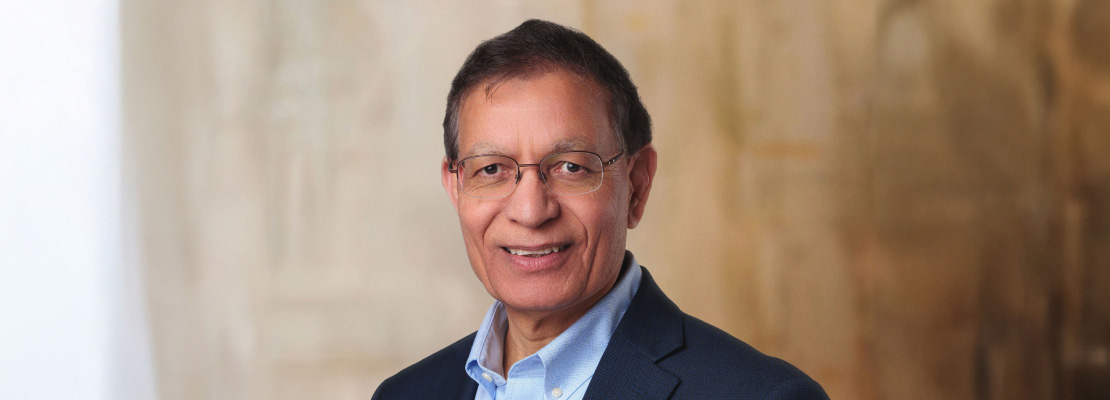
On a quiet Tuesday in early 2026, Jay Chaudhry sat down with The Motley Fool and explained why securing AI agents would be the next decade's work. He did not raise his voice. He did not hedge. He has been making the same bet for thirty years - that the network is the wrong place to put your trust.
Zscaler, the company he started in 2007, now sits between roughly 40% of the Fortune 500 and the internet they cannot live without. The product is called the Zero Trust Exchange. The idea is older than the brand: connect the user to the application, not the user to the network. The network was always the soft target.
He runs the company from San Jose with his wife Jyoti, who co-founded his first company with him in 1996, and with a board that includes their children. The Chaudhry family controls roughly 35% of Zscaler stock. Bloomberg and Forbes argue about exactly how rich that makes him - somewhere between $11 billion and $17 billion - and Chaudhry treats the question the same way he treats most distractions, which is to ignore it.
A foot wide, twenty feet deep.
Chaudhry's startup philosophy is a single sentence he repeats to anyone who asks: be a foot wide and twenty feet deep. It is the opposite of a platform pitch. It is what he tells founders when they want to do three things at once.
SecureIT, his first company, did one thing - managed firewalls for enterprises trying to get on the internet in 1996. He and Jyoti put their life savings in. Two years later, Verisign bought it. He moved to San Francisco to run the security services division. The pattern - one problem, one product, full obsession - became the template.
CipherTrust, founded in 2000, did email security. Secure Computing paid $274 million for it in 2006. AirDefense did wireless intrusion detection. Motorola bought it. CoreHarbor did managed e-commerce hosting. USi (which became AT&T's hosting business) acquired that one.
Four companies. Four exits. And then, in 2007, he started the fifth - and refused to sell.
An agent can do a lot of damage. Far worse than employees.- on securing AI agents, 2026
The Salesforce of security.
In 2007, the orthodoxy in enterprise security was a steel cabinet in a data center. You bought a firewall, you racked it, you wrote rules, you renewed the support contract. Chaudhry looked at the model and saw a Blockbuster store.
His thesis was contrarian then and obvious now: if applications were moving to the cloud and users were moving to coffee shops, the security stack had to move too. Not as appliances. As a service. Multi-tenant, internet-scale, sold by the seat. He cited Salesforce out loud, on stage, in pitch decks. Investors squinted. He kept building.
The product became the Zero Trust Exchange - a global network of more than 150 data centers that sits between every user and every application, decides what is allowed, and never puts the user on a corporate network at all. There is no castle. There is no moat. There is only a transaction, inspected in flight, and then closed.
Directional bars based on Chaudhry's public commentary on CNBC (May 2025) and The Motley Fool (Jan 2026). Not audited figures.
From Panoh to Nasdaq.
Plain talk from a soft-spoken CEO.
The strange specifics.
Birth name
Jagtar Singh Chaudhry. "Jay" is the name Silicon Valley uses; "Jagtar" still appears on the Bloomberg billionaires page.
The family company
The Chaudhry family controls about 35% of Zscaler through direct holdings and trust. His wife Jyoti co-founded his first startup. The company is, in the most literal sense, a family business.
Studied under a tree
Because Panoh had no electricity through his early years, Chaudhry studied outside in daylight. He has told the story to CNBC. He has stopped telling it as a hardship. He tells it as an inventory of what he didn't have to unlearn.
Frugal by reflex
People who have worked with him describe the same trait: he treats money like someone who watched his parents farm a half-hectare to feed three sons. Even after the IPO. Especially after the IPO.
He keeps building
He could have stopped after Verisign. After Motorola. After Secure Computing. He has been asked, on camera, why he didn't. He shrugs and starts talking about the next category.
The Benioff comparison
He cited Salesforce out loud, in 2007, when nobody was sure cloud-delivered enterprise software would scale beyond CRM. He turned out to be early on both ends of that bet.
Owning the category, then giving it a new name.
Cybersecurity has been violently re-categorized roughly every five years - from antivirus to firewall to UTM to SASE to SSE to zero trust to "AI security." Chaudhry has lived through every relabeling. Zscaler, more than most companies in the space, has shaped them.
The current chapter is the one he is selling now: zero trust for AI agents. The argument is simple. If a human employee can be socially engineered, an autonomous agent can be socially engineered at the speed of an API call. The "blast radius" of a misbehaving agent is larger than the blast radius of a misbehaving employee. The right response is the one Chaudhry has been pitching since 2007: never trust, always verify, and never put the agent on the network.
It is also a useful re-framing for shareholders. Zero trust for humans is a mature market. Zero trust for agents is, by definition, brand new. Chaudhry, who long ago internalized the idea that markets reward founders who can re-pitch the same idea to a new audience, is mid-pitch.
Recognition that has stuck
EY Entrepreneur of the Year (Southeast USA). Goldman Sachs' 100 Most Intriguing Entrepreneurs. Forbes' list of America's richest immigrant billionaires. Bloomberg billionaires profile. None of these are the achievement he leads with in interviews. The achievement he leads with is that Zscaler is still independent and still his.
The bench
He sits on the Zscaler board with two of his children. He has invested in and advised dozens of security and infrastructure startups, often quietly, often in categories adjacent to whatever Zscaler is doing next. He is a member of Indiaspora, the network of high-impact members of the Indian diaspora.
What he is doing this week
Same thing he was doing last week: signing customers, debating the engineering org, telling the press that the firewall is dead. He has been making the same argument since the Bush administration. He looks like he is willing to make it for another twenty years.