At Brunsbüttel in northern Germany, a nuclear power station is being dismantled. The next chapter planned for the site is a battery. In October 2026, Vattenfall selected Fluence to supply a system rated at 254 megawatts, holding more than 1,000 megawatt-hours of electricity. Its advertised endurance is about four hours. A place associated with making power will acquire another job: keeping power until somebody needs it.
Four hours sounds modest beside a nuclear reactor. But it asks a different question. What happens when the electricity you can generate and the electricity people want arrive at different times?
- Fluence builds big batteries, then helps owners operate and trade them.
- Its advantage rests on integration: equipment, controls, service, and software.
- Strong orders meet a harder test: getting factories and deliveries to run on schedule.
A business built around the clock
Fluence’s answer is to move electricity through time. Charge a battery when power is available or cheap; discharge when demand, prices, or grid conditions make it useful. Utilities, independent power producers, and renewable developers buy that flexibility. Increasingly, data centers want it too.
The company came from inside the electricity business. Siemens and AES formed its operating joint venture in 2017 and launched operations in January 2018. They brought experience with equipment, power plants, and customers who expect infrastructure to work for years. The listed parent, Fluence Energy, Inc., followed in 2021.
That ancestry helps explain the offering. Fluence assembles a working system around batteries: power conversion, controls, monitoring, project delivery, and maintenance. It occupies the space between battery components and the customer’s electricity network. The work is making those pieces cooperate.
The road is part of the design
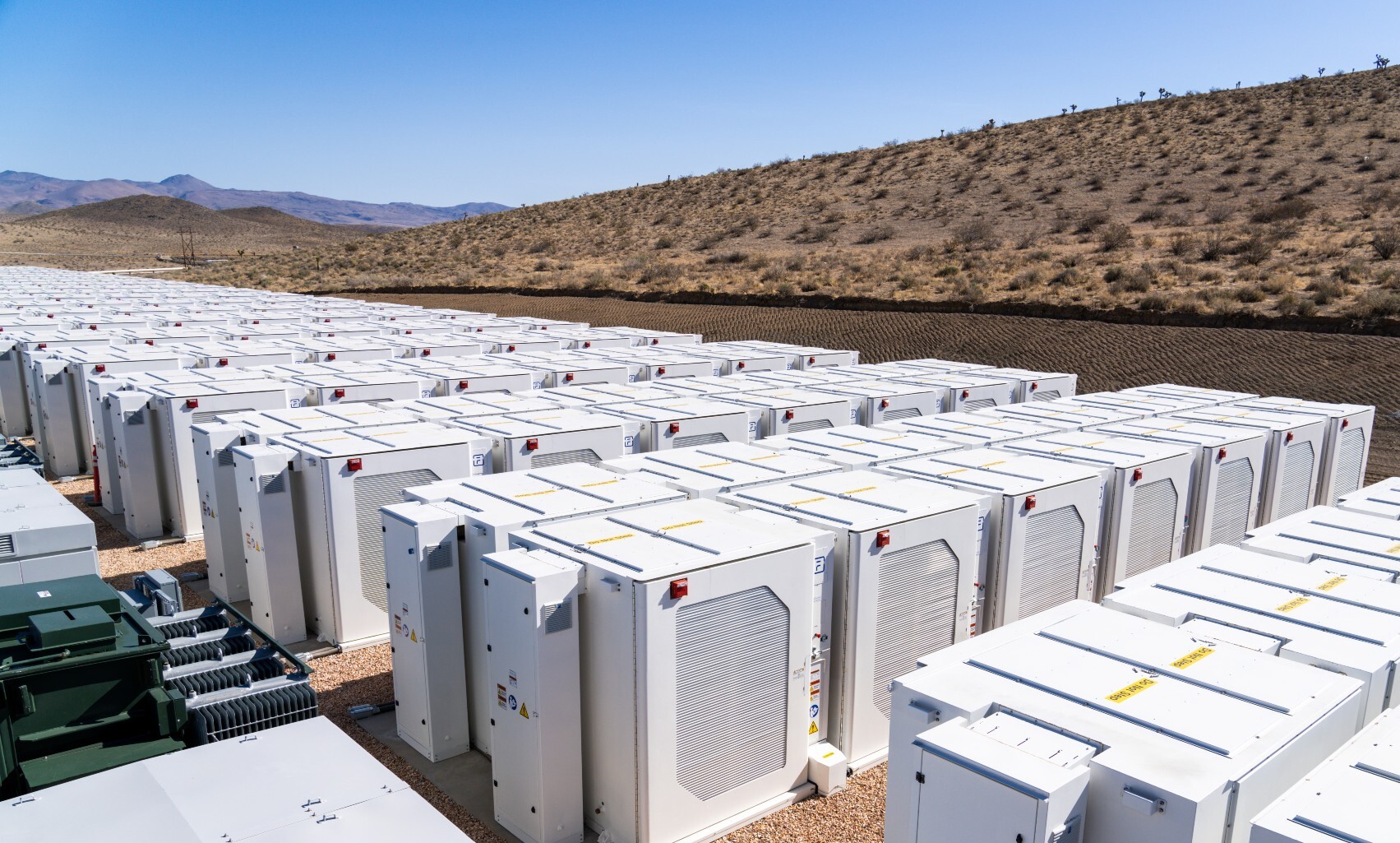
Consider a surprisingly ordinary obstacle to a giant battery: getting it to the customer. More storage in one enclosure can mean a heavier object to ship, lift, and install. Density on a specification sheet has to survive the journey to a real site.
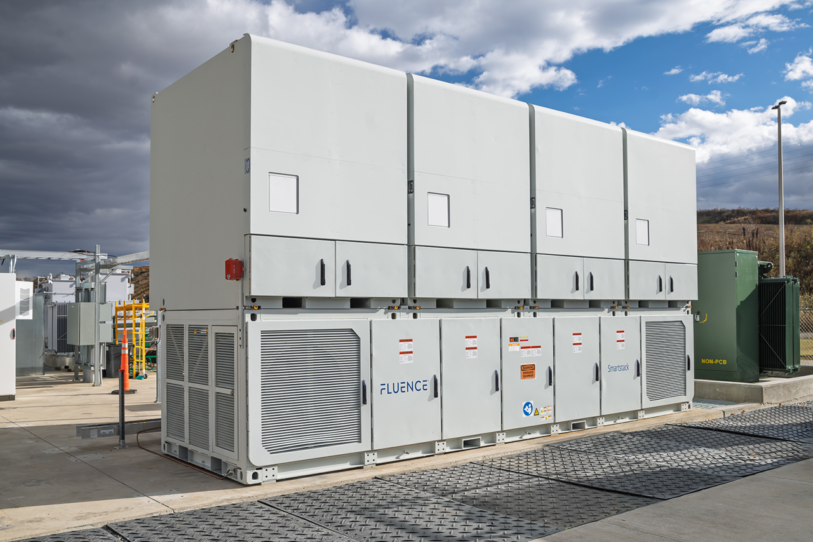
Smartstack, introduced in February 2025, separates battery pods from a base containing electrical and control equipment. Smaller pieces travel separately and come together onsite. The product page now lists 7.5 and 10 megawatt-hour configurations. At launch, Fluence claimed roughly 30 percent higher energy density than other available AC-based systems. That is a company comparison, rather than a universal efficiency gain.
The practical proposition is straightforward: put more storage into a constrained footprint while simplifying transport and installation. Alongside Smartstack, Gridstack and Gridstack Pro address utility-scale applications. Vattenfall’s planned German facility will use Gridstack Pro 5000, with operation expected by the end of 2028.
A battery needs a trading desk
Once installed, a battery acquires another problem. When should it charge? Selling too early might mean missing a better price later. Holding everything back might mean earning nothing. Meanwhile, the equipment has operating limits and warranty conditions.
Mosaic, Fluence’s bidding software, combines price forecasting, optimization, and automated market participation. It supports equipment from other providers, a useful detail for owners with mixed portfolios. The manufacturer of the box need not dictate the software used to trade its output.
Nispera handles another set of questions: what is underperforming, what needs attention, and what might fail? It collects operating data across wind, solar, hydro, and storage assets. Fluence’s 2022 acquisition agreement included an approximately $30 million cash buyout for Nispera’s existing private investors. Together, the software products connect physical availability with commercial decisions.
Mosaic informs market decisions. Nispera monitors performance. Physical limits still apply.
The invoice has several chapters
Fluence earns money selling storage systems and delivery, then adds operating services and software subscriptions. Despite the appeal of its digital tools, equipment dominates: in fiscal 2025, roughly $2.17 billion of its $2.26 billion revenue came from storage products and solutions. Services contributed about $84 million; digital applications, about $6 million.
That mix matters when assessing the company. Software can keep a customer relationship alive after installation, but Fluence still depends heavily on delivering physical projects. Its use of contract manufacturers avoids owning every production step. The tradeoff is that somebody else’s factory can become a constraint on its own promises.
For a buyer, the purchase price is only the opening calculation. Construction, connection, financing, charging electricity, maintenance, losses, and battery wear affect the return. The useful comparison is lifetime cost against achievable revenue and grid value. A cheap battery that cannot connect or participate in the relevant market is a poor bargain.
Fluence names Tesla, Wärtsilä, Sungrow, and CATL as competitors. Its pitch combines configurable systems, operating support, and software. Those features deserve comparison against each project’s actual requirements; they do not settle every procurement contest.
Then Houston changed the timetable
There is a second clock in this business: the factory’s. At June 30, 2026, Fluence reported approximately $6.4 billion in contracted backlog. But orders cannot charge a battery. Production has to turn commitments into equipment.
In September, CEO Julian Nebreda acknowledged “delays in the ramp up of our contract manufacturing facility in Houston.” Fluence cut its fiscal 2026 revenue forecast to approximately $2.4 billion, from the previous $3.0 billion midpoint, and forecast an adjusted EBITDA loss of about $200 million. Those were revised expectations, not final annual results.
Company forecasts issued August 5 and September 16, 2026. The reduction is 20%.
The immediate bottleneck was execution. Management said it was restructuring operations and connecting planning across supply, manufacturing, and delivery. A separate September agreement with EVE Power sought greater visibility into international battery supply and pricing. Neither announcement by itself proves the bottleneck has cleared.
Copy the whole chain
“Orders cannot charge a battery.”The execution test
The lesson for another business is practical: engineer the journey alongside the product. Fluence’s modular packaging addresses transport; its software addresses operation; its factory difficulties expose the cost of weak links between them.
A prospective buyer can copy that discipline by checking the whole chain: the delivery schedule, connection plan, warranty limits, trading arrangement, and service obligations. Evaluate the downside case alongside the expected return. If commissioning slips, the revenue clock starts later, even while the project’s other bills may keep arriving.
For customers, storage works when access to electricity, a usable connection, market rules, and operating economics align. A four-hour system cannot carry a site through an indefinite shortage without recharging. Forecasting cannot manufacture an attractive price spread. Brunsbüttel’s planned battery is compelling precisely because its job is specific: save electricity for a later hour, then be ready when that hour arrives.