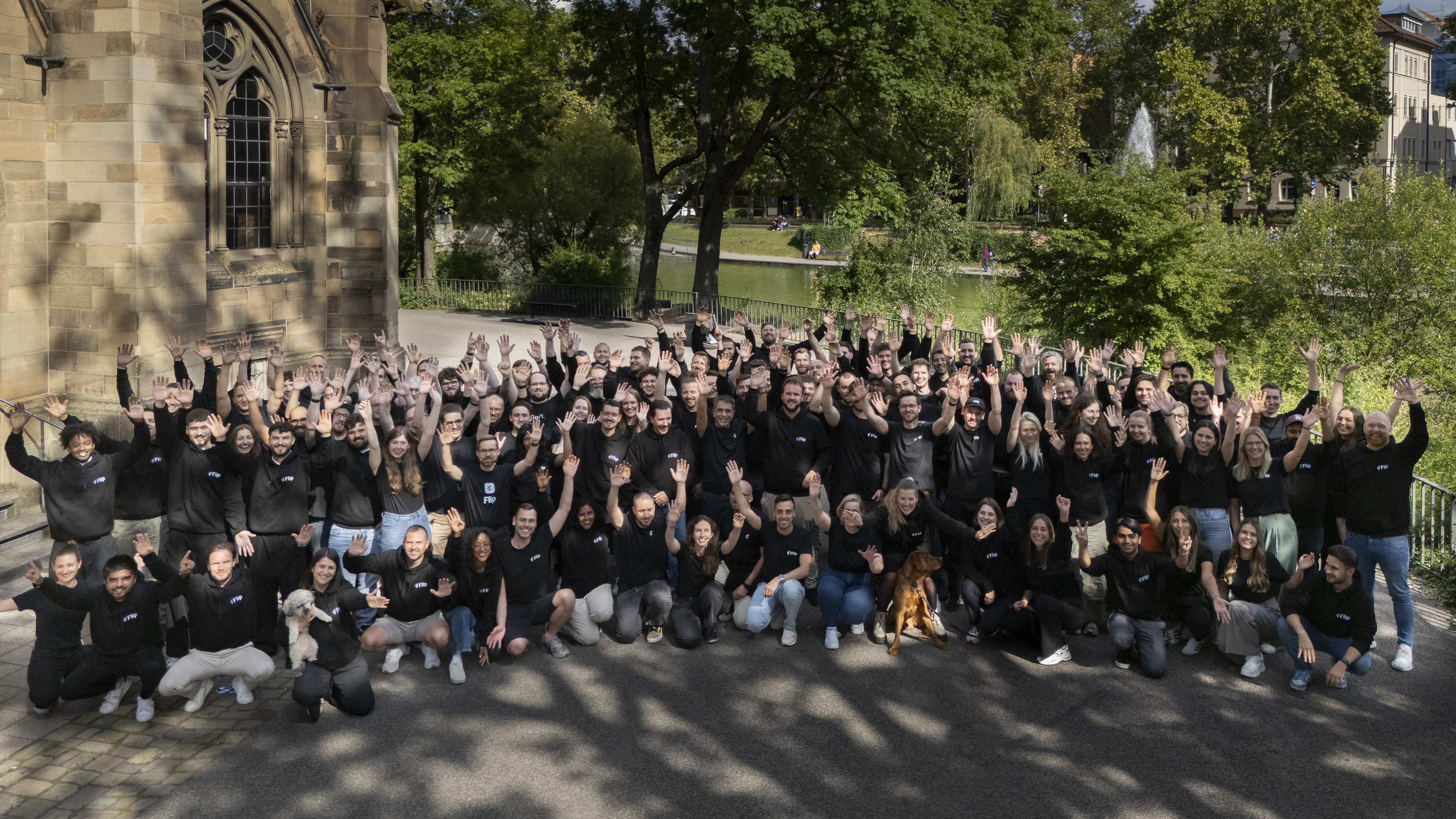
The first version of Flip did not begin with artificial intelligence, a lavish launch, or even a startup office. It began with an irritatingly ordinary observation inside Porsche: people at headquarters lived in a world of email and software, while colleagues in production and logistics could still be marooned on the wrong side of a noticeboard. Benedikt Brand, then known as Benedikt Ilg, saw the gap during his time at the carmaker. He and school friend Giacomo Kenner spent weekends turning that frustration into a mobile employee app.
The product was simple on purpose. A worker without a company laptop or email address could use a familiar feed and chat interface to get news, find a payslip, swap a shift, fill in a form, or contact a colleague. The employer got a controlled alternative to private WhatsApp groups and paper memos. Flip became the connective tissue between the head office and the people making, moving, stocking, serving, repairing, and caring.
That sounds obvious now. In 2018 it was a peculiar blind spot. The people buying enterprise software sat at desks, so software kept being designed around desks. Flip inverted the buyer's view: start with the person who has a phone, a short break, patchy connectivity, and no patience for a six-step login.
The first customer disappeared at the worst possible time
Porsche became Flip's first customer, which gave the founders a handsome logo and a dangerous concentration problem. Just after Brand left his job and the small team committed to the company, Porsche paused the project during a management change. For roughly six months, the customer that made the leap feel rational was no longer moving.
This is the useful part of the origin story. Flip did not rescue itself with a dramatic pivot. The team kept pushing the same thesis and found around 10 other organizations with the same communication wound. Porsche eventually returned. The pause changed the evidence behind the company: this was not one employer's custom problem; it was a repeatable category.
Don't start your search for a solution. Look for the problem and when you find it, make sure you completely understand it.Benedikt Brand, co-founder and CEO
Understanding it sometimes meant going to work. Brand and Kenner reportedly took shifts inside customer businesses, watching how an imagined everyday worker they called Werner received instructions, found information, and got through a shift. It is a charmingly German form of user research: less beanbag, more beverage machine.
A messenger grew into a work surface
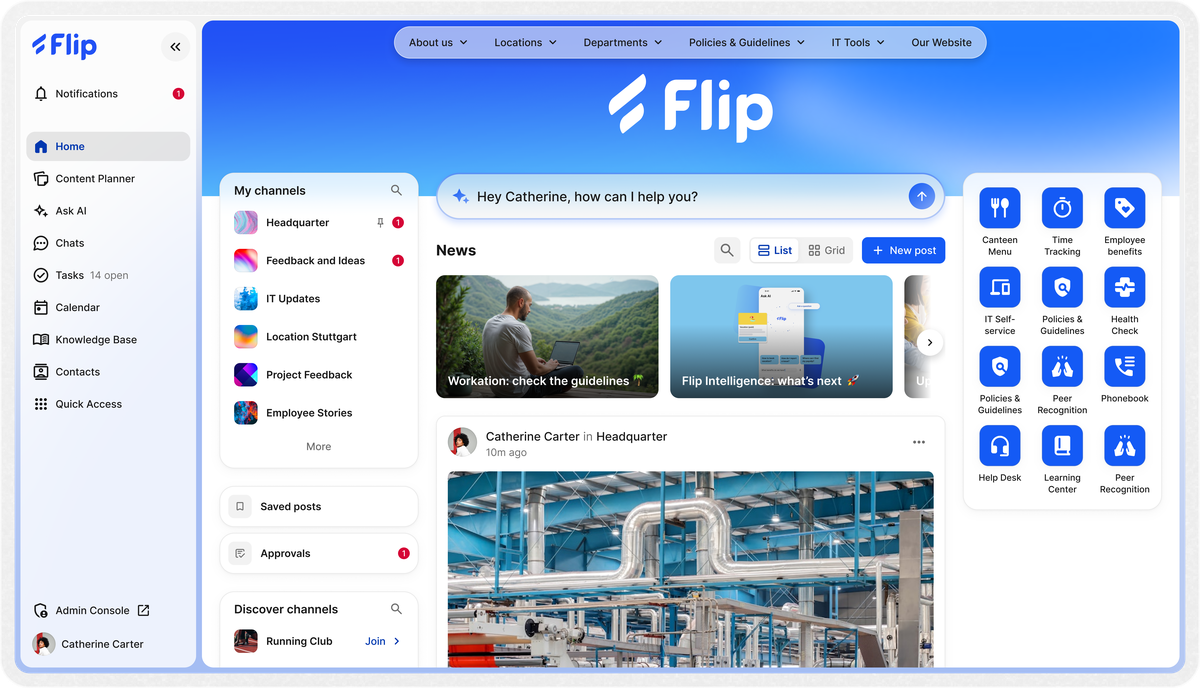
Flip still looks like an employee app, but the business is now broader. Its platform covers communications, HR self-service, company knowledge, operational tasks, surveys, calls, and workflows. A customer can brand the app, connect it to existing systems, and give workers one mobile doorway instead of a little museum of QR codes.
The product expansion followed a sensible chain. Once news reached the worker, the next question was whether the worker could act on it. Forms and tasks led to workflows. Workflows needed data from HR and operational systems. Access to those systems exposed the identity problem: many frontline employees do not have a corporate inbox, yet the standard enterprise login assumes one exists.
Frontline Identity attacks that assumption with passkeys, QR activation, and invite codes on personal or shared devices. Flip says an employer can provision secure, role-aware access without buying every worker a separate identity stack. For organizations wrestling with European data rules and works councils, the company's early obsession with GDPR, BYOD boundaries, and worker representation is not paperwork around the product. It is part of the product.
The AI pitch is really a distribution pitch
Flip's latest chapter arrived in two beats. In June 2026, it announced Frontline Identity, the Fusion app builder, an AI Flow Builder, and an AI Agent Gateway. In August, it raised $25 million from returning investors Notion Capital and HV Capital, new investor L-Bank, and others. The company said the money would fund the infrastructure required to accelerate AI adoption on the frontline - not another disconnected app.
Fusion is the flashiest piece. A manager describes a need in ordinary language and the system generates a role-aware, authenticated application inside Flip. The Flow Builder does something similar for multistep processes. Ask AI answers questions against company knowledge, while the Agent Gateway can connect it to systems including SAP, Jira, Salesforce, and Workday. In theory, a worker can ask for a live answer or complete a governed task without learning which enterprise system holds it.
The clever strategy is not claiming a better model. Flip is betting on access. Office workers already have a crowded AI buffet. The harder market is the estimated 2.7 billion people who do not work at desks and often lack the identity, device setup, permissions, and digital trail that make an agent useful. The app is the interface; identity and integration are the toll roads.
Who pays, and what does it cost?
Flip sells B2B software to employers, not to individual workers. Companies pay according to licenses, locations, modules, and integrations. Organizations above 300 employees receive a tailored enterprise proposal; smaller teams can use fixed packages. Flip does not publish exact dollar or euro prices, and its pricing page cheerfully declines the industry's favorite “cost of a coffee” comparison.
That discretion makes sense. A rollout across hundreds of stores or factories is not a download. It is identity design, system integration, privacy negotiation, content planning, local champions, training, and measurement. Flip says a typical customer of about 5,000 employees sees average returns of 12 to 15 times the software investment. Treat that as a vendor benchmark, not a law of physics. Results depend on which broken processes actually disappear.
The customer roster shows where the model travels: Bosch and MAHLE in manufacturing; REWE, PENNY, Rossmann, and TEDi in retail; McDonald's and KFC operators in food service; Greif in industrial packaging; Safestore and APCOA across distributed locations. The shared characteristic is not industry. It is a large workforce moving through physical places without a reliable corporate inbox.
Just because you don't have a laptop, it doesn't mean you should be excluded from digitalisation by your company.Adam Pikula, IT Director, Bosch USA
What to steal from Flip
There is another lesson in the funding history. Flip raised €3.6 million in 2020, $30 million in 2022, a $28 million Series A extension in 2025, and $25 million in 2026. Between those rounds it acquired The Bot Platform, built partnerships for customers leaving Workplace from Meta, and expanded into the UK and US. The company did not abandon its original wedge to chase AI. It used AI to deepen the same argument: everyone should be able to participate in digital work.
Where the playbook breaks
Flip is a weak fit for a desk-heavy company already well served by email, Teams, or Slack. It also struggles when workers cannot use personal or shared phones, connectivity is poor, works councils or privacy teams are brought in too late, old systems cannot integrate, or nobody owns adoption after launch. Buying the app without removing the noticeboard-era process merely creates a shinier noticeboard.
Competitors such as Staffbase, Blink, Yoobic, Beekeeper, Workvivo, Microsoft Teams, and Microsoft Viva all approach parts of the same market. Flip's position is unusually specific: mobile first, no email required, enterprise controlled, and broad enough to connect communication with action. The risk is equally plain. Every new layer makes the simple app more complicated, and large platform vendors can bundle adjacent features. Flip has to keep passing its own Werner test.
For now, the company has turned a mundane inequality into a durable business. The office received digital transformation as a parade of new tabs. Flip's users get one small screen and a demand that it work immediately. That constraint may be the company's best defense. The next useful AI product for a factory, store, kitchen, warehouse, or care setting will not win because it can talk. It will win because the right person can open it, trust it, and finish the task before the break ends.