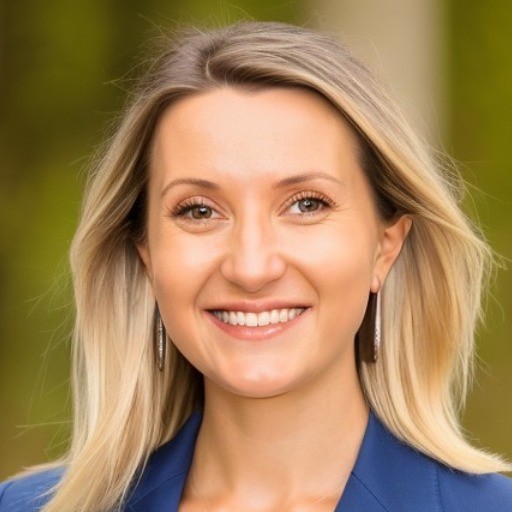
Start with the strange specific. The person building software to untangle your open-enrollment paperwork once spent her days at the Harvard-Smithsonian Center for Astrophysics, in the business of stars. At Harvard she carried a dual degree in computer science and astrophysics - two famously demanding fields, taken at once. The leap from galaxies to benefits administration sounds like a non sequitur. It isn't. Both are exercises in modeling enormous, messy systems and finding the signal.
Constantin left Romania straight after high school to study in the United States. At Harvard she didn't only study. She was Co-President of the Woodbridge International Students Society and Director of International Freshman Affairs - the person other newcomers found when they landed, disoriented, in Cambridge. A pattern shows up early: she gravitates to the seams of a system, the places where people fall through.
The Azure years
After Harvard came Microsoft, and more than five years of it. She worked on the Azure Compute Efficiency team, the unglamorous machinery that decides how one of the planet's largest clouds hands out resources. She came up under Satya Nadella's "learn-it-all" culture, earned patents in AI systems, and wrote code that hit millions of users the moment it shipped.
That last detail did something to her. When you have felt the weight of code that touches millions at once, you start looking for the place where that leverage matters most for individual people. She found it in an unsexy corner: HR and employee benefits.
"Having written code that immediately impacted millions of users at once," one profile put it, she "recognized HR and health benefits as the perfect place to use machine learning to inform individuals' decision-making - and to do so for a function that's historically been on the wrong side of the digital divide."
The tension she set out to kill
Here is the old fight inside every large company: enterprise efficiency versus a genuinely human employee experience. Pick one. Cut costs and employees feel like ticket numbers; coddle employees and finance winces at the bill. Constantin's whole pitch is that the trade-off is a relic.
"We resolve the historical tension between enterprise efficiency and an exceptional employee experience," she says. "We can solve for both enterprise efficiency and improving the employee experience in the same platform." The mechanism is personalization at scale - "bespoke AI agent personalization with plug-and-play ease," in her phrasing.
She co-founded Cascade in 2022 with Pulak Goyal, right as the field pivoted from deep learning to generative AI. The timing reads less like luck than like someone who had been watching the cloud from the inside and knew what was about to be possible.
The vote of confidence
In October 2024 Cascade closed a $3.75M seed round led by Gradient Ventures - Google's own early-stage AI fund - with AlleyCorp alongside. Total funding crossed $5.45M. Getting Google's AI fund to lead your round is a particular kind of signal: the people closest to the frontier model technology decided to back the founder applying it to payroll and PTO.
The recognition kept coming. GeekWire named her Young Entrepreneur of the Year in May 2024. In 2025 Google Cloud named her a Partner All-Star for advancing secure, agentic AI for HR. She and Goyal won The Conference Board's Innovators "Pitch to Win" competition.
What she tells other founders
Her advice is refreshingly free of mysticism. To HR leaders staring down AI: "Prioritize progress over perfection and adopt and experiment early with generative AI." To fellow founders: "Prioritize collaboration and intentionally build a very strong team with a diverse set of skills. I learned the value of collaboration during my time at Microsoft - to achieve anything at scale, we had to work together within and across groups."
It is the lesson of the Azure years, restated. Nothing big ships alone.
What keeps her in it isn't the funding headlines. "Increasing access to resources, and helping to connect employees with the programs that are already there but that they may not know about," she says, "is something that has been really rewarding and meaningful." The benefit you never claimed because you never knew it existed - that is the gap Cascade is built to close. The astrophysicist found her signal in the noise after all. It just happened to be hiding in an HR ticket queue.