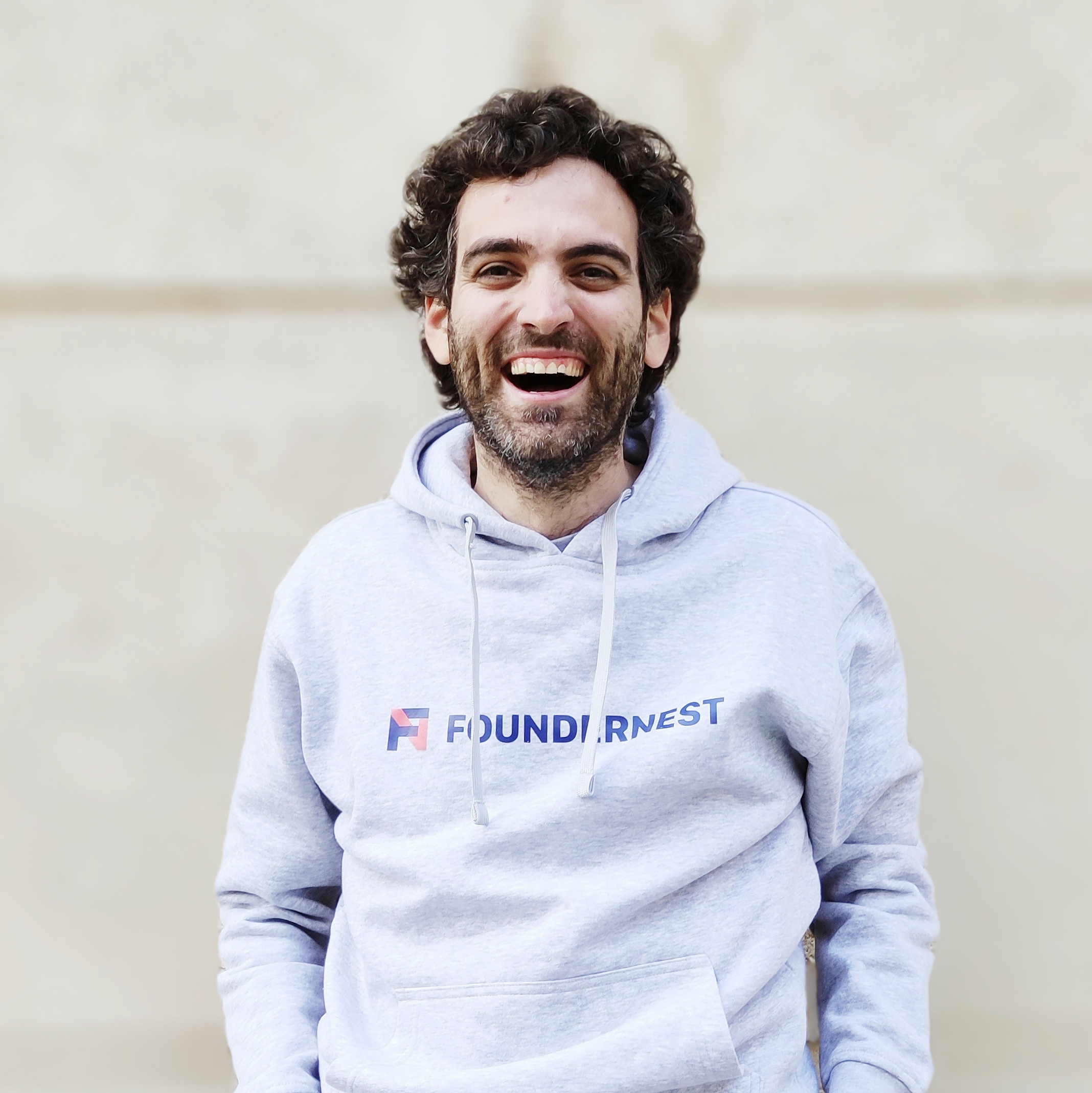
Spain, 2009. The country's unemployment rate climbs past 18%. Felix González Herranz does not look for a stable job. He co-founds JuntoSalimos - "Let's Get Out Together" in Spanish - a community platform for entrepreneurs trying to survive the wreckage. It is his first answer to a question that will define his career: how do companies find the right partners, the right opportunities, the right signal in an overwhelming amount of noise?
That question followed him through the Inter-American Development Bank (telecom infrastructure across 20+ countries), through consulting at The World Bank, through a Fulbright scholarship at Stanford, through an MBA that made him an Arjay Miller Scholar - which is Stanford GSB's way of saying "top 10% of the class." It was at Stanford that the answer started to crystallize into a company.
"I'm most proud of solving a real-world problem. We help people make decisions that matter."
- Felix Herranz, Co-Founder & CEO, FounderNestFounderNest launched in 2018 out of Palo Alto. The pitch: Fortune 500 companies, VC firms, and corporate R&D departments spend enormous resources trying to understand what's happening in the market - which startups are emerging, which competitors are pivoting, which technologies are gaining traction. They do it with spreadsheets, consultants, and gut instinct. Felix built an AI to do it better.
The platform today contains 54 million company profiles, 1.2 billion aggregated data points, and 300 million smart insights spanning 200+ jurisdictions. It is not a directory. It is an AI analyst - AMIA (AI Market Intelligence Analyst) - an orchestrated network of domain-specific agents that can generate competitive intelligence reports, map white spaces in a market, surface hidden acquisition targets, and track technology trends before they become obvious.
The clients include L'Oréal, Roche, Telefónica, Novo Nordisk, AstraZeneca, Kyocera, Chanel, Zoetis, AB InBev, and Mondelez. The pattern: companies with large, complex innovation mandates that cannot afford to get the landscape wrong. When Roche wants to scout biotech startups before anyone else, FounderNest is the tool they reach for.
A Family Business, Silicon Valley Edition
Here's a detail that doesn't fit the standard Silicon Valley founder narrative: Felix co-founded FounderNest with his brother, Miguel González Herranz. Miguel serves as COO and CPO. The third co-founder, José Vicente Ruiz Cepeda, holds the CTO role - a Fulbright Scholar himself with an MS in Machine Learning and AI from Columbia University.
The brothers-building-a-company dynamic is either a red flag or a superpower depending on who you ask. At FounderNest, it appears to be the latter. The company has grown to 41 people, opened offices in Madrid and the UK, and secured backing from Ulu Ventures alongside a syndicate of investors who previously backed PayPal, Waze, Palantir, Square, and Pinterest.
Felix's path was not a straight line from engineering degree to software startup. The man has a BS in Electrical Engineering and Computer Science from Universidad Politécnica de Madrid, a degree from Télécom Paris, a Stanford master's, and an MBA. He taught at Singularity University. He has been a guest lecturer on innovation at his undergraduate university since 2014 - which means he was teaching while also building JuntoSalimos. This is not a person who does one thing at a time.
The Problem He Refuses to Let Go Of
The Inter-American Development Bank work is worth understanding. For several years, Felix worked on broadband infrastructure programs across more than 20 countries in Latin America and the Caribbean. Not advisory work from a conference room - actual implementation, country by country. He saw firsthand how hard it is for organizations to understand what exists, what's coming, and what decisions to make with incomplete information.
That experience shapes everything about FounderNest's product philosophy. The platform is not built for people who already know what they're looking for. It's built for people who need to discover what they don't know exists. Company fit assessment. Hidden gems in emerging markets. Trend detection before trends become headlines. The technical term is "innovation scouting." The simpler description: finding signal before it becomes noise.
"Your company's vision and mission serve as guiding stars. Look for candidates who not only comprehend but also embody these core principles."
- Felix Herranz on building teamsThe seed round closed in December 2022. The convertible note followed in July 2023. Total raised: $2.6 million across seven rounds - a lean number for an AI platform with Fortune 500 clients. It suggests either fierce capital efficiency or a founder who has learned from watching too many well-funded startups burn through money solving problems nobody had. Probably both.
In October 2024, Felix was back in Madrid for a U.S. Spain Executives Community panel on the differences between building a business in the US versus Spain, investment dynamics, and startup challenges. A man who left Spain's economic crisis, built his way through 20 countries, earned two Stanford credentials, and landed in Palo Alto - still showing up to explain the journey to the next generation of Spanish entrepreneurs. Old habits from JuntoSalimos die hard.
In October 2025, he's on a stage at InsureTech Connect in Las Vegas, talking to insurance executives about how to turn data and startup collaboration into real innovation. The audience trusts him because he has the receipts: clients, data, a platform that works, and a career that has always been about closing the gap between what companies know and what they need to know.