The office had already enjoyed one career before Faiz Mohamed Haneef gave it another. It had been a textile shop. Now it was supposed to persuade software professionals to join a young technology company. There was no washroom. Candidates accustomed to large multinational employers arrived, considered the surroundings, and sometimes disappeared from the recruitment process. The premises were making a counteroffer.
Haneef remembers those confused faces. He also remembers the people who stayed. When he later described the beginning of NeoITO, the software engineering company he founded in 2014, he put those early employees near the centre of the story. Some of the people who believed in the venture became its executives. Before there was much of an institution to join, there was a person asking to be believed.
That is a useful place to begin with Haneef, whose work now spans engineering services, products and investing. His career has acquired more titles and a wider geography. The early questions were rather compact: how to find customers, what to spend, whom to hire, and how many promises a small group of people could reasonably keep.
An office with a previous career
In a 2022 essay about frugality, Haneef recalled renting his initial space from his father. Improving the furniture and infrastructure had to wait. He concentrated on customers and cash flow, eventually creating more jobs and moving into larger premises. The sequence matters. The business would pay for the appearance of a business when it could afford to do so.
His first customers came through his network. He described an almost comical amount of deliberation before spending each penny. A small founder’s purchase has several possible lives: it can become equipment, a nicer room, or money still available when the next payment takes longer than expected. Choosing one means postponing the others.
There is an obvious complication in this approach. The room that saves money can make hiring more difficult. Someone deciding whether to leave a familiar employer must assess a future using whatever evidence is available. A modest office is evidence too, even when its occupant has a sensible explanation for every missing convenience.
Haneef’s recollection gives those early employees a particular importance. They accepted the uncertainty as well as the offer. Later loyalty, in his telling, began with that decision. A company culture can be described in polished language; it can also begin with remembering who agreed to work in a shop that had stopped selling cloth.
“Be kind to people and situations.”Faiz Mohamed Haneef, reflecting on NeoITO’s early employees
The interview with too much good news
A hiring anecdote dated 2017 puts numbers around his view of responsibility. Haneef asked a candidate to imagine that 80 percent of the company’s employees were already busy. A new client appeared whose work would require the attention of the whole team. What should happen next?
The candidate proposed using the remaining 20 percent. Haneef rejected the answer. Even a financially attractive engagement could be the wrong commitment at that moment.
The arithmetic is deliberately uncomfortable. Sales success does not increase the number of available people. The customer’s requirement remains the customer’s requirement, however enthusiastically the agreement is signed. Somewhere between the proposal and the delivery date, someone has to account for the missing capacity.
Same team. Two commitments. A conversation has to come first.
Haneef’s answer was about the people carrying those commitments. The interview ended with the candidate being hired. Agreement on the first attempt was evidently less important than understanding the company’s priorities by the end of the conversation.
“Clients will come, but dedicated employees won’t,” he said. The sentence is blunt enough to invite disagreement. Clients, after all, pay the bills. Its force lies in the choice being described: a particular piece of revenue, available now, against the continuing confidence of a team already doing the work.
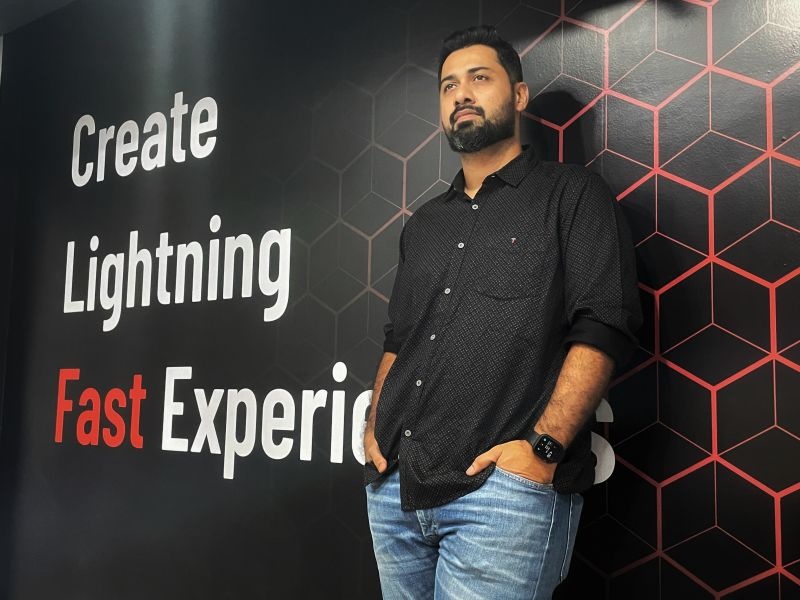
Before the founder, the engineer
Haneef brought an enterprise technology background to the small office. His professional history includes Hallmark, Lowe’s and Infosys. He attended the University of Kerala, and his credentials include an IBM application developer certification for WebSphere Commerce, issued in 2009. Commerce systems were part of his working vocabulary before NeoITO existed.
His developer identity is still visible in smaller, less ceremonial places. His GitHub account uses the handle faizmh. Among its public repositories is a project for adding custom data to posts in Ghost CMS, alongside Angular starter projects and other web development material. The subjects are practical: ways to make software do the next required thing.
The contrast with his present job is instructive. A founder must make decisions about customers, staffing and direction; a developer must make a particular implementation behave. Both jobs punish promises that have not been thought through. The level of detail changes, but consequences remain stubbornly attached to the decisions.
NeoITO’s own trajectory connects those two scales. Its work brings engineering to startups while also serving enterprises with commerce, data and AI projects. That gives Haneef a business in which the concerns of a small product team and those of a larger organisation can meet. A founder wants to get a product into use. An established business needs changes that will hold up while people continue using it.
A second map, and then a second role
In October 2020, NeoITO announced an office in Salt Lake City. Haneef described the opening as the continuation of an existing relationship with Utah’s startup community. The announcement put Joel in charge of the operation and included support from Daily AI co-founder Spencer Dusebout. Expansion arrived with names attached to it.
That detail gives the geography some substance. An overseas office is easy to represent with a dot on a map. Working relationships are harder to compress. People have to know what a company can deliver, trust the people responsible and have a reason to continue the conversation. The office formalised a connection Haneef said was already there.
He also entered organised entrepreneurial networks. Crunchbase dates his TiE charter membership to April 2020. His current work includes a managing partner role at Neotera Ventures, where Brian Chapman is listed as partner. The engineering founder is also considering businesses from the investor’s side of the table.
Those positions carry different obligations. A services company commits people to a customer’s project. An investor commits capital to a company and its decisions. Experience in one role can supply useful questions for the other: what will this require, who will execute it, and which assumption is carrying more weight than it should?
Products enter the conversation
When NeoITO reached eight years, Haneef chose an unusual anniversary highlight. The achievement closest to him was the culture of entrepreneurship inside the company. He thanked the team and clients, then looked ahead to product lineups of its own. An engineering business that helped other people build had ambitions to put more of its own ideas into circulation.
Happilee, a conversational engagement business associated with Haneef, gives that ambition a concrete form. Its focus is helping businesses handle customer communication through channels such as WhatsApp. The problem is familiar to anyone who has watched an unanswered enquiry slip down a busy inbox: communication has work attached to it, and the work accumulates.
Products also change the questions a founder must answer. Service delivery begins with a customer and an agreed requirement. A product asks many customers to adopt a shared answer. Decisions about what to include, what to postpone and what to charge become part of the operating model. The team has to learn from use as well as build.
In his KPH House conversation with Felix Josemon, Haneef’s expanding mix of work became a subject in its own right. The discussion covered multinational teams, services and products, venture capital and the effect of AI on delivery models. These are connected concerns for someone whose business depends on how software work is organised and valued.
The people who believed the room
There is a temptation to make an early office into a lucky charm once a company survives it. The textile shop deserves a more practical role in Haneef’s story. It made recruitment harder. It made the difference between a plan and an established employer visible to every candidate who came through the door.
His later reflections return to the people who crossed that distance with him. Their place in the story helps explain the hiring question about the oversized new project. Protecting an existing team’s commitments becomes easier to understand when the founder remembers how difficult it was to assemble that team in the first place.
The scale of Haneef’s work has changed since 2014. The useful thread is the attention he gives to resources that enthusiasm cannot immediately replenish: money already spent, time already promised, confidence already extended. There is room for ambition in that accounting. There is also a place for telling the next customer to wait.