The first employee to leave Sergii Tymchuk’s company prompted a meeting that lasted until two in the morning. There were about eight people in the business. Tymchuk and a colleague spent four hours working through what had happened. To the young founder, a resignation felt as though the whole enterprise might come apart. A small company can make an ordinary departure feel like a referendum.
Years later, the co-founder and CEO of Computools would write about another early mistake: trying to handle everything simultaneously. The ambition was understandable. The results were less cooperative. His career has involved learning how to build a business large enough to accommodate his plans, then learning how to stop standing in its way.
“Instead of focusing on refining a single process, I attempted to handle everything simultaneously.”
Sergii Tymchuk, March 2024
There is something endearing about a software entrepreneur arriving at the problem of management by becoming part of the problem himself. Tymchuk’s answer has been to give responsibilities names, write decisions down and examine the point where work gets stuck. The founder who once held a midnight postmortem over one resignation now makes a case for organizations that can function without their founder attending to every detail.
The sunflower-oil apprenticeship
Tymchuk grew up in a village in Ukraine’s Zaporizhzhia region, in a family working in agriculture. His parents hoped he would follow them. At sixteen, he earned money producing sunflower oil, having agreed a ten-percent share with his father. He remembers monthly earnings of roughly $400 to $500. His early education in business came with a product, a customer and a calculation.
Computers had already claimed his interest. In 2008, he began arranging internet access for surrounding villages, assembling prospective customers and working with wireless internet suppliers. He was finding demand and organizing a service before he had a software company to organize. The setting was rural; the commercial questions would travel perfectly well.
At Zaporizhzhia National Technical University, he studied software systems. The money he had earned mattered, but so did the habit of putting an idea into circulation and seeing whether anyone would pay for it. He later described his experience and knowledge as important starting capital. The move into technology carried some agricultural common sense with it: understand the conditions before expecting a harvest.
A name with a previous owner
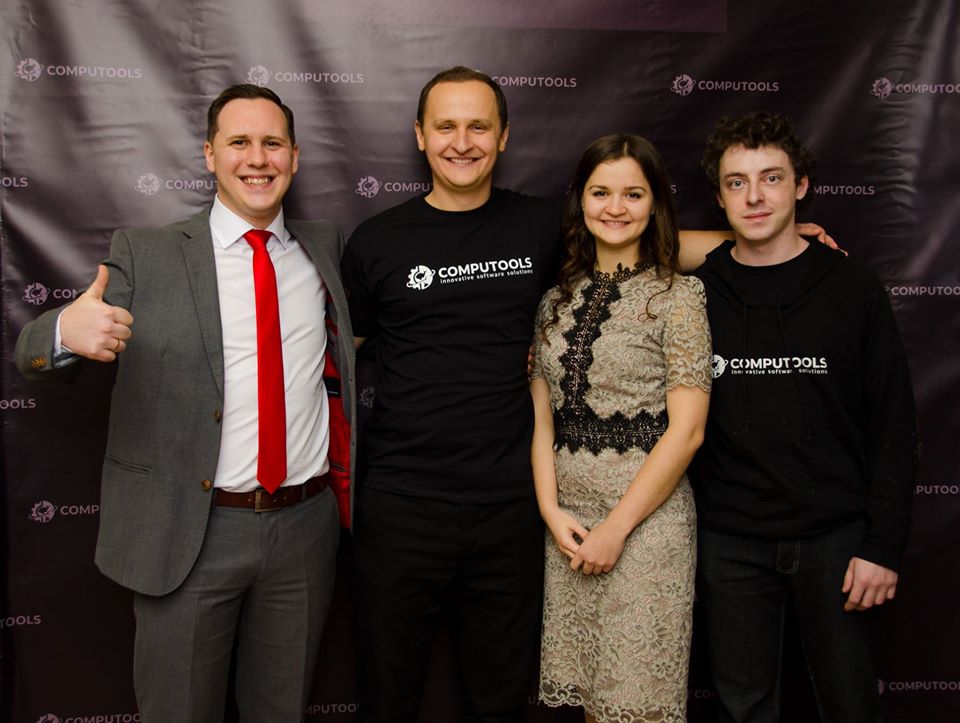
Computools was founded in 2013. Its four co-founders were Tymchuk, Grigoriy Shadara, Oleg Svet and Viktoriia Stepanova. Their present responsibilities divide across strategy, operations, delivery and finance. That division makes a useful counterpoint to the image of one person trying to handle the entire business. A company has several kinds of work; leadership needs room for each.
The name itself had already lived another life. Canadian businessman and engineer Roger Marion established the Computools brand in 2000. Its earlier activities included technology consulting and infrastructure management. Tymchuk’s company history separates that earlier brand from the business the four partners independently founded in 2013, when the name and domain passed to their new chapter.
It is an unusually personal connection to find behind a corporate name. Marion is thanked for his friendship, encouragement and generosity. Businesses often present their names as inevitable, as though the lettering had been waiting patiently for the founders to arrive. Here, another entrepreneur had made something Tymchuk admired, and a conversation helped it acquire a future.
Reported team counts in Computools’ 2020 corporate responsibility report. Historical snapshots; the final figure is a lower bound.
Learning to leave the moving train
The early company grew quickly enough to change the founder’s job several times. By the end of 2015, Computools employed 34 specialists. A Kyiv office followed in 2016. In 2017, the team reached 99, with representative offices in London and Tel Aviv. Each expansion added people who needed information, decisions and a clear understanding of who could make them.
In a September 2018 conversation, Tymchuk described handing over development work in 2014, then withdrawing from personal involvement in sales at the end of 2016, when the company had roughly fifty people. He could no longer give customers and company development enough attention at the same time. He had identified a bottleneck with a particularly familiar face.
At the beginning of 2018, with about 120 people in the business, he stepped away from daily operations. Giving up authority was difficult, he acknowledged. After years of constant involvement, observing and improving processes could feel dull beside sales and marketing. He compared the temptation to return with jumping back onto a train already racing around its circuit.
That admission lends texture to his management philosophy. Delegation can sound splendid when presented in a conference slide. It can feel strangely like unemployment when the task being delegated has supplied your sense of purpose. Tymchuk described having to accept that the work of improving the organization deserved his attention even when the daily commotion seemed more inviting.
His football analogy was warmer. He preferred the team’s victory to seeing his own name among the scorers. He pictured his contribution as a coach’s: assemble capable players and position them well. For someone building an engineering company, that is a substantial change in the definition of productive work.
The discount that fixes nothing
By March 2024, Tymchuk was writing explicitly about the limits of doing too much. His essay on business management begins with his attempt to address everything at once and moves toward a narrower discipline: identify a constraint, give it proper attention and deal with its cause. A long list of urgent tasks can make every task harder to understand.
Consider his example of a shortage of skilled employees. A discount might appease a disappointed customer, but it supplies no additional engineering capability. Hiring and training address that constraint more directly. Other problems require different responses: clearer project ownership, better quality checks, more effective planning. Diagnosing the problem comes before selecting the remedy.
- Find the constraintWhat is holding the work up?
- Address the causeSkills, ownership, planning or quality?
- Check the resultDid the work actually improve?
An editorial illustration of the approach in Tymchuk’s management writing.
He also leaves a useful escape hatch: apply systematic solutions only where they help. Some situations benefit from flexibility. This is an agreeable qualification from an advocate of process. A company can spend so much energy describing how work should happen that the description becomes another thing preventing it from happening.
What happens after the meeting?
Tymchuk’s 2021 writing about business improvement asks what happens between agreeing on an idea and delivering something a customer can use. He wants decisions translated into specific commitments, with an owner and a deadline. He describes a separate monitoring function to check whether those commitments have been fulfilled and bring problems to management’s attention.
The distinction exposes a familiar corporate pleasure: discussing progress can be much easier than producing it. Tymchuk measures useful action against what reaches the client. A meeting may be necessary, but the customer cannot install it. The same applies to a strategy document admired by everyone who attended the meeting that commissioned it.
His approach to remote work has a similarly practical streak. In April 2024, he advocated written rules for schedules, calls and reporting, alongside adequate equipment and backup internet access. The office remains useful as a shared base. A good headset gets its own attention. Grand ideas about distributed teams still depend on whether anyone can hear the person speaking.
His leadership advice also asks managers to keep their technical knowledge current and make room for honest conversation. He recommends one-to-one meetings and listening to colleagues’ ideas. For an engineer who has moved into executive work, the requirement is specific: understand the field well enough to ask useful questions, assess competence and evaluate the work, even when you cannot master every technology.
The student returns to the classroom
Learning continues through this account. After his software education, Tymchuk enrolled in a General MBA program at City Business School in 2019. His public LinkedIn profile also lists study at the London School of Economics and Political Science during 2023 and 2024. The technical founder kept adding management education to his experience of running a company.
In February 2025, he joined the Employers and Entrepreneurs Council at National University “Zaporizhzhia Polytechnic.” The partnership connects business with educational programs and students’ professional development. For an employer whose writing repeatedly returns to the supply of capable engineers, involvement in education follows a recognizable line of thought: help develop the skills the work requires.
Now the management system is a product
Enforcium introduces another chapter. Its current website names Tymchuk as founder and CEO and presents a business operating system connecting goals, metrics, responsibilities and execution. The problem it describes is familiar from his essays: managers have plenty of tools and information, yet still struggle to see where progress has stopped and what requires a decision.
The product’s stated ambition is to reduce manual status checking and preserve time for decisions that affect results. It puts an owner against each goal and metric. Read alongside his earlier writing, the continuity is clear: the recurring management questions have acquired a software interface. His experience supplies the premise; customers will judge the usefulness.
There is a modest pleasure in the trajectory. The teenager arranging internet access became a founder, the founder learned to distribute authority, and the executive began selling a way to make responsibility visible. The problem has grown more complicated as the organizations have grown, but his interest in how the parts fit together has remained consistent.
Back at the eight-person company, one resignation seemed capable of ending everything. The later Tymchuk has spent years explaining how to make a business less dependent on any single person, himself included. It is a demanding ambition for a founder. Success requires building something that can carry on working while he has the good sense to let it.
Follow the conversation
- Computools: Tymchuk’s biography
- Sergii Tymchuk on LinkedIn
- The 2018 Solar Digital conversation
- The 2018 IT Ukraine interview
- His essay on management bottlenecks
- His guide to remote work
- His writing on decisions and execution
- The Zaporizhzhia Polytechnic announcement
- Enforcium
- Watch: Moments from the Computools life (Russian)