A queue is a small act of optimism. Everyone in it believes something worthwhile will happen at the other end. For a business, though, a queue is also a systems problem: people arrive unpredictably, staff work at different speeds, and nobody enjoys being told to remain where they are. Waitwhile's answer is to let customers wait elsewhere and summon them by text message. Civilisation advances, one less crowded waiting room at a time.
- NeoITO builds and modernises software for startups and enterprises.
- Its most revealing work addresses what happens after a product gains traction.
- The transferable lesson: measure the bottleneck before buying more code.
The software behind that agreeable idea has its own waiting-room problem. An early product can attract customers faster than its architecture can accommodate them. In NeoITO's account, Waitwhile began with an AngularJS minimum viable product, then needed help becoming a platform that could handle growth. NeoITO worked on that transition using Node.js and Angular. Its case study reports more than two million monthly hits. Hits are traffic, rather than a count of people, but the figure conveys the distance from a modest first experiment.
This is a useful way into NeoITO, a software engineering company whose work often begins around the moment a promising idea becomes a demanding business. A prototype proves someone wants the thing. Running it reliably requires a different collection of talents: architecture, testing, deployment, design and people who can agree on what should happen next. Success has a habit of submitting an unexpectedly large maintenance bill.
02A textile shop is a poor recruitment brochure
Founder and CEO Faiz Mohamed Haneef recalls starting in an office that had previously been a textile shop, without a washroom. In a public LinkedIn recollection, he describes candidates arriving from large companies, looking confused and sometimes declining to return. This was an early obstacle in his own telling: persuading people to join the enterprise before its surroundings suggested much of an enterprise at all.
The company dates its founding to 2014. Haneef's technical background includes Hallmark, Lowe's and Infosys, according to NeoITO's leadership biography. Its origin story describes taking experience from large retail organisations into startup product development. That journey now runs in both directions: the company sells startup engineering alongside enterprise commerce and AI work. The interesting overlap is practical. A small company needs room to grow; a large company needs room to change.
A company-authored culture essay offers an unusually specific illustration. In an interview, Haneef asked what a candidate would do if most employees were already committed and a new client required the entire team's attention. The answer he wanted was to explain the constraint to the client, allowing it to wait or move on. Treat this as NeoITO's stated management philosophy. Its attraction is plain enough: a full sales pipeline does not manufacture spare engineering capacity.

03Seven years to make the handoffs smaller
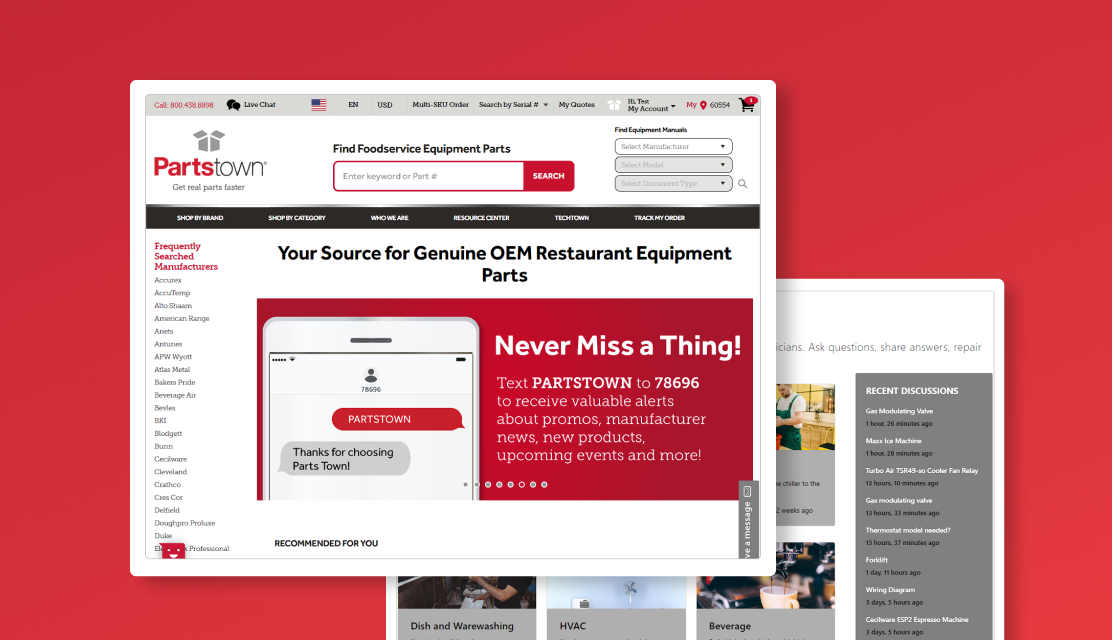
At Parts Town, the problem was less romantic than inventing a product: releases and handoffs took too long. NeoITO describes a seven-year relationship that grew from vendor work into an embedded engineering partnership, with more than 20 full-time-equivalent staff supporting commerce, testing, DevOps and frontend architecture.
The technical work included modernising a SAP Hybris storefront with independent React frontend modules. Smaller modules permit teams to change individual features with less dependence on a single large release. NeoITO also introduced deployment pipelines, container tooling and automated tests. Changes to meetings and shared definitions of readiness accompanied the code. The case study reports 40% faster release cycles and 30% fewer handoff delays.
Those are vendor-reported outcomes, with no promise that another organisation will reproduce them. Still, the mechanism is more instructive than the percentages. If work repeatedly stops between teams, adding another developer may simply deliver more work to the same queue. The intervention has to address how decisions, tests and releases travel. A rewrite can be expensive theatre when the bottleneck is permission to ship.
Parts Town engagement · results reported by NeoITO
04Buying a team, rather than another login
NeoITO's core offer is a B2B engineering service. Customers pay for product development and delivery capacity; they are not buying a single standard application with a monthly subscription. YourStory lists fee-for-service revenue. The portfolio spans startups, growing software businesses and enterprises, including Waitwhile, Parts Town, mortgage CRM business Daily AI and gaming platform POGR.
Its current service menu has four practices: data and AI, retail and commerce, CRM and customer-data platforms, and startup product engineering. In ordinary language, that means building applications, connecting systems that do not talk to one another, upgrading commerce infrastructure and putting analysis or automation into existing workflows. SAP Commerce Cloud implementation and storefront integration are particular areas of emphasis.
A customer can bring an internal engineering team and give NeoITO responsibility for a product area or a modernisation project. That makes the relevant alternatives an internal hiring programme, a specialist development studio or a larger systems integrator. The choice depends on scope, available management attention and the need for ongoing ownership. NeoITO's distinctive proposition is the combination of retail-system experience with early-product delivery. Its customer histories make that positioning more tangible than a long list of programming languages would.
There is a price floor to this kind of help. Clutch lists a $10,000 minimum project size and an indicative hourly band of $25-$49. One client reported spending $75,000-$100,000 on an engagement running from March to September 2020. These are published directory figures and historical client spending, rather than a quotation for your project. They put the service in the territory of a deliberate engineering investment. An inexpensive off-the-shelf tool can be the better choice for a standard problem.
“Code is a liability. Working software is the asset.”NeoITO's stated engineering philosophy
05What outgrew what?
The revealing detail in the HeadCoach story is the starting point. NeoITO describes a wellbeing product for athletes and coaches moving beyond a limited no-code setup. It reports delivering a scalable app in six months with React Native, Python and AWS. The original approach had become a constraint. The case suggests that evidence of a product's needs can justify custom development; the mere possibility of future growth is a weaker reason to pay for it.
POGR presents another constraint: team capacity. NeoITO's account says the gaming data platform expanded its delivery team from three people to thirteen and reduced a two-year development timeline to six months. That is a reported project outcome, not a controlled comparison. It is nevertheless a concrete example of what an external partner can supply: several disciplines arriving together, rather than a founder conducting thirteen separate hiring searches.
Then there is Skoop, where the engineering problem involves ingredients and billing. NeoITO describes combining custom hardware, computer vision and backend processing to recognise ingredients and automate charges for add-ons in food service. A basic MVP took five months, according to the case study. AI here has a wonderfully unglamorous job: helping the bill reflect what was served. An algorithm becomes easier to judge when somebody can point to the transaction it is meant to improve.
DashProphet offers a similar lesson in data analytics. NeoITO describes secure, multi-tenant data handling and a simpler interface for turning business information into predictive insights. The case reports 40% less processing time and 25% lower operating costs; its 99.99% uptime figure is explicitly a target. The distinction matters. A target is an intention, and an outcome is something a customer can examine.
06Borrow the diagnosis before the technology
There is something here a reader can copy without commissioning any software. Name the current constraint first. Is the product hard to change, does data arrive in incompatible formats, are tests slowing every release, or is the team simply too small? Attach a measurement to that constraint. The Parts Town example makes a persuasive case for counting handoffs and release delays alongside writing features.
Then keep the intervention proportionate. A small team with a defined responsibility is easier to evaluate than a grand transformation programme. This is editorial advice drawn from the customer examples, not a guarantee of results. It depends on a client who can supply product decisions, access to its systems and someone able to accept the finished work. More engineering cannot settle an unresolved argument about what the business actually needs.
The relationship also has a local, tangible side. MakeUtah's May 2025 newsletter confirms that NeoITO partnered with the hard-tech organisation and sponsored space for six companies. It is a modest detail compared with enterprise architecture, but a useful one: supporting founders can mean paying for somewhere to work, as well as building what they sell.
For a buyer, the final test is whether the software can be operated and changed by the people who inherit it. Ask to see the handover plan before admiring the demo. A successful prototype has already persuaded somebody to care. NeoITO's more consequential assignment is helping a business keep that promise when customers return tomorrow.