The first customer came from someone Ernesto Morales already knew. He had started North Star Alliances, a business devoted to helping organizations form useful relationships, and found his own opening through his professional circle. There is a pleasing economy to that origin. A partnership consultant ought, at a minimum, to know whom to call.
Getting the introduction was only the beginning. Morales says the firm needed about two years to become profitable. Those early days involved assembling a client base and working out which services people would actually buy. The business he established in Los Angeles in 2012 had to survive the same test it proposed for its clients: turn an agreeable conversation into work somebody values enough to support.
That distance between interest and commitment runs through his career. A company may have money, a public agency may have a program, and a neighborhood may have quite definite ideas about both. Morales has made a profession of getting those interests into conversation. The difficult part begins when everyone discovers that the word “progress” has arrived with several competing definitions.
01 / BEFORE THE FIRMLearning to connect rooms
Morales describes growing up in Los Angeles among communities with considerable creativity and uneven access to opportunity. Local businesses wanted to contribute, he recalls, but struggled to obtain support and resources. That is his account of where the work started: close enough to see the possibility, and close enough to see why good intentions sometimes failed to travel very far.
He earned a Bachelor of Science in Business Management and an MBA at Pepperdine University. His subsequent work included directing corporate relations at its Graziadio business school, developing relationships with companies including Boeing, Northrop Grumman and Wells Fargo. It was an education in how organizations decide to participate, with all the different incentives that a shared university connection can bring into one room.
He later held business development positions at Cordea Consulting and Rose Hills Memorial Park. At Rose Hills, his responsibilities included engagement with the Hispanic market. Across those jobs, the recurring task was to understand the audience well enough to build a relationship that could last beyond the first transaction. A mailing list can supply names. It offers rather less help with earning their confidence.
02 / THE BUSINESS OF FOLLOWING THROUGHSomeone has to do the work
North Star Alliances combines strategic advice with implementation. Its business spans public engagement, communications, marketing and events. That range helps explain why Morales’s role has developed beyond making introductions. Once a partnership is agreed, there are still schedules, messages, vendors and people to coordinate. The charming part of the meeting eventually encounters the spreadsheet.
His client relationships have crossed corporate and civic boundaries. In February 2024, the firm began a branding, marketing and communications assignment with Cabrera Capital Markets, visiting the company’s Chicago offices to understand its needs. This was relationship work aimed at how a financial business presented itself, extending the firm’s practice beyond the neighborhood meeting or public event.
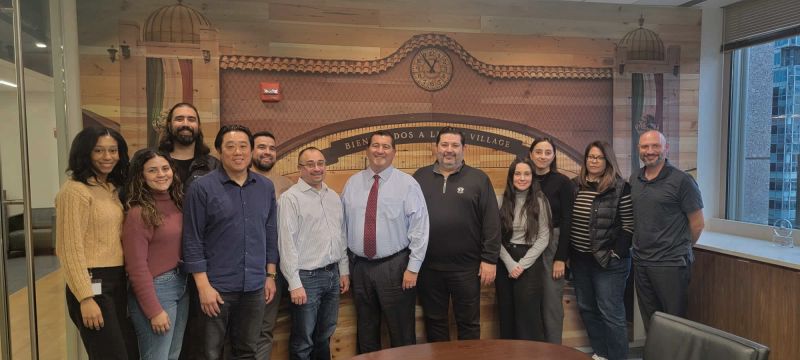
Later that year, Morales described the team’s work supporting the White House and the U.S. Department of Education’s Educación En Acción summit in Washington. Held on October 15, the event brought Latino educators, performers and advocates together. Such assignments ask a firm to translate a broad institutional purpose into a day that people can attend and experience.
The difference in settings is instructive. A client’s brand and an education summit have different audiences, expectations and practical demands. Both require somebody to establish what the participants need before deciding how to address them. Morales’s career has given that apparently modest sequence a commercial home.
03 / MAKING ROOMThe founder learns to step back
Morales has described a shift from supervising project details closely to giving colleagues more responsibility. Growth made delegation necessary. A founder can be involved in everything for a while; eventually, even a very good calendar begins to look like a work of speculative fiction. The organization has to develop judgment beyond one person.
His public updates offer small examples of how he presents that change. When Jacqueline Bobadilla moved from event coordination into a project coordinator role, he congratulated her and highlighted her work with Metro. When Katie Ball joined the staffing operation, he pointed to the experience she would bring to the firm’s expansion. These are specific jobs with specific responsibilities, the machinery behind the larger language of partnership.
He also identifies mentorship as part of his approach, describing a balance between guidance and room to make decisions. The interesting tension is built into the founder’s own expertise. Someone whose business depends on knowing when to speak, ask and connect must also learn when a colleague should handle the conversation.
He has offered a less comfortable example from his own experience: a project that went poorly because he had not understood cultural and logistical details well enough. In his telling, the lesson was to research the community before setting the direction. It is a useful admission in a profession that sells expertise. Experience can suggest what to ask; it can also tempt someone to stop asking. Giving a colleague authority, or giving a resident time to explain a concern, requires leaving room for an answer the leader did not anticipate.
at PepperdineBusiness development
at Rose HillsClient strategy
at North Star Alliances
and participationCommunity
relationshipsCommunications
and execution
A map of responsibilities across his career, rather than a measure of project outcomes.
04 / THE PUBLIC SIDEOpportunity has an administrative life
On April 19, 2018, California Assembly Speaker Anthony Rendon appointed Morales to the Employment Training Panel. The appointment placed his interest in economic opportunity within a state body concerned with workforce training. The Assembly’s record gives the milestone an exact date, a useful anchor in a career often described through relationships rather than formal transitions.
He also serves on the board of the Mexican American Opportunity Foundation. And his work now includes membership relations at the Supply Chain Federation, where his responsibilities cover member engagement and strategic partnerships. These roles extend the same professional concern into different settings: how organizations find participants, keep them involved and make the relationship worthwhile.
There is a public accountability dimension to that career, too. In January 2024, California’s Fair Political Practices Commission approved a $22,500 administrative fine in a case involving North Star Alliances, Morales and Lauren Morales-Chitay. The five counts concerned contributions made in another’s name and failures to disclose acting as an intermediary.
The penalty applied to the respondents in that case collectively. It is a consequential part of the record for a business leader whose work depends on institutional relationships and public confidence. His stated emphasis on transparency belongs alongside that enforcement history.
05 / OUTSIDE THE HOME MARKETChicago is more than a pin on a map
In early 2024, North Star Alliances announced plans for offices in Chicago and New York. Morales shared the expansion announcement with evident anticipation. The firm already reported experience running programs in several states, including Illinois, Georgia, Texas, Nevada and Arizona. The ambition was to make its national reach a more deliberate part of the business.

For a firm built around local knowledge, expansion poses a useful question. Which parts of the method travel, and which must be learned again? A process for organizing an event can be carried elsewhere. Familiarity with a community takes longer. The argument for this kind of consultancy rests partly on respecting that difference.
In 2026, Morales highlighted the BIG 4 economic development partnership linking Commerce, Industry, Santa Fe Springs and Vernon. North Star Alliances was working with CitiesBuilt4Business and DEODATE, bringing the coalition to the NAIOP I.CON West industrial conference. The geography was Southern California again, but the task involved helping four municipalities present shared economic interests to potential partners.
06 / WHAT HE WANTS TO KEEPA larger business, a closer conversation
Morales’s interests include the practical uses of data and digital tools in public engagement. He has discussed gathering feedback and understanding community needs through technology, while retaining face-to-face contact. That combination suits the problem his firm sells its help solving: reaching people is easier than understanding what they are telling you.
He puts storytelling in the same practical category. Discussing an urban revitalization assignment, he described using murals and digital campaigns to reflect the area’s history. The detail matters because a neighborhood already has a story before a consultant arrives. Asking residents to participate means taking that history seriously, including the parts that make a proposed change difficult to welcome. A communications plan has to make space for memories as well as ambitions.
He has also described measuring projects through both participation figures and follow-up conversations. Attendance answers one question: did people come? Listening afterward asks what the experience meant to them. Those answers can be awkward for an organization eager to declare a project finished. They can also reveal what deserves to continue. For Morales, that is part of the stated ambition: relationships and local opportunity that persist after the assignment itself has ended.
“You don’t need a million-dollar budget to build trust.”
ERNESTO MORALES · 2026
His aspirations include developing younger leaders and expanding the firm’s work into new regions and sectors. He has also spoken about the value of family time alongside professional impact. Those ambitions put ordinary demands on the same finite resource. More responsibility requires more people who can carry it.
The first client story remains a useful place to leave him. A professional acquaintance became a customer, and the business grew through the work that followed. Years later, with a broader roster of partners and a national practice, the essential question is still pleasantly concrete: once everyone has shaken hands, what will they actually do together?
Keep the conversation going
- Ernesto Morales at North Star Alliances
- Ernesto Morales on LinkedIn
- Personal website and essays
- The first customer, profitability and building a firm
- A conversation about leadership and community engagement
- Membership relations at the Supply Chain Federation
- The January 2024 enforcement decision
- North Star Alliances on Instagram