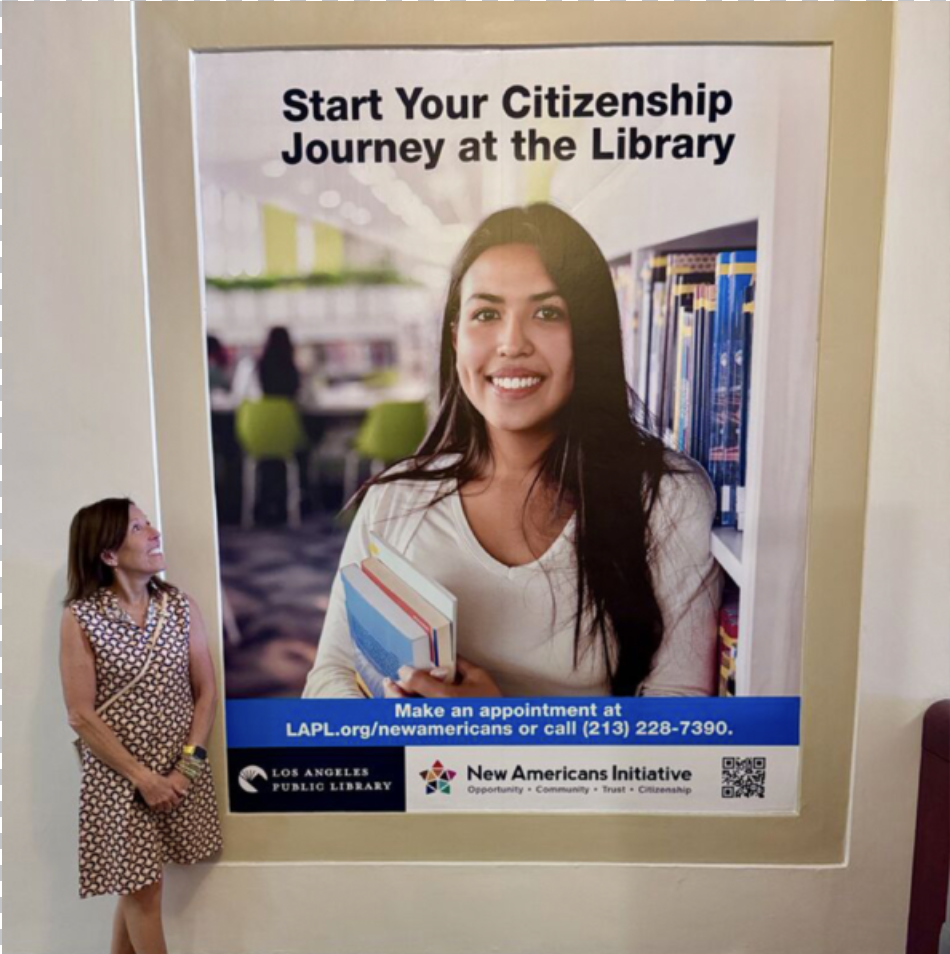
Dana C. Arnett went to a celebration at Los Angeles Central Library and found her own work waiting at the entrance. The campaign invited people to begin their citizenship journey at the library. Her agency had helped create it. She had wanted, quietly, since 2018, to see something her team made on a library wall. In 2025, there it was, installed without her knowing. She cried.
Advertising offers plenty of places to put a message. For Arnett, this particular wall mattered. A library entrance is a place people pass through on their way to something else. A campaign there can become an invitation: come in, ask a question, discover that a service exists. The work had arrived where she hoped it would, in her own city, beside an actual doorway.
By then, she had already spent decades helping television reach its audience and another ten years building Wicked Bionic. Yet the moment she treasured was small enough to describe without a presentation deck. She walked into a building she loved and saw a reason for someone else to feel welcome.
The final pair of eyes
Before the library wall came the television screen. Arnett worked in post-production, the portion of the business responsible for turning everything that has been shot into something an audience can watch. Her credits included work on MasterChef and For Love or Money. Her professional world involved schedules, staff, budgets and the approaching certainty of a broadcast deadline.
At times, she oversaw as many as ten television series and the teams attached to them. She was the last pair of eyes before broadcast. That is an unusually literal form of accountability: eventually, the work leaves the room. Any remaining mistake acquires an audience.
Earlier, while working as a press agent in her twenties, she acquired a nickname from industry executives: “the make-it-happen girl.” It is a useful description of a production temperament, although perhaps an exhausting job specification. Once people know you can get something done, they tend to arrive with something else.
She had begun working for other people at seventeen. Television gave her a long stretch of knowing what she wanted to do and getting to do it. She loved post-production. Even the early warnings that reality television would never last failed to spoil a career spent largely working in it. Predicting the end of a genre is evidently easier than making its delivery schedule.
Her first job was as a receptionist on Barney Miller. Morgan Bell recognized her potential, promoted her and introduced her to post-production. Arnett also remembers working for documentarian Arnold Shapiro, whose kindness, humor and fairness stayed with her. These are the people she names when she considers how a career gets made: someone notices your interest, gives you work to try and takes the time to teach you. Years later, she would be the person able to offer that encouragement.
An eighteen-month gap in the schedule
Then, in 2013, she stopped. In her own account, she had achieved the goals she had set for that career and recognized that she was finished. There was no ready-made second profession waiting just offstage. She allowed herself eighteen months away from the work, without forcing an immediate answer to the question of what came next.
That pause is one of the more revealing choices in her story. A person accustomed to delivery dates gave herself time without one. She remained ambitious and interested in working, but trusted that another absorbing occupation would emerge. Leaving something she had loved did not require her to pretend she had always wanted to escape it.
In March 2015, Arnett partnered with Carlos Sapene to open Wicked Bionic. His background included entertainment and digital marketing. Their new agency offered a different set of creative problems: brands, websites, social media, influencer campaigns. She liked the movement in the field, the sense that its possibilities kept changing. At an age when a long résumé could have supplied a comfortable introduction, she had made herself a beginner again.
A familiar audience can still surprise you
Wicked Bionic developed into a Los Angeles agency handling strategic communications, advertising and media buying for public and private organizations. Its work combines research with creative development, multilingual communications and community outreach. The practical question behind that list is simple: how will the intended person actually encounter and understand the message?
The Los Angeles Public Library relationship makes that question concrete. By April 2018, Arnett and Sapene were presenting the agency’s media approach to the Board of Library Commissioners. Arnett was then introduced as president and chief operating officer. The discussion concerned the New Americans Initiative and the work of reaching residents who could benefit from citizenship information.
One detail from that presentation deserves to outlive the slide deck. A Korean-language advertisement was underperforming, while an English-language advertisement showing a Korean family worked well on Korean websites. Representation, language and placement had produced a combination that a simple translation rule would have missed.
The campaign’s first month also supplied numbers worth examining: Facebook and Instagram placements reached 154,000 people; Google search and display generated more than 4,200 clicks. Those were early campaign results, presented in 2018. They describe attention and response, rather than completed citizenship applications. Keeping that distinction intact makes the achievement easier to understand.
Arnett has a compact explanation for the research habit: “we don’t just guess.” Familiarity with a community gives someone experience to bring to the work. Different generations, places and circumstances still need investigation. A campaign aimed at a broad identity can miss the very particular people inside it.
The inconvenient person without Wi-Fi
Her writing in 2026 turns repeatedly to the people a convenient media plan leaves out. A household without dependable internet access presents a problem that another digital placement cannot automatically solve. So does an older audience that gets information elsewhere. The available channel and the trusted channel may be different things.
She argues for looking beyond digital advertising to radio, print, community events and established local relationships. The test is how information travels in someone’s life. A message can be beautifully made and still arrive in a place its intended reader never visits. The person has no obligation to rearrange a day to make an agency’s distribution plan look sensible.
That concern has become part of her agency’s stated working principles: listen first, build partnerships and keep the human consequence of a campaign in view. There is an operational demand inside those agreeable words. Listening can change the brief. Research can complicate a preferred audience. Reaching people may require a medium less fashionable than the one everyone arrived wanting to buy.
“we don’t just guess”
Dana C. Arnett · on audience research
Learning how to get through the other door
Arnett also had to learn how organizations purchase the work she wanted to do. A 2022 account of Los Angeles small-business support describes her participation in the Chamber’s OneLA Inclusive Procurement Program. She learned about contracting with city, county and federal government, including how to prepare capability statements. Experience managing television productions had not supplied every document a public buyer would need.
Her education continued through the Los Angeles Small Business Academy, Goldman Sachs 10,000 Small Businesses, Cornell’s diversity and inclusion certification program and executive education at Dartmouth’s Tuck School of Business. The distinction matters: attending executive programs does not make this an MBA graduation story. It makes it a story about an experienced operator going back to learn what her new job required.
In May 2026, she spoke publicly about ProcureLA, the city initiative designed to help local businesses compete for contracts. She credited it with helping Wicked Bionic expand and pursue work with greater precision. There is a pleasing symmetry here. An agency concerned with making public opportunities visible had itself benefited from help navigating a public opportunity.
Who opens the circle?
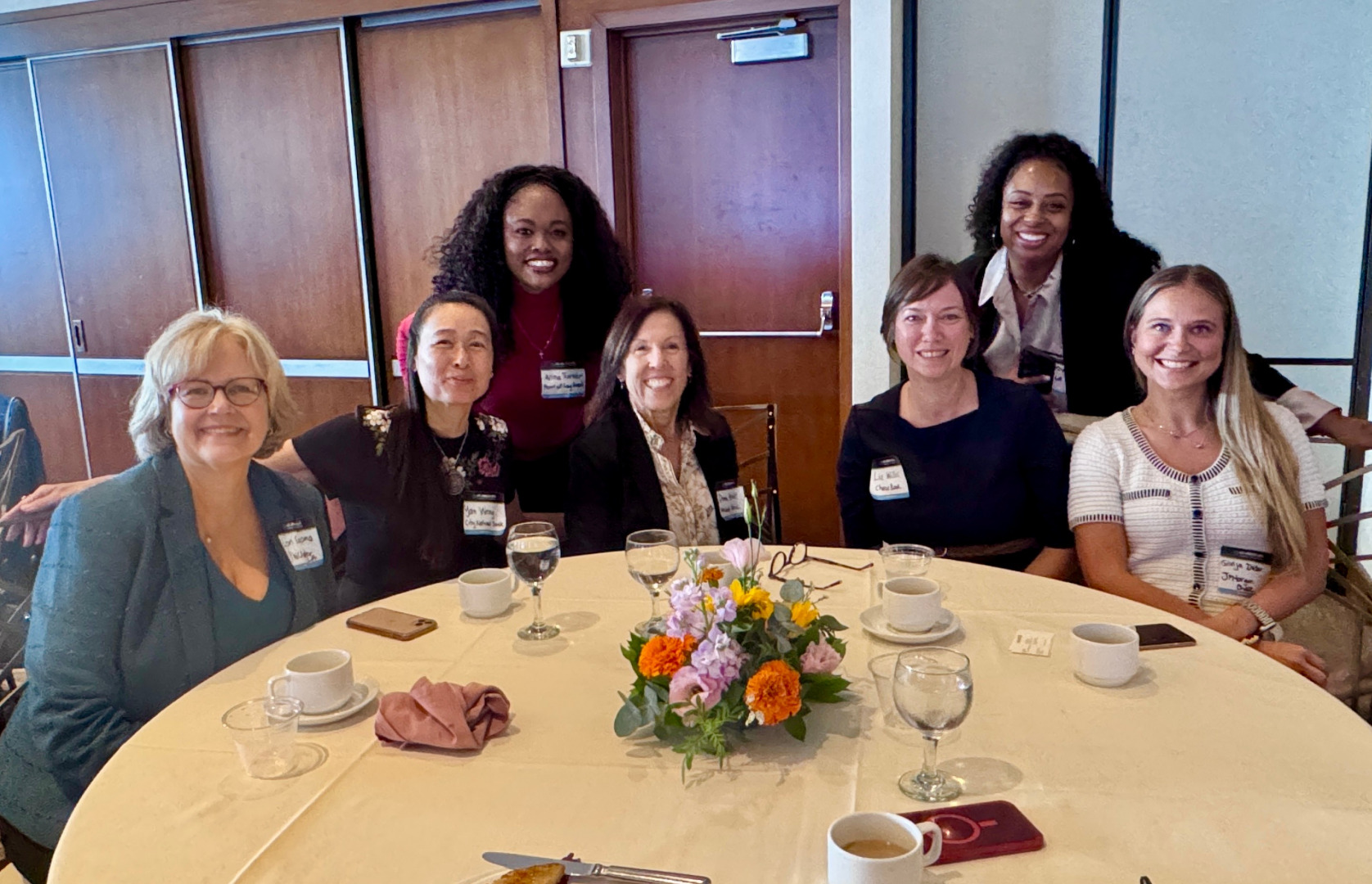
By July 2026, Arnett was writing about another sort of entrance: the business event where everyone appears to know everyone else. After a Los Angeles panel with Amanda Ma, moderated by Claudia Bodan, she considered the uncomfortable visitor standing outside an established conversational circle. Her advice assigned responsibility to the people already comfortable inside it.
Go over. Introduce yourself. Bring the newcomer back and introduce them with a detail that gives them something to talk about. Follow up without attaching a request. Her argument treats generosity as a habit of attention, something an established businessperson can practice in the next thirty seconds. A name badge, for all its optimism, cannot make the introduction for you.
Arnett has put time into the organizations around those conversations. She has chaired WBEC-West’s Los Angeles Forum, participated in WBENC’s national forum and serves on the Fulfillment Fund’s ScholarBridge board, supporting college access. Wicked Bionic received WBEC-West’s Class II Supplier of the Year recognition in 2022 and 2023. The associations supply both professional recognition and places to help someone else advance.
There are also less formal reminders to stay curious. In July 2026, she shared a television clip of herself, aged five, appearing on Art Linkletter’s House Party on July 24, 1967. She remembered telling the Seven Dwarfs to dig her some gold, then dancing with them. Even before a career in production, she apparently understood that an assignment could be followed by some fun.
She wanted the clip to remind her to protect creativity and joy amid adult responsibilities. The library photograph offers a grown-up companion image: Arnett, looking up at the work, pleased by where it has landed. After years spent getting television out to the world, she found another satisfying destination for a message. Someone would walk through that door and learn what was available to them.