An advertising agency asks Los Angeles teenagers about cannabis. The obvious temptation is to arrive with a warning and leave with a slogan. Fraser Communications invited them to help shape the material instead. Its work for the county included workshops and music videos, with an ambition more precise than winning an argument: encourage teenagers to delay experimenting. The adults still had a message. They let the intended audience influence how it sounded.
That choice gives a useful introduction to Fraser, a woman-owned Los Angeles agency whose founder, Renee Fraser, has a doctorate in psychology. Her firm sells the familiar machinery of advertising: research, strategy, design, production and media placement. Its particular interest is the moment when a person understands a message but has a reason to ignore it. A campaign can be beautifully made and still lose at that moment.
Across its portfolio, those reasons vary. Parents want help without feeling judged. Drivers worry that dealership service costs too much. People considering quitting vaping may prefer to hear from someone who has actually tried. Fraser’s work is interesting because the creative decisions often trace back to these quite ordinary anxieties. The psychology appears in the assignment before it appears in an advertisement.
A psychologist buys into advertising
Renee Fraser established the company in 1998, with the stated intention of using advertising to encourage constructive changes in individual and social behavior. Her team biography describes a boutique agency built around experienced staff and useful research. It also lists surfing, swimming and cycling among her interests. There is a person behind the doctorate, and apparently she occasionally gets away from the conference room.
“Everything we do is aimed at changing behavior.”
Renee Fraser · Founder and CEO
The company’s client list makes that ambition less abstract. Public-health departments sit alongside First 5 California, water agencies, universities and automotive brands. The mix places Fraser between a general advertising agency and a specialist public-service communications shop. Its advantage is the ability to carry an audience insight through to a finished campaign and its distribution. Research, in this arrangement, has somewhere to go.
In 2023, Fraser announced Paul Simon, formerly chief science officer at the Los Angeles County Department of Public Health, as senior science advisor. The appointment put additional public-health experience behind its positioning. For a client, that combination can be useful when a brief involves both explaining a sensitive issue and producing material people will willingly watch.

Give the microphone to someone who has quit
The agency’s adult-vaping work offers a concrete account of how research changed the creative direction. Fraser says focus-group findings favored unscripted personal stories over polished commercial delivery. Talent-relations director Sheyla Ornelas led an effort to recruit former vapers through community organizations and previous research participants. The campaign aimed at adults aged 18 to 39, with storytellers chosen to reflect the intended audience.
Those accounts traveled through social and video platforms, including TikTok, Reddit, Snapchat and YouTube. Outdoor advertisements carried individual quotes and QR codes leading to longer videos. A bus stop became an invitation to hear somebody out. Fraser reported more than 1.5 million video views and 34,000 clicks in the first two weeks. Those numbers describe attention and response; they do not establish how many viewers stopped vaping.
The teen cannabis work followed a related instinct. The agency wanted material young people could discuss with one another, and the workshops helped develop its music-led execution. The rejected starting point was a prohibitive tone. That is a creative judgment, rather than evidence that a particular earlier Fraser campaign failed. What changed the approach was the decision to take young people’s reactions seriously before committing to the finished message.
The numbers need a second question
A 2024 paper in Preventing Chronic Disease, coauthored by Renee Fraser, examined LA County’s Done with Menthol campaign. Fraser managed development, production and media execution, with partners including Gwen Young Communications and Sentient Research. The campaign borrowed the visual appeal of tobacco advertising to encourage quitting. Its 2021 run emphasized harm; the 2023 version emphasized family and confidence in making another attempt.
The initial run generated more than 66 million impressions and approximately 56,000 digital clicks. But the evaluation could not establish a causal health effect. Other tobacco campaigns overlapped, and limited funding constrained the research. That distinction is essential: a persuasive message can produce observable engagement without proving lasting behavior change. The findings also require care when applied to communities with different political or cultural conditions.
What $2.84 million actually buys
Public records give this business a useful dose of financial specificity. On February 27, 2024, Los Angeles County’s Board of Supervisors approved increasing a Fraser tobacco-control media work order from a maximum of $1.811 million to $2.84 million. The covered period ran from November 21, 2022, through June 30, 2025, with funding from California’s tobacco-control program.
The authorization divided that ceiling across three budget periods: $800,000, $1.3 million and $740,000. These are maximum obligations for a defined assignment. They should not be read as Fraser’s profit, a universal campaign price or the cost of the earlier menthol campaign. For prospective buyers, they illustrate the scale that sustained public-service media work can reach.
$2.84m approved maximum
Fraser operates as a professional-services business. Organizations hire it to investigate a problem, develop a campaign and deliver the work. Its service menu includes focus groups, statistical analysis, brand positioning, influencer arrangements, paid media, websites and performance testing. A buyer can therefore commission the connected pieces of an assignment rather than trying to coordinate every handoff internally.
Parents, pill warnings and a pair of dogs
For BrightLife Kids, the creative problem was helping families recognize behavioral-health support as something practical and approachable. Fraser’s research found appeal in the idea of a parental toolbox. The resulting campaign combined everyday family imagery with a message about having tools for difficult feelings. Distribution included multilingual digital creative, social media, billboards and transit advertising.
Fraser reports more than 85,000 family sign-ups in 13 months. That is an agency-reported acquisition result, distinct from a measure of clinical improvement. Still, it shows the intended destination of the advertising: registration for a client service. Fraser made and distributed the invitation; the program provided the support. For organizations with useful services and low awareness, that division of labor is central to the agency’s value.
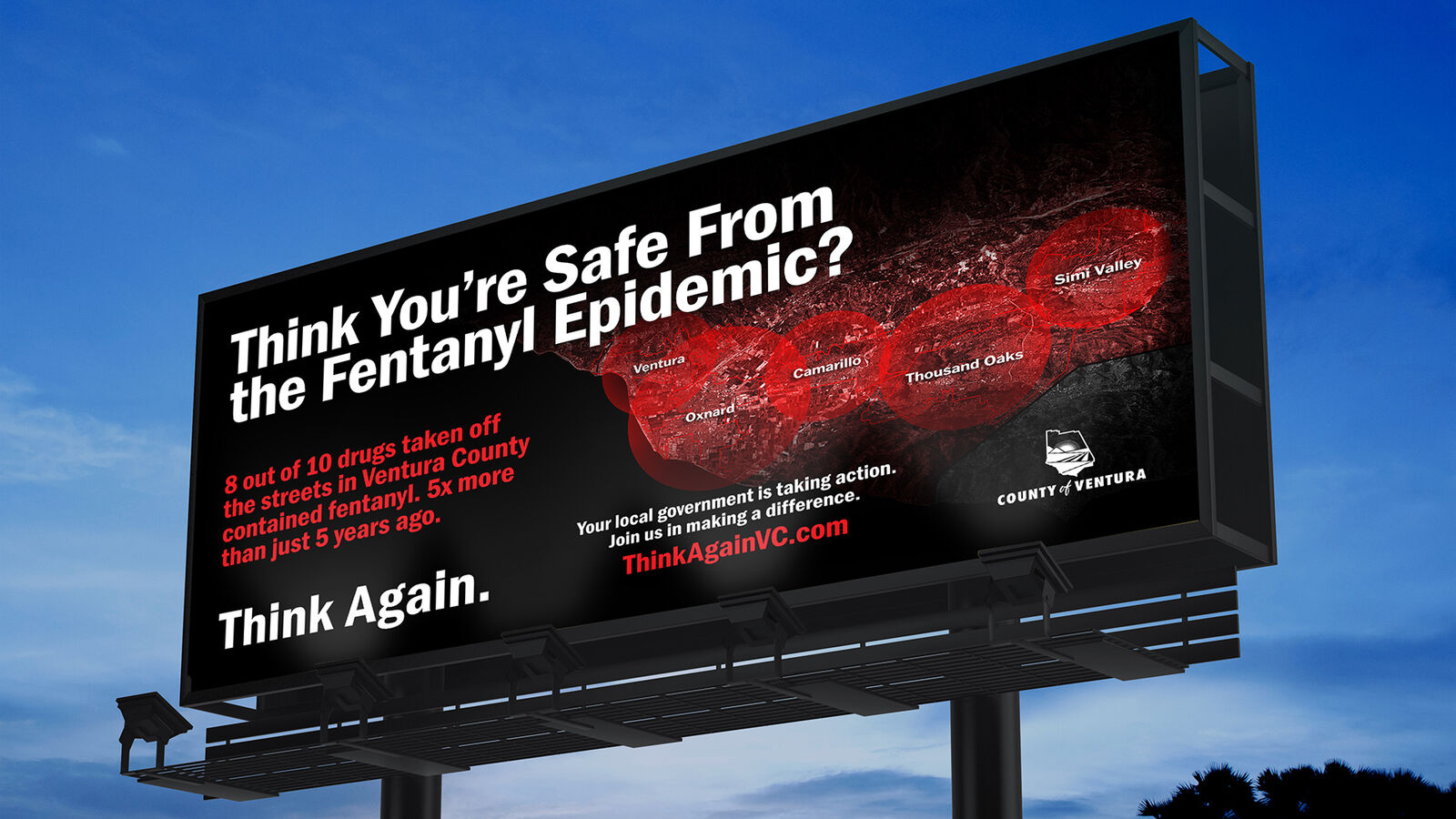
Ventura County presented a different obstacle: the belief that fentanyl was somebody else’s problem. Fraser’s bilingual Think Again campaign used local information and place names to bring the warning closer to home. Digital, print, radio and outdoor placements directed residents to a dedicated website. Here the creative task was geographic as much as emotional: make an abstract crisis recognizable in a familiar neighborhood.
The commercial side supplies a lighter example. For Hyundai, Fraser described drivers’ concerns about dealership prices and trust, especially among owners of older or secondhand vehicles. It built information and appointment pathways around seasonal service events. Creative featuring the Hyundai Dogs appealed to owners’ affection for their cars. The agency reports more than 540 appointments in 22 days through its custom landing page.
Other assignments widen the picture. Water-conservation work has included Southern California water districts and the bewaterwise campaign. Education projects include branding and enrollment communications, from UCLA Extension advertising to a marketing toolkit for Siembra’s College Connect app. These clients have different products, but each needs people to understand an offer well enough to consider doing something with it.
The useful thing to borrow
A reader running a communications team can borrow a sequence from these examples. Define the action first. Ask the intended audience what makes it difficult. Let those answers influence the messenger and format. Give the advertisement a useful destination, then decide which response will count as progress. A compelling video attached to an awkward registration process leaves half the assignment unfinished.
The details should change with the problem. Fraser’s Missouri work for NoMOMeth uses personal documentaries and a supportive website, plus materials local prevention centers can distribute. That makes local participation part of the delivery system. Copying its reassuring tone without the help resources would discard an important piece of the idea. Likewise, a format that suits young social-video viewers needs testing before it travels to another audience.
The agency’s internal stories also point to the practical labor beneath the positioning. In a published account, summer intern Rachel Bermudez described building a media toolkit, helping on a CalFresh Healthy Living video production, reviewing scripts and contributing to research. Her account portrays colleagues who explained their thinking when she asked questions. It is one person’s view, but it offers something more tangible than a list of office values.
Fraser reports healthcare and video awards for its recent client work, while its mid-2026 commentary discusses AI workflows, creators and changing search habits. The channels keep moving. The enduring test is more human and more demanding: did the campaign understand the person it hoped to persuade? Fraser’s strongest work makes that question visible in the finished advertisement.
Explore the work
Visit Fraser Communications, browse its public-health portfolio or read its campaign blog. Follow the agency on LinkedIn, Instagram, Facebook and X.
Watch: teen cannabis campaign video ↗Listen: Renee Fraser’s radio conversations ↗