Eric Mathewson had a reliable answer for people who called his San Francisco office and asked about the California weather. He arrived before dawn and left after dark, so the forecast was reasonably consistent: “Pretty much the same as yours - 68 degrees and fluorescent.” In 2011, twelve years into building WideOrbit, that was his contribution to the romance of running a technology company.
The joke suits the business. Television sells spectacle. Mathewson’s company dealt with orders, schedules, inventory and bills. A viewer might remember the commercial, resent the interruption or leave to make a sandwich. Somewhere behind that small event, a broadcaster needed to know which advertisement had been booked, where it belonged and what money was due. WideOrbit put software around that work.
It was a substantial commitment to the backstage. Mathewson founded the company in July 1999 and remained its chief executive until August 2024. Across those twenty-five years, he watched the media industry argue about its future while helping customers conduct the less theoretical business of getting through the day. His story has an unusually useful unit of measurement: how long it takes to make something dependable.
A financier finds another kind of market
Before broadcasting, there were financial portfolios. At Kidder Peabody in Palo Alto, Mathewson worked on equity derivatives. At Montgomery Securities, in San Francisco and New York, he managed portfolios for wealthy technology people. The professional background matters because he approached media through the machinery of a transaction: the information required, the systems recording it and the money passing between participants.
He was also investing in technology before he became a software-company founder. His private equity technology investing dates to 1994. Early investments included Infospace, Xoom, CommerceBid and OpenTable.com. These were different businesses, but they placed him close to the internet’s commercial development. When he started WideOrbit, he had experience with both financial markets and companies trying to build new ones.
The opportunity he chose was specific: make buying and selling media easier. Advertising produces a cheerful amount of creative conversation, followed by a less cheerful quantity of administration. Broadcasters need systems that connect what salespeople promise to what operations can deliver. Mathewson put his attention there, using capital from his earlier Silicon Valley ventures to help launch the company.
A simplified sequence. WideOrbit’s business grew around the records and handoffs that connect these jobs.
That choice gave him an unglamorous but exacting customer. A station’s traffic department has to arrange advertising within the schedule; its finance operation has to account for the business. Useful software has to respect both. A graceful demonstration is pleasant. A system people can use repeatedly, amid changes and deadlines, is the thing they actually buy.
The first station is the hard one
WideOrbit’s first television station to go live on its core WO Traffic software was WENY in Elmira, New York, in February 2001. The geography gives the beginning a useful scale. A company founded in San Francisco had to become practical inside a working local broadcaster across the country. Its proposition had to survive contact with an actual schedule.
By 2011, Mathewson could make a telling comparison. WideOrbit had brought 36 stations and networks live during the previous month. Getting its first 36 running had taken nearly four years from the company’s founding. The later pace looks impressive only after you sit with the earlier one. Several years of work can fit inside a number that an established company eventually produces in a month.
Nearly four years to bring the first 36 live.
Then 36 in a month, as Mathewson described in 2011.
There was a pleasing connection at the 2,000th WO Traffic implementation. It was WJRT, an ABC affiliate in Flint, Michigan, owned by Lilly Broadcasting. Lilly also owned WENY, the first station. The company’s expansion had brought it back to an early customer’s orbit. In the two years before that milestone, core installations had averaged 24 stations and networks a month.
The work between milestones could be very small. In 2007, Mathewson estimated that customers had submitted around 28,000 feature requests since WideOrbit began, and that the company had fulfilled perhaps 25,000. Most requests were minor. A product announcement rarely gets excited about copying an order to another station or changing which items appear in a report. The person who performs that task all afternoon may feel differently.
One important customer was NBC Universal. By 2007, WO Traffic had been rolled out to thirteen Telemundo stations, with NBC-owned stations also part of the plan to replace older systems. Implementation capacity had increased as WideOrbit added people in installation, account management and support. Growth required the staff to put the software into service and help customers keep using it.
That is a revealing version of entrepreneurship. It involves a founder’s judgment, certainly, but also a considerable collective effort to answer requests and make successive installations work. The grand vision keeps returning as someone else’s practical question. Can this order be entered more easily? Can that report show what the station needs? A durable business has to tolerate the repetition.
Television keeps its own calendar
Mathewson’s relationship with technological change had a dry streak of its own. In 2015, he recalled the expectations around WideOrbit’s founding. His Silicon Valley friends thought the transition toward internet delivery of media would take three to five years. He had allowed ten to fifteen years before connected devices accounted for most audio or video consumption.
Sixteen years after founding the company, he was still giving the video transition another ten to fifteen years. The recollection is funny because the horizon keeps moving. It also explains the sort of market he was serving. People’s viewing habits and broadcasters’ operating routines were moving at a pace that a technology investor’s calendar could not command.
“Consumer habits change surprisingly slowly, though.”
Eric Mathewson, 2015
His point was about the people using media, as much as the devices delivering it. New capabilities can arrive before most viewers reorganize their lives around them. A software business serving broadcasters has to work within that interval. The existing customer still has advertising to sell, schedules to manage and accounts to settle while the future is being discussed.
By 2016, Mathewson was describing WideOrbit’s role in terms familiar to digital advertising: “We’re the publisher ad server for TV stations.” The company had introduced a local television marketplace connecting buyers and sellers through automated transactions. He was carrying his interest in market structure into broadcasting, trying to make inventory easier for buyers to reach.
He resisted one assumption about that automation: that buyers would chiefly want inexpensive overnight slots. Some advertisers, he said, had started by seeking prime-time football. Better access could be useful for valuable programming too. There were harder questions around attribution, the attempt to work out which advertisement contributed to a sale. He discussed both the available data and the difficulty of connecting it, including privacy considerations.
The combination is characteristic of his public business conversations: confidence in improving transactions, accompanied by attention to the untidy details. Automation still needed inventory. Measurement still needed connections between records. Television’s established routines did not evaporate because a marketplace had opened. There was work to do inside the gap between an available technology and a functioning market.
A party, a handover, another desk
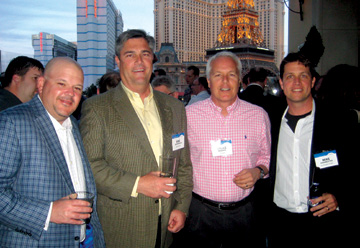
The company’s public history also contains relief from the fluorescent forecast. At the 2012 NAB gathering, WideOrbit hosted its annual cocktail party at HYDE in the Bellagio, overlooking the fountains. Mathewson delivered opening remarks at the convention’s Television Luncheon, which honored Garry Marshall and Second City. There were demonstrations, customers and colleagues, and at least one occasion to look beyond an office ceiling.
On February 22, 2023, Lumine Group completed its acquisition of WideOrbit as part of a transaction that also involved Lumine’s spin-out from Constellation Software. Mathewson joined Lumine’s board at closing. WideOrbit then served more than 5,000 stations and cable networks worldwide, processing over $35 billion in advertising revenue annually. Those figures describe customers’ advertising activity through the systems; the dollars are not WideOrbit’s own revenue.
Lumine describes its acquisition approach as buying and holding businesses permanently, with independent operations and continued investment. For a founder who had spent more than two decades building one company, the arrangement offered a setting in which to apply that experience across other media software businesses. Mathewson said at the time that he wanted to bring his operating knowledge to Lumine.
The CEO handover followed in August 2024. Susie Hedrick, whose background included senior sales leadership at WideOrbit and the chief executive role at vCreative, took over. Mathewson’s focus shifted toward his role on Lumine’s board and its investment committee. Ownership and daily leadership changed on separate dates, a distinction that matters in a company built around ongoing customer relationships.
His work now also includes managing Prescient Capital, investing in software enabled by artificial intelligence, semiconductors and early-stage companies, largely around San Francisco. He earned his bachelor’s degree in Social Science at Berkeley and attended Stanford Law School’s Directors College in 2023. The move into governance came with some time back in a classroom.
There is continuity in that next chapter. Mathewson invested in technology before WideOrbit; now investment again occupies part of his working life. Between those periods sits a quarter-century of responsibility for one operating company. The first installation, the small requests and the eventual handover all belong to that experience. His career gives patience a concrete shape: years spent making the next transaction work a little better.