The deal was almost done. In 2018, Pukar C. Hamal was preparing to close the largest enterprise sale his startup had attempted when the customer supplied a final little requirement: a security questionnaire approaching 200 pages. His team spent the night answering it. Somewhere between the prospect of a signed contract and the reality of hundreds of questions, a different business began to suggest itself.
A questionnaire is an unlikely muse. It has neither the glamour of a new invention nor the charm of a blank page. Its talent is for arriving precisely when everyone would prefer to celebrate. But Hamal had encountered something consequential: companies could build software people wanted and still struggle to prove, in the buyer’s preferred format, that it was safe to buy.
He founded SecurityPal in March 2020. The task he chose was specific enough to sound unambitious at a dinner party: help companies finish security reviews. The ambition behind it was considerably larger. Hamal wanted enterprise transactions to move more easily, and he wanted people in Nepal to have a substantial part in making that happen.
The security questionnaire that helped set Hamal on the path to SecurityPal.
A childhood with several points of departure
Hamal was born in Kathmandu, spent early childhood in Darchula and Dang, and moved to New York with his family at seven. Forest Hills became home. Stanford followed, and eventually San Francisco. His personal geography contains both Himalayan foothills and the New York loyalties that survive a move west: the Yankees, Knicks and Giants.
English was his fourth language. His LinkedIn profile now lists eight languages, with proficiency ranging from native fluency to elementary knowledge. That distinction matters. A list of languages can become a party trick in a founder biography; in Hamal’s case, it also records a childhood and career spent moving among different communities, rather than assuming everyone already spoke his language.
He attended Stanford from 2009 to 2013, earning a bachelor’s degree and studying international relations. The university also supplied an early encounter with the practical business of putting people together. In 2012, Hamal and fellow student Aditya Singh were developing farmGeni.us, a platform to connect Stanford community members with specialized skills.
Singh had grown frustrated with how students assembled project teams. Social encounters were a poor mechanism for finding the right collaborator; technical students could find themselves treated simply as the person who would write the code. Their proposed platform addressed that mismatch. Long before security assurance, Hamal was working on a problem of coordination: useful people existed, but useful connections did not reliably follow.
His subsequent experience included TalentBin, PwC and work connected to the U.S. State Department. At Teamable, which he cofounded in 2016, the coordination problem was recruiting. His career crossed hiring, enterprise sales, public policy and diplomacy before cybersecurity became its organizing subject. The through line is easier to see in the work than in the job titles: helping people and institutions get to an agreement.
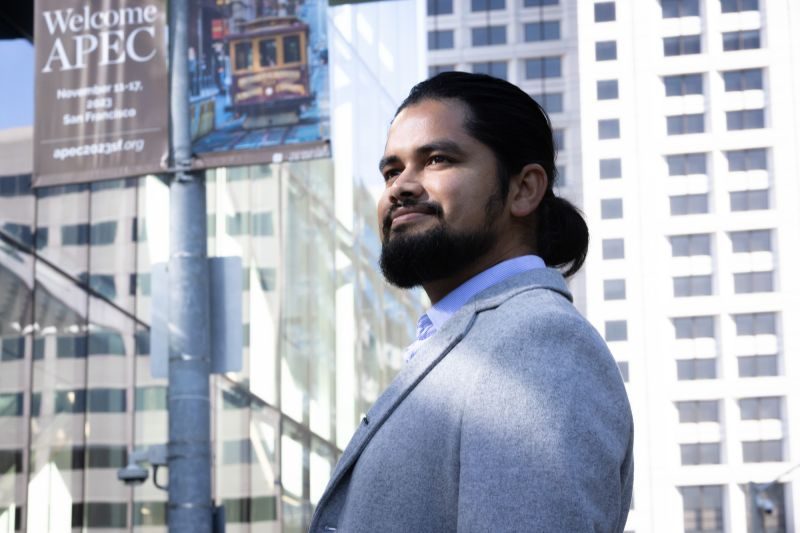
The business of letting somebody go to bed
SecurityPal’s early pitch had an appealing lack of ceremony. Customers could forward a security questionnaire and let someone else complete it. Airtable became an early major customer; Figma followed. Hamal initially worked with U.S. contractors, doing the labor that made the promise credible before building a larger operation around it.
The attraction was comprehensible to anyone who had watched a sales process acquire an unexpected administrative appendix. Revenue teams wanted the contract signed. Security teams needed accurate answers. Buyers wanted evidence that a supplier could be trusted with their data. A review sat at the intersection of those reasonable demands, with a remarkable ability to consume everybody’s evening.
By its September 2022 public launch, SecurityPal said it had reached seven-figure annual recurring revenue while bootstrapped and had more than 200 customers. It announced a $21 million Series A led by Craft Ventures, with investors including Martin Casado and Frederic Kerrest. Its announcement also reported that 54% of leads and revenue came through inbound interest or referrals.
That last number is revealing. A finished questionnaire is not especially photogenic. It does, however, travel well by recommendation between colleagues who have endured the same task. Hamal had chosen work whose value became obvious when somebody else no longer had to do it. The company could make its introduction through a relieved customer.
As SecurityPal grew, Hamal described the broader work as customer assurance: maintaining confidence across a commercial relationship, rather than treating the first questionnaire as the whole job. His 2024 interviews emphasized how reviews could involve evidence, policies and conversations as well as forms. The product had to accommodate a relationship that continued after the signature.
Kathmandu gets a place in the operating plan
In February 2023, Hamal and U.S. Ambassador Dean R. Thompson inaugurated SecurityPal’s command center in Kathmandu. The operation offered round-the-clock support, including assistance in several languages. An enterprise seller in one country could need an answer while the person responsible in another country was asleep. Geography, handled carefully, could help.
For Hamal, Kathmandu involved more than coverage across time zones. In his opening remarks, he credited Laxman Basnet with believing the operation could scale through local talent. Basnet, now the company’s general manager and vice president of global operations, helped turn that belief into an organization. A founder’s connection to a country needed an operating partner who could build there.
“We are in Nepal because there is great talent and opportunity here.”
Pukar C. Hamal, Kathmandu opening, 2023
Hamal also spoke about his grandfather, Ram Chandra Hamal, who had fought for voting rights and a more democratic Nepal. The occasion brought together two parts of his own identity: an American citizen building a company and a grandson returning to a country whose future mattered to his family. The ambassador’s presence gave that connection a particularly public expression.
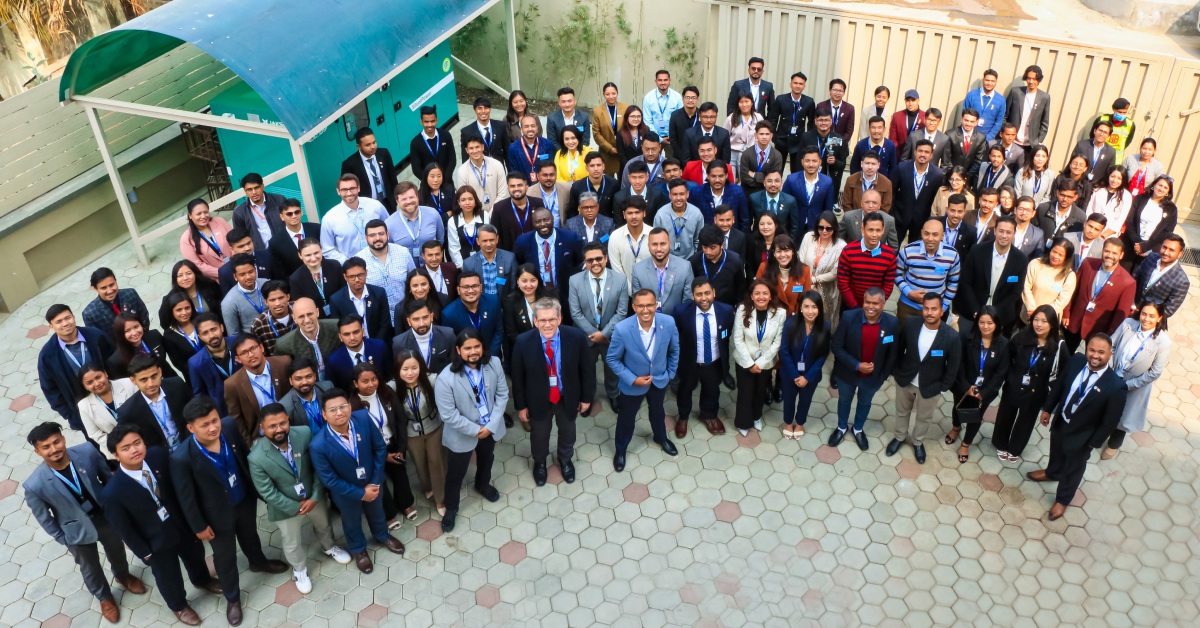
He called the emerging technology community Silicon Peaks. The phrase gives Nepal a place on a familiar mental map while keeping its own landscape in view. The initiative’s directory now brings together companies, founders, universities and investors connected to Nepal. It makes the network visible, including businesses built by Nepalis elsewhere in the world.
In 2026, Hamal argued that Nepal could develop into a center for technology entrepreneurship as well as a destination for outsourced work. That is a more demanding proposition than opening an office. It asks whether experience serving global customers can help people build companies of their own, and whether capital and professional connections will be available when they do.
A schoolhouse belongs in this story
In February 2024, SecurityPal announced matching funds for a primary school in Nepal’s Western Terai, working with Team Dayā. The commitment was $10,000 toward a project estimated to need $40,000 for a three-room schoolhouse. Hamal and colleague Ruth Rafalovich planned to help raise additional money.
The amounts are useful because they make the undertaking tangible. A school needs rooms, materials and people who will help pay for them. Hamal’s interest in economic opportunity extends backward from the trained analyst to the child who has yet to enter a classroom. The school project makes that connection concrete without requiring an audience to applaud an abstraction.
His public manner has required some practice, too. Writing about speaking at Harvard and MIT in 2026, Hamal described himself as an introvert who had learned to become an omnivert. He recalled being nervous about public speaking when he was younger. Speaking about technology and opportunity, he said, helped him find his voice.
There is a pleasing fit between that admission and a career spent explaining overlooked people and overlooked work. The founder promoting Nepal’s technical community also remembers being the thirteen-year-old visiting those university campuses with his parents. Returning as a speaker gave him another way to measure the distance traveled.
Who gets the tools?
By September 2026, Hamal’s public conversations had expanded into personal agency and access to computing. On Humans + AI, he discussed how modern tools might let more people make the kinds of leaps his own life had involved. His compute.world project provides another outlet for that interest, examining countries, computing infrastructure and the resources behind it.
His writing asks similarly expansive questions. A December 2025 essay considers whether discussions of artificial general intelligence have become too absorbed in reproducing familiar office work. The distinction he explores is between imitating existing tasks and expanding what people can accomplish. For someone whose company helps finish questionnaires, it is a useful reminder that the paperwork is supposed to lead somewhere.
Hamal has also chosen profitability over repeated fundraising after SecurityPal’s initial venture round. That preference sits comfortably beside his stated intention to spend decades building. A company expected to last needs customers who stay and a way to support the work between milestones. The next announcement is only one date on its calendar.
The original questionnaire asked whether a company could be trusted. Hamal’s subsequent choices keep raising related questions: who gets to do valuable work, where that work can happen, and how its rewards can support the next generation. His answer has taken the form of a business, a Kathmandu team, a school commitment and a growing set of connections. For a detour that began with paperwork, it has covered considerable ground.