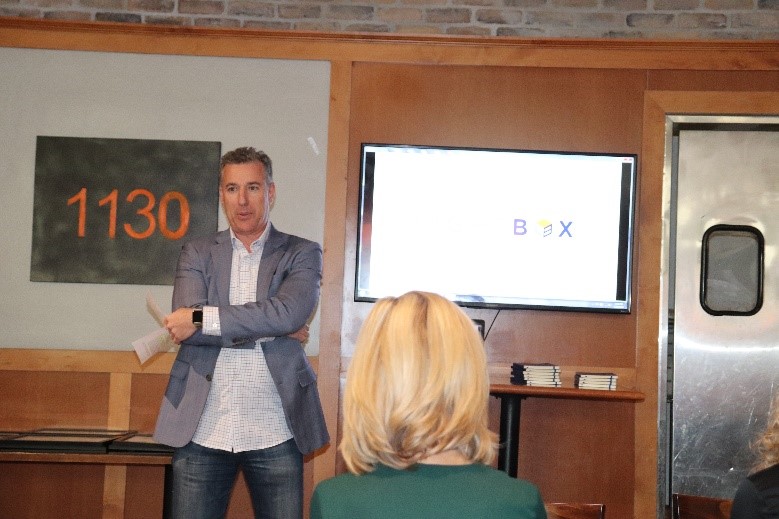
Eric Frank has a business idea that can make a perfectly respectable cocktail party guest quietly look for the bar. It involves property records, procurement systems, environmental reports and the problem of getting them to agree. He knows this. Explaining LightBox in June 2026, he paused after the extended version of its origin story to joke that a party audience would already have walked away.
There is something appealing about a founder who can hear his own explanation getting long. Frank has spent a career working on information that professionals need, even when the rest of the room would rather discuss almost anything else. His subject is the machinery behind a decision: where the facts come from, how they reach a desk, and how much work somebody must do before they become useful.
At LightBox, which he founded in 2018, the decision might concern buying an office building, lending against a warehouse or assessing a development site. A property stands quite still. Its information manages to be everywhere. Frank saw a business in bringing the pieces together.
The education of an information broker
Frank earned a Bachelor of General Studies at the University of Michigan. His early career took him to Morgan Guaranty and into the developing internet economy, where he helped create ADR.com. The portal served the American depositary receipt market, connecting an established corner of finance with a new way of delivering information.
There is a useful continuity between that project and his later work. A specialist market already existed. Professionals already understood their jobs. The opportunity lay in making information more accessible within that market. Building something useful did not require teaching investors that investing mattered.
His subsequent career included Thomson Reuters, where he helped with the integration of Thomson Financial and Reuters and became president of its Investment & Advisory division. The division represented $2.3 billion in revenue. That number belongs to the business he managed; it gives a sense of the operating scale he encountered before starting LightBox.
Revenue of the Thomson Reuters Investment & Advisory division Frank led.
From 2012 to 2014 he served as a director at AGDATA, whose work included information services, software and payment facilitation. From 2014 to 2017 he was a managing director at DMGI and DMGT, overseeing a portfolio of American commercial real estate information companies. The career crosses finance, agriculture and property. Information is the recurring occupation.
A familiar customer, an unfamiliar amount of homework
Commercial real estate gave Frank a striking comparison. The analysts, investors and lenders resembled the customers he knew in financial markets. Their information environment looked considerably less developed. They needed to combine scattered records and tools before they could begin the work they were actually paid to do.
He discussed that gap with CREW Network chief executive Wendy Mann in 2021. Individual businesses were repeatedly building their own ways of gathering and arranging data. Frank wanted a vendor to handle more of that shared burden, leaving customers to concentrate on lending, valuation, development and transactions.
Think of the duplication as an invisible expense attached to a visible building. An acquisition team needs a useful view of the asset. A lender needs another. An appraiser brings a different set of questions. Every handoff creates another opportunity to gather something already gathered, or to discover that two files describe the same property differently.
“We’re not looking to disrupt.”
Eric Frank, in conversation with Wendy Mann, 2021
That position makes his choice of market easier to understand. He wanted to sell help to professionals with established responsibilities. The ambition was substantial, but the customer's work remained the starting point. A broker's relationships and an appraiser's judgment had a place in the picture.
Buying the pieces, then making them fit
LightBox began with backing from Silver Lake and Battery Ventures. Rather than invent every component, Frank assembled existing capabilities. Environmental Data Resources and ExactBid came into the business in 2018. The first supplied environmental information; the second brought procurement capabilities. Albert Lojko joined the emerging LightBox organization as chief operating officer.
In May 2019, LightBox acquired Real Capital Markets, adding a commercial property marketplace. Digital Map Products followed in June, bringing location and geographic information capabilities. ClientLook, a customer relationship management tool for brokers, joined that December. The purchases moved across different parts of the same transaction.
- 2018Environmental data
+ procurement - 2019Marketplace
+ location data - 2021Building footprints
+ cash-flow modeling - 2022Zoning due diligence
- 2025Revere joins
BuildingFootprintUSA and Assess+RE followed in 2021, adding building mapping and cash-flow modeling. PZR joined in 2022 with zoning due diligence. There is little cocktail party glamour in the list. There is considerable explanatory power: each acquisition addressed a particular kind of information or a particular job.
Buying the pieces, of course, creates a second assignment. A collection of businesses has to become useful together. Frank discussed the integration challenge with Auren Hoffman in a December 2022 interview about real estate's adoption of data. Acquisition was part of his method; the connections between the acquired capabilities were the reason for using it.
The distinction matters when reading his career. Frank's experience included combining large information businesses before LightBox. Here, the organizing question was unusually concrete: could the next piece make a property decision easier to complete? A handsome collection of separate logins would be a rather expensive answer.
The room beyond the spreadsheet
Frank's working world also includes people building other kinds of information businesses. His public biography lists board roles with The Tie, Social Market Analytics and the Risk Assistance Network & Exchange. The connections extend the same professional theme into digital assets, market signals and risk intelligence.
Within LightBox, one addition was Manus Clancy, who joined the senior management team in January 2024 after 28 years at Trepp. His remit included data innovation. Recruiting someone with that history connected Frank's software and data ambitions with a long view of commercial property markets.
There is another, less technical, version of building connections. Frank has supported LightBox's relationship with CREW Network and its work advancing women in commercial real estate. He was an early signatory of the organization's CEO Pledge for Action. His public explanation emphasized the staff, customers and partners already involved, and the importance of mentoring future professionals.
LightBox's Developing Leaders program pairs emerging professionals with experienced mentors. Dianne Crocker and Truist's John Rybak helped create the program in 2019. It would be easy to let a CEO absorb the credit for everything beneath the company name. The people who built this initiative deserve to remain visible.
Its effects can be surprisingly specific. Participant Megan Watson described being paired with AEI Consultants chief executive Holly Neber. Their conversations covered difficult discussions, career development and advocating for herself. Watson continued seeking Neber's advice after the program ended. A relationship had outlasted the schedule that introduced it.
For a company concerned with making information travel, that is a pleasingly human parallel. Some knowledge arrives in a dataset. Some arrives because a more experienced person makes time for a question.
When a property needs an internet connection
Frank's work has also reached beyond the buying and selling of buildings. LightBox became involved in broadband mapping, using location information to help identify where service was available. Georgia and Alabama used its mapping services; Montana selected the company in January 2022.
The practical question differs from underwriting a building, but the underlying difficulty is recognizable. A map needs a dependable account of the places on it. Information about structures and addresses becomes useful in another setting when it can be connected to information about service.
Frank also encountered the competitive and contractual side of that market. In March 2022, LightBox publicly expressed disappointment after its challenge to the Federal Communications Commission's mapping contract award was denied. The winning bidder was CostQuest. Frank disputed aspects of the data arrangements. A career built around information includes arguments about who controls it.
The next deal should arrive with its facts attached
In January 2025, LightBox acquired Revere. Frank signed the announcement, describing plans to connect capital markets participants through the combination of Revere and LightBox RCM. The acquisition continued the earlier pattern: add a capability, then work toward a more connected experience.
LightBox Live now presents that experience as a progression from finding a deal to opening its data room, extracting information from documents and moving into underwriting. A persistent LightBox ID ties records to a property. The product accommodates an existing Excel model, a small but telling concession to how investment work actually gets done.
The goal gives Frank's long acquisition list a readable ending. The environmental information, transaction materials and property records should meet around an asset, with fewer demands on the user to assemble them again. Software earns its place by reducing the amount of clerical labor surrounding a consequential decision.
He brought the same priority to his June 2026 discussion of artificial intelligence: reliable information and accuracy must come before excitement about speed. The attraction is straightforward. Documents can yield useful data. The harder question is whether the resulting information deserves a professional's confidence.
His public manner offers a modest counterweight to the scale of the project. He jokes about the length of his explanations and describes building the business as fun. The central concern stays stubbornly practical. Somewhere, a property professional has another file to open, another record to reconcile, another decision waiting. Frank has built his next chapter around shortening that preamble.
Continue the conversation
Interviews, company updates and Eric Frank’s public profiles.