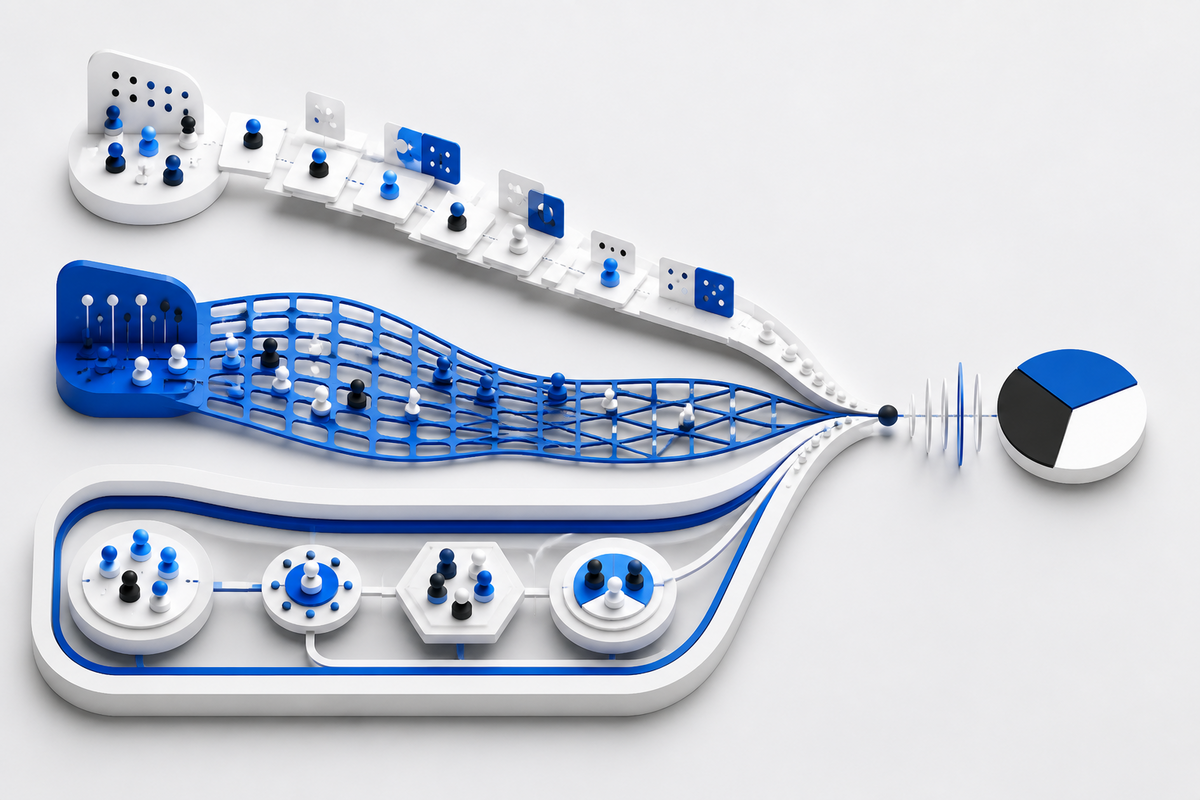
The dangerous moment in an employee-experience software demo arrives when the dashboard looks obvious. A heat map glows. A comment summary finds a theme. A manager receives a recommended action. Culture Amp, Microsoft Viva Glint and Qualtrics EmployeeXM can each produce some version of that sequence. Seen from the conference room, the products begin to blur. Seen from the Monday after survey results land, they separate quickly.
The real purchase is not a questionnaire. It is a route through the organization: from an employee's answer, through permissions and analysis, to a manager who must do something credible. Each platform makes a different bet about where that route should live. Culture Amp puts it beside performance and development. Qualtrics puts it inside a broader experience-management system. Viva Glint puts it in Microsoft's workplace layer. A buyer who starts with question libraries will miss the larger commitment.
The same survey, three centers of gravity
Culture Amp is the most legible as a dedicated people platform. Its current packaging groups Engage, Perform and Develop. Engage covers pulse and engagement surveys, lifecycle listening, benchmarks, text analysis and action planning. Perform adds goals, reviews, continuous feedback, calibrations and performance analytics. Develop adds career paths, competency libraries and trackable growth plans. This is useful when the people team wants engagement data to inform the conversations already happening between managers and employees.
That coherence is the attraction. It is also the boundary to inspect. Culture Amp says its platform integrates with major HR systems, and every subscription includes HRIS integrations, Slack and Teams integrations, single sign-on and security controls. Still, the product's natural center is the people program. If the company wants to connect employee sentiment with customer experience, contact-center friction or research data, another architecture may have a more direct story.
Where each platform naturally expands
Conceptual map, not a product score: people practice → workplace suite → enterprise experience management.
Qualtrics starts from a wider frame. Its employee-experience suite includes People Engage and People Lifecycle, with continuous listening, analytics and manager recommendations. The company explicitly promotes connecting employee-experience data to customer outcomes and business performance. Its product definitions also describe CrossXM Analytics, a service for bringing employee and customer experience data together. That matters when the buying group includes customer-experience or research leaders, not only HR.
Breadth has a tax. A broad platform only earns its keep when the organization has owners, data access and a question worth joining across domains. “Can we correlate this?” is easy. “Who changes a decision if the relationship appears?” is harder. Qualtrics can support a more ambitious measurement program, but a buyer should not confuse analytical possibility with operating readiness.
The products look similar at the moment of listening. They reveal themselves at the moment of action.YesPress analysis
Glint comes with a floor underneath it
Viva Glint is the procurement wrinkle in this comparison. Microsoft currently lists Viva Glint as an individual Viva app at $2 per user per month, paid yearly. It can also come through Viva Suite. But Viva is not an independent island: Microsoft says it requires an eligible Microsoft 365, Office 365, Microsoft 365 Business or SharePoint plan. Microsoft also states that Glint has a 50-seat minimum and that a Viva Glint or Viva Suite license is required to create, edit or respond to Glint surveys.
So “standalone” needs careful language. There is a separately priced Glint subscription, but not a deployment detached from Microsoft's licensing base. For a company already standardized on Microsoft 365, that may be an advantage. Identity, collaboration and familiar manager touchpoints can live near the tools employees already use. For a company outside that environment, the apparent app price is not the whole bill or the whole change.
This makes the Microsoft decision unusually sensitive to installed base. The right spreadsheet has two columns most comparisons omit: “licenses we already own” and “workflows managers already inhabit.” Glint can be economical when those answers point to Microsoft. It can be cumbersome when they do not. The dependency is neither automatically good nor bad. It is simply too important to hide below a feature row.
Choose the work, then choose the software
A buyer's shorthand
Start here when engagement, performance and employee development should share a dedicated operating home.
Start here when Microsoft is already the workplace layer and the licensing dependency is acceptable.
Start here when employee listening belongs in a wider experience program with cross-domain analysis.
For a mid-sized organization building its first mature engagement program, Culture Amp offers the clearest line from listening to people practices. For a Microsoft-heavy enterprise that wants feedback close to the collaboration suite, Glint deserves an early look. For an organization with an established experience-management team and a serious plan to connect workforce signals to customers or operations, Qualtrics has the broader canvas.
Those are starting hypotheses, not verdicts. Company size alone does not decide this. Neither does the number of templates. The useful question is organizational distance: how many handoffs sit between an insight and the person who can act? A specialized product may shorten that distance for HR while lengthening it for business analysts. A suite may reduce login friction while creating governance work. A broad platform may unite data while asking managers to learn a process they never requested.
Make the pilot slightly uncomfortable
Most pilots are too clean. The vendor loads tidy sample data, a sponsor plays the role of manager and nobody tests the awkward edge cases. A useful pilot follows one real business unit from invitation to follow-up. Include a small team where confidentiality thresholds matter. Include a manager with limited time. Include comments that resist simple categorization. Then watch what the system and the people around it actually do.
The five-part proof
- Load the real hierarchy and test employee access, identity and HRIS synchronization.
- Set confidentiality rules and verify what managers can see in small cohorts.
- Run a short survey with open comments, then inspect summaries against the source material.
- Assign one action to a manager and trace reminders, ownership and progress reporting.
- Price the complete environment, including required base licenses, services and internal administration.
Ask every vendor to show the same difficult workflow. How does an HR leader spot a cross-company issue? How does a line manager see only the appropriate slice? How does the employee learn that speaking up changed something? Where does the action live three months later? If an AI summary is involved, ask how it points back to evidence and how a manager challenges a weak interpretation.
Privacy settings deserve their own session, away from the polished demo. Employee listening depends on people believing that the stated rules match the software's behavior. Test minimum reporting groups, comment visibility, demographic filters, exports and administrator roles with the legal and employee-relations teams in the room. Then write the rules in language an employee can understand. A platform can enforce thresholds, but it cannot repair a vague promise about anonymity after a manager recognizes a voice in a small team.
The buyer should also separate listening cadence from managerial capacity. Continuous listening sounds responsive, yet a stream of surveys can outrun the organization's ability to explain or act. Decide how many issues a team can reasonably own, how often leaders will report progress and what closes an action. Sometimes the right design is fewer pulses with stronger follow-through. The software should support that discipline rather than quietly rewarding more collection.
Pricing deserves the same realism. Culture Amp says pricing varies by employee count, selected product and service tier, with annual billing. Qualtrics describes usage-based packaging and asks buyers to request suite pricing. Microsoft publishes a Glint list price, but the eligible base subscription and seat minimum belong in the total. Implementation, internal administration and manager training belong there too. A cheaper license that creates a second operating system for managers can become an expensive bargain.
Put adoption risk into the contract conversation. Ask what happens when the hierarchy changes, when an acquisition adds a new tenant, when a survey needs another language or when managers miss action deadlines. Ask which services are included and which require consulting. The answers turn an attractive first-year quote into a more honest picture of ownership. They also reveal whether the vendor's definition of success matches yours: a launched survey, an active dashboard or a documented change in how work gets done.
Listening is a promise
Employee surveys carry an unusual moral weight for software. Asking a worker to describe a problem creates an expectation that somebody will notice. Repeating the question without a visible response teaches a darker lesson: participation is ceremonial. The winning platform is therefore not the one that extracts the most sentiment. It is the one the organization can use to close the loop reliably.
Culture Amp, Viva Glint and Qualtrics EmployeeXM each have a credible route. Culture Amp's route runs through the people system. Glint's runs through Microsoft. Qualtrics' runs through experience management. Choose the route your managers, analysts and employees can actually travel. The dashboard is a moment. The operating habit is the product.
Frequently asked questions
Can Viva Glint be purchased without Microsoft 365?
Not as an independent deployment outside Microsoft's licensing stack. Microsoft sells a Viva Glint subscription, but Viva requires an eligible Microsoft 365, Office 365, Business or SharePoint base plan.
Which option combines engagement and performance most directly?
Culture Amp packages Engage with Perform and Develop, making it the most explicit combination of employee listening, performance workflows and growth tools in this group.
When is Qualtrics EmployeeXM the natural fit?
It is a strong candidate when employee listening belongs within a broader experience-management program, especially where teams intend to connect workforce, customer and business outcome data.
Are published prices directly comparable?
No. Culture Amp and Qualtrics ask buyers to request pricing. Microsoft publishes a Viva Glint list price, but buyers must include the eligible base subscription, 50-seat minimum and implementation costs.
What should an employee-experience pilot prove?
It should prove the full action loop: access, confidentiality, response, comment interpretation, manager permissions, action ownership, integration and follow-up reporting.