The cleanest way to choose between Culture Amp and 15Five is to close both sales decks and open your calendar. Look at the meetings your company already protects. Is there a People team with the authority to run a listening cycle, segment the results, brief leaders, and chase an action plan? Or does the real work of performance happen in weekly conversations between managers and employees, one team at a time? That mundane evidence says more than a row of green check marks.
On paper, the two products have converged. Culture Amp offers engagement surveys, pulse surveys, reviews, calibration, one-on-ones, goals, development plans, continuous feedback, analytics, integrations, and an AI coach. 15Five offers engagement surveys, reviews, check-ins, one-on-ones, goals and OKRs, feedback, career plans, analytics, integrations, and AI assistance. A procurement spreadsheet can make them look like close substitutes.
They are not identical. More importantly, they do not make the same behavior feel central. Culture Amp grew up around organizational listening and benchmarking. 15Five grew up around a lightweight recurring report that could help a manager know what was happening before the next formal review. Each has expanded far beyond that origin, but software remembers its first habit.
A feature list tells you what the software can do. A calendar tells you what your company will keep doing.
Start with the owner, not the logo
Culture Amp's public plans page is built like a conversation with an HR leader planning a program. Pricing depends on employee count, product, and service tier. Enterprise service can include manager and executive training, a results call with a People Scientist, coaching, and pre-launch review. The platform says it serves more than 6,000 organizations and 25 million employees. Its core promise is to turn workforce data into decisions at organizational scale.
15Five's current pricing page makes a different first impression. It publishes annual per-user prices: $4 a month for Engage, $11 for Perform, and $16 for Total Platform, as of its February 2026 update. Weekly check-ins, one-on-ones, high fives, goals, reviews, career tools, and a mobile app sit visibly inside the performance packages. 15Five says more than 3,000 organizations use its platform. A buyer can do rough arithmetic before talking to sales.
This does not mean Culture Amp is only for large companies. Its plans page explicitly describes support for organizations with fewer than 200 employees. Nor is 15Five only for startups. Its own site says the platform is best suited to mid-market and enterprise organizations. The simple small-versus-large verdict is tempting, but the better distinction is centralized program versus distributed ritual.
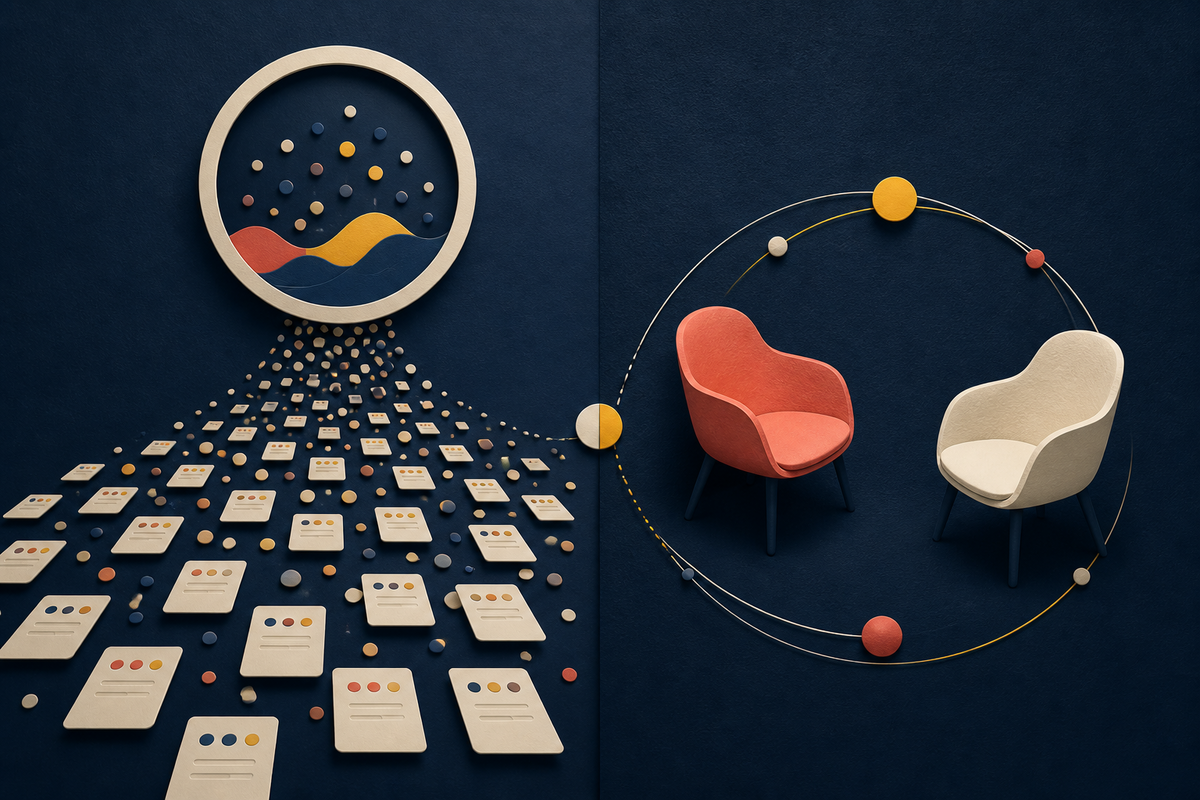
A map and a set of footsteps
An engagement survey is a map. It can show that one function feels blocked, that confidence in leadership has fallen, or that managers in one region are outperforming a benchmark. The value comes from coverage, confidentiality, segmentation, statistical care, and follow-through. Culture Amp puts that system close to the front door.
A check-in is a set of footsteps. It can surface this week's obstacle, the win nobody saw, the conversation an employee is avoiding, or a goal drifting off course. Its value comes from frequency and managerial response. If managers skim the answers or cancel the one-on-one, the stream becomes clerical work. 15Five puts this recurring exchange in unusually plain view.
Every useful feedback system must close the loop
Healthy companies need both motions. They need the wide-angle view and the close conversation. Both vendors know this, which is why their catalogs overlap. The choice is about which motion currently fails in your company and which platform gives that motion a credible owner.

Price the burden, not only the seats
15Five's published prices make an initial comparison easy. They do not make the total decision automatic. Add the hours managers spend writing and responding, the cost of low participation, the work of integrating the HRIS, and any add-ons. Culture Amp's quote-based model demands a sales conversation earlier. That can frustrate a buyer who wants a number, but it also reflects differences in product mix, service, and rollout scope.
The implementation burden differs too. A large survey program needs data governance, communication, confidentiality rules, leader briefings, and action planning. A high-frequency check-in program needs managers who read, respond, and hold useful conversations without turning the form into surveillance. Neither burden disappears because a product has AI. AI can summarize comments or help draft a review; it cannot decide whether an employee trusts the process.
Run an ordinary-week trial
The most revealing pilot is not a polished demo with sample data. Give each finalist one representative team, one skeptical manager, one busy HR partner, and one messy month. Import real structure from the HRIS. Launch one workflow. Let a manager miss a deadline. Let an employee ask who can see a sensitive response. Then watch how the product, permissions, notifications, support, and internal owner handle the friction.
Five questions worth stealing
- Who notices first when participation falls?
- What useful decision comes from the data next week?
- Can employees understand who sees each response?
- How much manager time does the recurring workflow consume?
- What must HR manually assemble for executives?
Also test the less glamorous edges: SSO, role changes, historical data, demographic filters, exports, accessibility, mobile use, Slack or Teams notifications, and deletion rules. Ask for references from organizations with your headcount and operating model, not merely your industry. A 250-person remote software company and a 250-person manufacturer may share a seat count while having almost nothing else in common.
Trust is part of the interface
People software sits in an awkward place. The organization wants enough visibility to improve work, while an employee needs enough privacy to answer honestly. A dashboard that is technically impressive can still poison the signal if people cannot tell whether a comment is confidential, anonymous, attributed, or visible to their direct manager. During a pilot, ask an ordinary employee to explain the permission model back to you. If the explanation requires an administrator, the interface has not done its job.
The same caution applies to AI features. Ask what data is used to generate summaries or coaching, how long prompts and outputs are retained, whether customer data trains shared models, and who can see an AI-produced inference. Review each vendor's current security, privacy, and AI terms with counsel rather than relying on a comparison article or a sales assurance. These documents change faster than an annual buying guide.
Finally, decide what the product must never become. A weekly check-in can support a conversation, or it can feel like a monitoring form. An engagement survey can protect candor, or it can become a hunt for the author of a critical comment. Configuration matters, but leadership behavior teaches employees what the system is really for. Trust is not a soft benefit around the workflow. It determines the quality of every response inside it.
The verdict lives in the rhythm
Choose Culture Amp when the urgent job is to give HR and executives a dependable organization-wide view, compare signals, manage formal cycles, and support a scaled program with the appropriate service layer. Choose 15Five when the urgent job is to make manager-employee conversations, goals, feedback, and performance follow-up recur in the flow of work, with packaging that is easy to model publicly.
Then challenge that recommendation. Culture Amp has manager tools and continuous feedback. 15Five has engagement surveys and organizational analytics. A final decision should come from feature depth, data handling, integration fit, adoption evidence, and commercial terms. Product boundaries move; your operating constraints are more stubborn.
The best platform is not the one that promises the most complete view of people. It is the one that helps your company perform a specific act of management more reliably: listen, interpret, talk, respond, and return. If nobody can name the owner of that loop, postpone the contract. The missing feature is inside the company.
Questions buyers keep asking
What is the main difference between Culture Amp and 15Five?
Both cover engagement and performance. Culture Amp's center of gravity is organization-wide measurement, benchmarking, and HR-led analysis. 15Five makes recurring manager workflows such as check-ins and one-on-ones especially prominent.
Which one is better for a small company?
15Five's published per-user packages are easy to estimate, but Culture Amp also supports organizations below 200 employees. Compare minimum commitments, admin time, and the behavior each product expects.
Which one is better for an enterprise?
Culture Amp publicly describes a substantial enterprise service layer. 15Five also targets mid-market and enterprise buyers. Validate governance, security, integrations, rollout support, and references at your scale.
How much do they cost?
As of its February 2026 update, 15Five listed annual plans at $4, $11, and $16 per user per month. Culture Amp says its annual pricing depends on employee count, product, and service tier. Confirm current quotes directly.
Can either replace an HRIS?
Both are generally positioned to integrate with an HRIS and add engagement and performance workflows. Buyers should confirm the system of record, payroll boundaries, and available integrations for their stack.