
Buying performance software sounds like a systems decision. It is closer to drafting a management constitution. The forms people complete, the reminders they receive, and the evidence they see before a difficult conversation become the company's practical definition of good management. That is why the familiar Lattice versus 15Five debate rarely gets settled by a feature grid. Both can run reviews, collect feedback, manage goals, support one-on-ones, analyze engagement, and apply AI to people data. The meaningful choice sits underneath: which behavior does your company need to make routine?
Lattice's center of gravity is the connected talent record. Its platform brings performance reviews, goals, growth plans, engagement signals, compensation workflows, and analytics into a shared context. 15Five's center of gravity is the manager in motion. Its Best-Self vocabulary shows up in strengths-based reviews, weekly check-ins, coaching, one-on-one agendas, and manager development. The products have converged, but their starting points still shape the experience.
Choose connection when reviews, goals, growth, and pay decisions keep losing context between systems.
Choose cadence when one-on-ones drift, feedback arrives late, and managers need a repeatable coaching practice.
Lattice wants the record to remember
Lattice presents performance as a chain of connected decisions. A goal creates evidence. Feedback adds texture. A review turns that evidence into an assessment. Growth plans and compensation decisions can then draw from the same context. Its current performance product includes reviews, talent reviews, performance improvement plans, succession planning, one-on-ones, updates, and real-time feedback. Its compensation product adds benchmarks, bands, cycle management, analytics, statements, and pay-for-performance workflows.
That architecture is useful for a People team tired of stitching together a review score, a salary spreadsheet, and a half-remembered goal update. Lattice's advantage is not simply that it stores more fields. It is that the fields can meet at consequential moments: calibration, promotion, succession, and pay. The vendor's newer AI story follows the same logic. Evidence-based review drafts draw from goals, feedback, updates, one-on-ones, and growth areas already in Lattice.
“High performance is a habit.”Lattice's stated product belief
There is a tradeoff. A richer system asks for governance. Someone has to define review cycles, competencies, permissions, compensation bands, and the relationship between them. If the organization has no appetite for that work, a connected platform can become a well-designed archive. Lattice makes the strongest case when HR needs consistency across teams and executives expect a defensible line from goals to talent decisions.
15Five wants the manager to notice
15Five begins closer to the conversation. The company's Best-Self Review is explicitly strengths-based and growth-oriented. Its Perform plan combines reviews with OKRs, a talent matrix, career paths, one-on-ones, weekly check-ins, feedback, and recognition. The Total Platform adds engagement and manager-training microlearning. Its manager products now include Kona, an AI meeting assistant and coach, plus expert coaching and learning content.
The practical idea is that performance improves through frequent, lower-stakes contact. A weekly check-in gives the manager a view of wins and blockers. A one-on-one creates room to interpret them. A later review has a trail of context instead of a blank text box and a contest of recent memories. This philosophy is visible even in the name: 15Five began with a ritual designed to take an employee about fifteen minutes to write and a manager about five minutes to read.
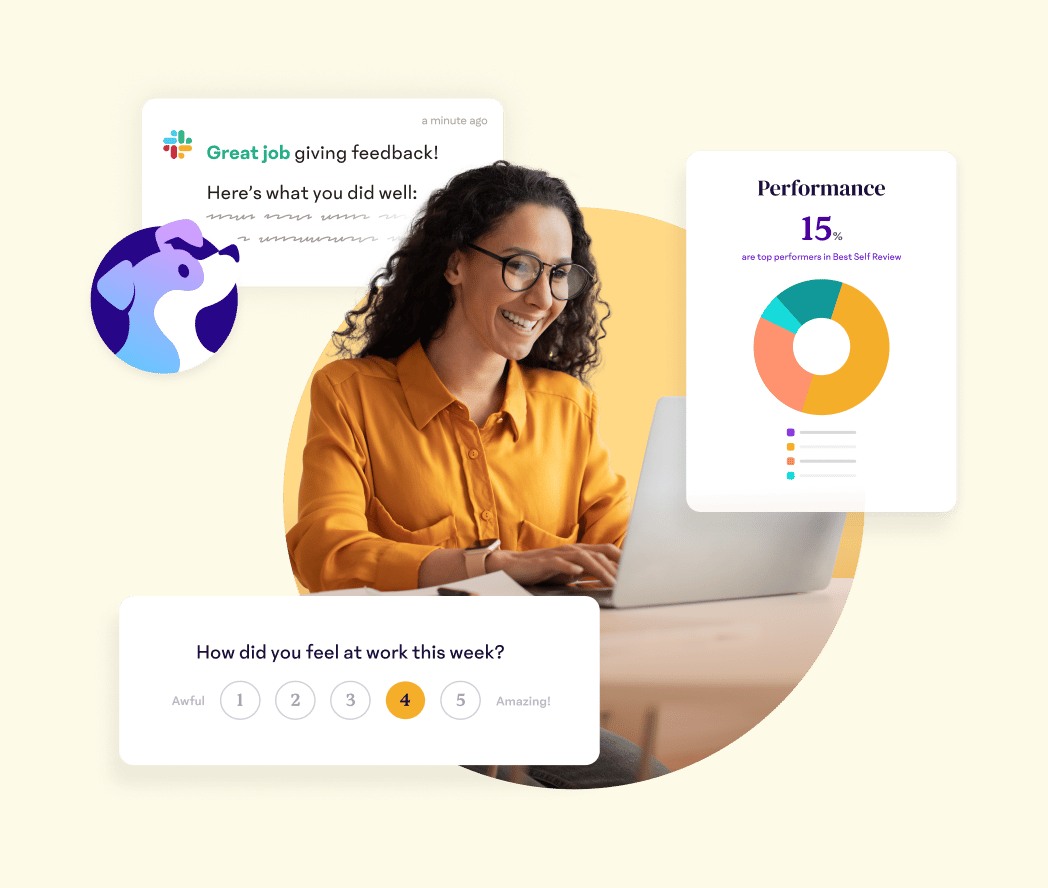
15Five is not merely a coaching course wrapped around a check-in form. Its current platform includes compensation insights, pay ranges, benchmarking, a total rewards dashboard, people analytics, and an HRIS connector. It is also investing in AI-assisted reviews, Growth Studio workflows for development and succession, Focus Briefs, and AMAYA for people insights. Still, the manager remains the hero of its product narrative. For companies where new managers are promoted faster than HR can train them, that focus can be the point.
Editorial fit map
Fit follows organizational maturity
Company size is a poor shortcut for this decision. A fifty-person business can have complex compensation rules, several job families, and a board asking for disciplined succession planning. A thousand-person company can still have a painfully simple problem: managers cancel one-on-ones and save feedback for December. The more useful measure is program maturity. If HR has defined competencies, review stages, calibration rules, and pay bands, Lattice gives those structures room to connect. If those structures are still developing and the immediate need is a consistent management rhythm, 15Five offers a more opinionated place to begin.
The employee experience matters too. A platform can delight the buying committee and still create ceremony for everyone else. Ask an individual contributor to find a goal, prepare a check-in, request feedback, and understand a completed review without help. Ask a manager to do the same while switching among eight direct reports. Then ask HR to correct a reporting line, reopen a review, compare ratings, and explain a pay recommendation. The friction at those handoffs is more revealing than the polished path in a sales demonstration.
There is also a cultural question hiding inside configuration. Lattice can support a tightly governed process or a lighter one, while 15Five can be customized beyond its default philosophy. Neither product forces a single management doctrine. But defaults have gravity. Under deadline pressure, teams use the supplied template, accept the reminder schedule, and follow the easiest screen. Procurement should examine those defaults as carefully as security documentation because defaults are what become habits.
The feature grid is telling half the truth
At list price, the headline comparison is unusually neat. Each company currently lists a core performance tier at $11 per user per month, billed annually. But equal numerals do not mean equal contracts. Lattice packages products modularly, lists Compensation at an additional $6 per seat per month, and states a $4,000 minimum annual agreement. 15Five lists Engage at $4, Perform at $11, and Total Platform at $16 per user per month, billed annually. Scope, implementation, service, discounts, and minimums can change the real quote.
Review sites show why a universal winner is difficult to name. G2's current comparison gives both products similar ease-of-use and setup scores, while its reviewer mix skews more heavily toward mid-market companies for Lattice and includes a larger small-business share for 15Five. Those are signals, not a verdict. A user praising a lightweight check-in rhythm may be solving a different problem from an HR operations leader praising calibrated reviews.
One caution on “all-in-one.” Product boundaries move. Lattice's current public navigation emphasizes its talent platform and integrations, while 15Five describes an HRIS connector. Confirm the live scope of core HR, payroll, data ownership, and integrations during procurement rather than relying on an older comparison article.
Run the decision like a working session
The useful buying exercise starts before a demo. Write down the recurring failure in one sentence. Perhaps managers avoid feedback until review season. Perhaps compensation meetings begin with three contradictory spreadsheets. Perhaps employees cannot see how their goals connect to advancement. A vendor can be impressive and still miss the bottleneck.
Name one expensive failure
Choose a behavior you can observe, such as late reviews, weak one-on-ones, missing evidence, or days spent reconciling compensation data.
Pilot the chain
Run a real check-in, one-on-one, review draft, calibration, and pay recommendation with representative managers. Do not limit the pilot to HR administrators.
Measure context quality
Count less admin time, but also inspect whether the final conversation contains clearer evidence and whether the employee can understand the decision.
Price the operating model
Include implementation, governance, manager training, integrations, add-ons, and the internal owner who will keep the system credible after launch.
AI makes this discipline more important. Both vendors can summarize signals and help draft reviews. The quality of that assistance depends on the context accumulated before the review begins. An elegant draft built on sporadic updates is still thin. The better AI platform will often be the platform employees and managers reliably feed throughout the year.
The cleanest verdict is conditional. Choose Lattice when the organization needs a stronger connective layer for structured talent decisions, especially where performance, growth, goals, engagement, and compensation must inform one another. Choose 15Five when the urgent problem is manager behavior and the company wants a visible coaching framework woven into weekly work. If both problems are real, rank them. Software can reinforce one operating habit at a time; implementation energy is finite.
The wrong choice is the one made from the longest checklist. The right choice is the one that makes a missing behavior ordinary: a manager notices sooner, an employee understands the expectation, or an HR leader enters a pay meeting with evidence everyone can trace. That is what the platform will teach.
Questions buyers keep asking
What is the main difference between Lattice and 15Five?
Lattice centers a connected talent system across performance, goals, growth, engagement, and compensation. 15Five centers manager effectiveness through check-ins, coaching, reviews, and its Best-Self framework.
Which is better for manager coaching?
15Five makes coaching more explicit through Best-Self practices, manager training, Kona, check-ins, and one-on-ones. Lattice also offers manager tools and AI coaching, so test the actual workflow.
Which is better for compensation planning?
Lattice has a clearly packaged compensation add-on with bands, cycle management, benchmarks, analytics, statements, and pay-for-performance. 15Five also offers ranges, benchmarking, compensation insights, and total rewards views.
Do both platforms use AI?
Yes. Both use people and performance context to draft reviews, summarize signals, surface insights, and support managers. Availability varies by plan and release stage.
How should a company test them?
Pilot one real management chain from check-in through review and compensation handoff. Measure completion, admin time, evidence quality, and whether managers find the prompts useful.