The useful thing about a drone is not that it flies. Birds manage that without a cap table. The useful thing is that it can fly the same route every morning, notice a loose rail fastener or a hot transformer, come home, replenish itself, and deliver a report before anyone has laced a work boot. Dronehub has spent a decade trying to close that loop. Its thesis is wonderfully unglamorous: the aircraft gets the attention, but the dock, battery, software, and data pipeline turn a flying camera into infrastructure.
The company began in 2015 as Cervi Robotics, founded by Ukrainian-born engineer Vadym Melnyk in a university pre-incubator in Rzeszów, Poland. It did robotics and automation work, not just drones. Then an inquiry connected to the European Space Agency arrived in 2017: could someone automate landing and battery replenishment? Melnyk says his small firm responded when others did not. The resulting contract was worth roughly €200,000 by his later account, and within about six months the team had a prototype automatic charger.
That contract bought more than components. It gave a young team a credible evaluator and a specific nuisance to solve. A drone may follow waypoints perfectly, yet a person still has to retrieve it, change or charge the pack, check conditions, and send it back out. Dronehub put the nuisance at the center of the company.

The crash before the focus
Deep-tech histories are usually polished until every prototype behaves. Dronehub's did not. In a 2024 interview with Poland's Agency for Enterprise Development, Melnyk described a drone falling during a special demonstration for prospective customers. Orders did not follow. Cash flow tightened, and key employees left. For a business selling autonomy, the failure could hardly have been more literal: the machine did not stay autonomous long enough to finish the pitch.
It took us some time to get rid of unnecessary ambitions and focus on what creates real market value and what we can earn money on.Vadym Melnyk, translated from a 2024 PARP interview
What changed was the answer to a basic question: what business was Dronehub actually in? The earlier temptation was to cover the ecosystem. The sharper answer was OEM infrastructure and automated data processing. Melnyk told PARP that software had grown to nearly 80 percent of the company's activity. Instead of insisting on selling a complete, vertically owned drone service every time, Dronehub could supply or license the docking, charging, autonomy, and analytics layers to operators and integrators who already understood a market.
That is the comeback worth studying. It was not a magical product launch. It was a reduction in ambition that increased the addressable surface. The same core machinery could sit beside a railway, at a refinery, on a security perimeter, or eventually on a moving vehicle. Different job, familiar loop.
What the box actually does
Dronehub's stationary product combines a weatherproof enclosure, landing system, environmental controls, power, communications, robotic battery handling, and mission software. The company says its mechanism swaps a battery in about two minutes. That distinction matters because many docks recharge the aircraft in place, leaving it unavailable for a longer interval. A fast swap can increase mission cadence, provided spare packs, maintenance, airspace permission, and communications are all available.
The closed autonomy loop
Six handoffs, one useful outcome
The software layer plans missions, watches the fleet, manages data, and helps identify anomalies. Dronehub calls its current analysis stack Sentinel. The sales promise is not another folder of aerial video. It is a shorter queue of frames that deserve attention: the fastener that changed, the unexpected object near a track, the heat signature on an asset. The company reports performance above 95 percent on critical defects and reports within 15 minutes in its Deutsche Bahn materials. Those are deployment-specific company claims, not universal guarantees.
Turnaround, company-stated
Its portfolio now extends beyond the fixed dock. UAV Nomad is a mobile version intended to service drones from a static or moving host, developed through a roughly $1.72 million Polish R&D program. HUUVER, led by Dronehub through a seven-partner European consortium, is stranger in the best way: a vehicle that can fly to a site and then drive, preserving battery while inspecting tunnels, rough ground, or places where hovering is wasteful. Cargo configurations target medical and package logistics. These programs show engineering range, though a funded prototype and a scaled commercial fleet are not the same thing.
The customers buy fewer dangerous walks
The natural customers own things that are long, remote, hazardous, or awake at 3 a.m. Rail operators need repeated views of track and hardware. Energy companies monitor pipelines, substations, turbines, and plant perimeters. Security teams want a camera dispatched when a ground sensor trips. Logistics programs care about minutes and road access. Government and defense buyers care about persistent coverage, controlled data, and supply-chain provenance.
Named references give the pitch some weight. Melnyk has identified PKN Orlen as an early customer for refinery monitoring. Dronehub has announced anomaly-detection work associated with Deutsche Bahn. It supplied drone capability to U-Space4UAM, a 13-partner, five-country urban-air-mobility program led by Honeywell and funded through the European Union's SESAR effort. An ESA-backed project called SIS-SREM applied drone and satellite data to safety at the Dolní Morava mountain resort in the Czech Republic.
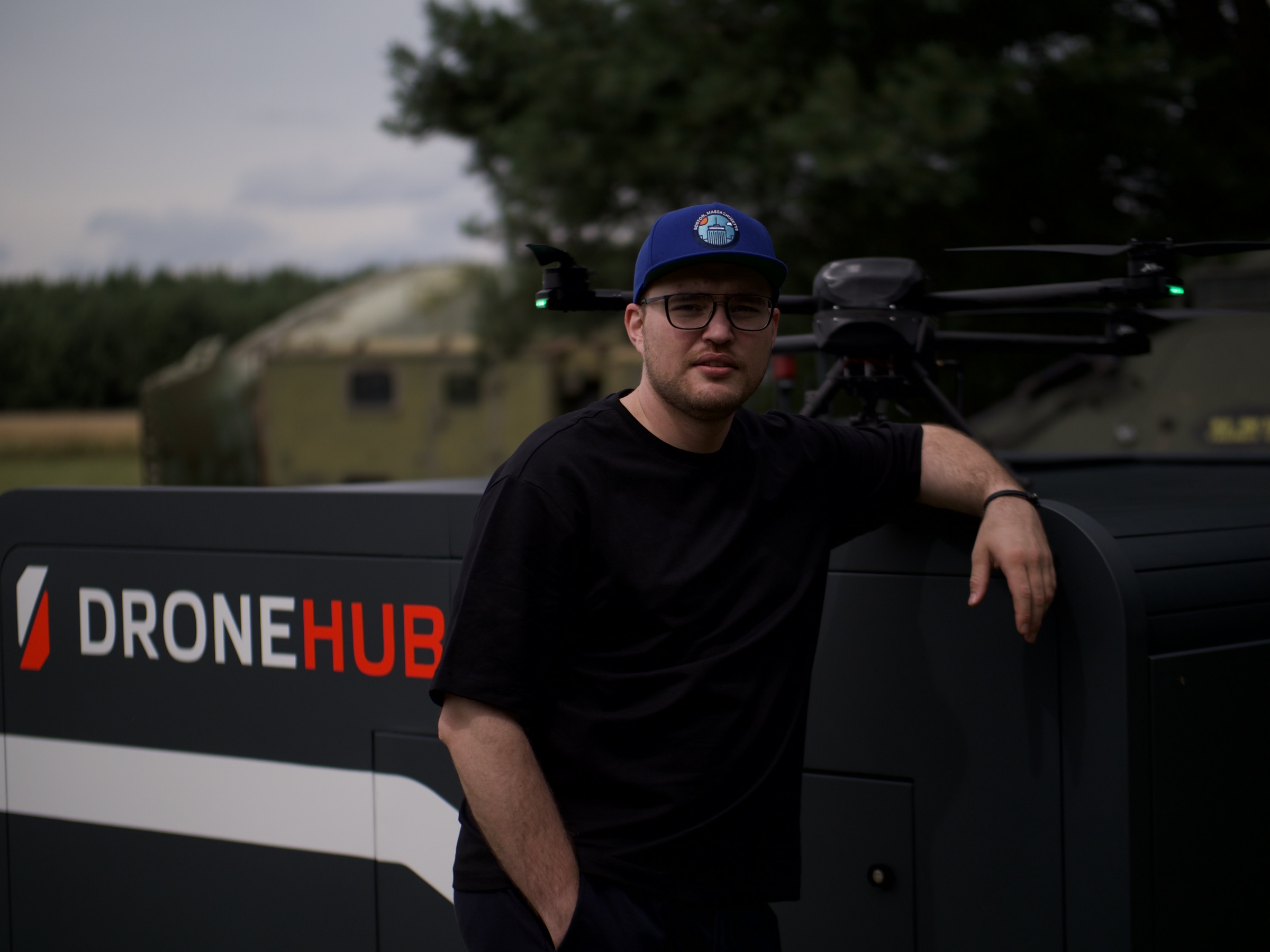
The partnership list reads like a grant writer's frequent-flyer card: ESA, the European Defence Agency, IBM, Honeywell, EU research consortia, and the Polish National Centre for Research and Development. This is not incidental. Hardware is expensive to test, regulated environments are slow to enter, and public programs can serve as both financing and a demanding first customer. Dronehub announced PLN 2 million in private pre-seed funding in 2020 and received $500,000 through GENIUS NY in 2022, which supported its US expansion. The supplied company record puts total funding at $3.66 million, but public databases count contracts, grants, and equity differently.
Three ways to make money from one hard layer
Dronehub's current business model has three doors. A customer can buy an integrated system. An OEM or systems integrator can license the infrastructure IP and place it inside a broader offer. A government program or prime contractor can co-develop a variant through an R&D engagement. The Polish base provides engineering and manufacturing; the US entity gives the company a route into American industrial and federal programs.
This positioning separates Dronehub from companies whose advantage is the aircraft itself. Percepto and Airobotics sell autonomous industrial systems; DJI's Dock line brings enormous hardware scale; Hextronics, Easy Aerial, Nokia, and others attack adjacent combinations of docks, networks, and operations. Dronehub's wager is that robotic battery exchange, licensable integration know-how, and a US-plus-Europe structure can win projects where uptime and procurement provenance matter more than a famous airframe.
The buyer's test: If one scheduled pilot can inspect the site cheaply once a quarter, autonomy is probably an expensive ornament. If the asset needs daily coverage, sits far from staff, exposes people to danger, or punishes missed defects, the economics begin to move.
What a founder can steal
Dronehub's story contains four practical moves that travel beyond drones. None requires a rotor.
The overlooked ESA inquiry supplied a real problem, budget, evaluator, and deadline.
Flight was crowded. Replenishment and redeployment were the less glamorous constraint.
Ski slopes, rail, refineries, and perimeters share a trigger-fly-return-report loop.
The crash exposed the fragility of selling a whole autonomous dream in one demonstration.
The counterlesson is just as useful. This approach does not work everywhere. Beyond-visual-line-of-sight rules, local airspace, privacy restrictions, bad weather, radio coverage, maintenance, cybersecurity, and integration with the operator's existing systems can each stop a deployment. A battery swap does not fix a grounded aircraft or an unavailable permit. AI detection also needs representative data, controlled thresholds, and human review when consequences are serious.
Nor does the model suit light use. A dock, spare batteries, network link, software, and operating approvals create fixed costs. The more repetitive and costly the inspection, the more those costs can spread. The occasional roof survey is a pilot's job. A 20-kilometer rail segment that needs regular inspection is closer to Dronehub's favorite spreadsheet.
Where Dronehub fits now
Dronehub sits between aircraft makers and the organizations that need reliable outcomes. It is part hardware company, part enterprise software vendor, part R&D contractor, and part IP licensor. That mixture is untidy, but the market is untidy too. Railways do not purchase autonomy the way a startup buys a subscription. Defense programs do not treat foreign components, data locations, or maintenance plans as footnotes. Industrial customers want an audit trail, not a cinematic reel.
The company earned recognition in the 2023 FT 1000, ranking No. 220 overall and No. 2 in the Aerospace & Defense category for the measured 2018-2021 growth period. Awards are not deployment counts, and prototypes are not recurring revenue. The more revealing achievement is that Dronehub survived its embarrassing flight and arrived at a clearer sentence: it builds the infrastructure behind autonomous operations.
That sentence is less exciting than “the future of flight.” It is also more useful. The next wave of drone companies will not be judged by whether an aircraft can take off by itself. They will be judged by whether the entire operation can keep going, whether the data tells anyone what to do, and whether the economics beat sending a person. Dronehub's box is an attempt to make those boring questions answer themselves.
Continue exploring