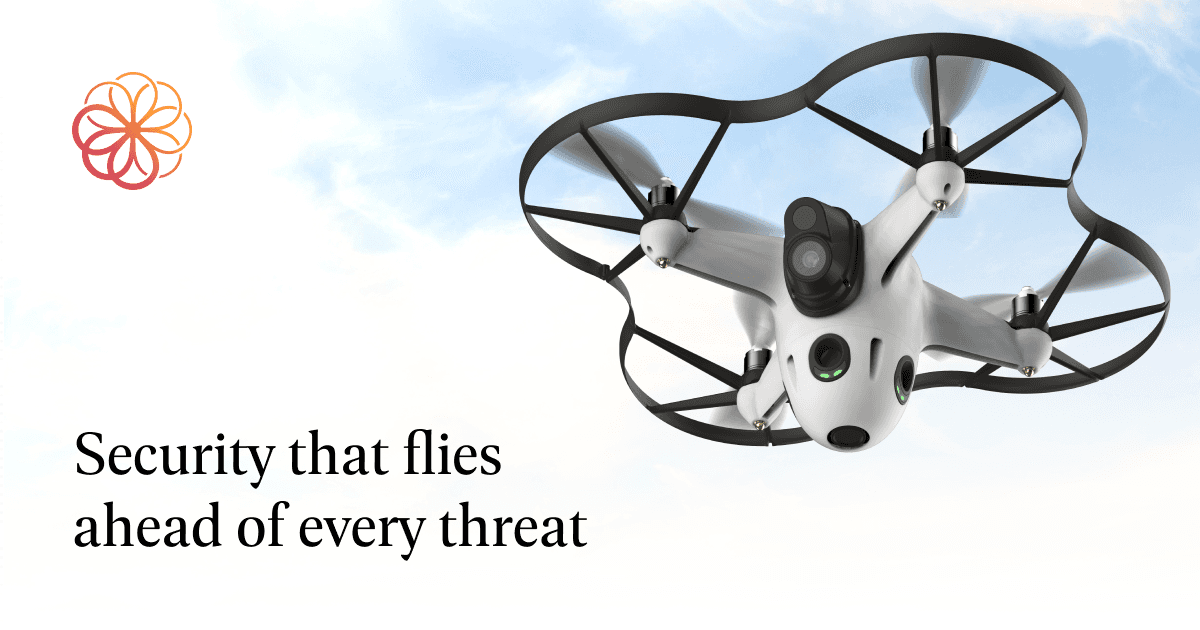
The security system that stopped watching and started flying. A drone that lives in a box, wakes on a sensor, and patrols the perimeter for you.
The Bee, mid-patrol against a Swiss-grey sky. Note the propeller guards - the whole thing is built to fly close to buildings, in the rain, without a pilot's thumb anywhere near it.
Here is the pitch, stripped of the sky metaphors. Most security systems are passive. A camera records the break-in you review the next morning. A sensor beeps and waits for a human to decide whether the beep mattered. Sunflower Labs asked a slightly annoying question in 2016 - why do these systems only watch when they could act? - and then spent nine years building the annoying answer.
The answer is called the Beehive, and it is two products wearing one name. There is the Bee, a compact quadcopter wrapped in propeller guards so it can fly close to buildings without turning into a lawsuit. And there is the Hive, a weatherproof base station that houses the Bee, charges it, and processes what it sees. The Bee lives in the Hive the way a car lives in a garage, except the garage also refuels the car and the car drives itself.
When something trips - a motion sensor, a camera, a schedule, or a person tapping a button - the Bee launches in seconds. It flies to the spot, avoids the obstacles in its way, and streams live HD video (with thermal as an optional payload) to whoever is meant to be watching. It can tell a person from a vehicle from a raccoon, follow a moving target, and do all of this in what the company says is 99% of weather conditions. Then, mission over, it flies home and lands itself on the Hive to recharge. Ready again in minutes.
The unglamorous miracle here is the landing. Flying a drone is a solved problem; a hobbyist can do it. Getting a drone to launch, patrol, dodge a chimney in a crosswind, and then set itself back down on a charging pad the size of a coffee table - reliably, thousands of times, with no human thumb on a controller - is the part that took years. That reliability, not the camera, is the actual product.
The economics are the other half of the pitch. A human security patrol is expensive, sleeps, and can only stand in one place at a time. Sunflower's Bee covers a 4-acre property in about 30 seconds and never asks for a night-shift premium. The company and its investors put the advantage at roughly 10x. You can find that number thrilling or unsettling depending on your priors, but it is the number the whole business rests on.
Spent nearly a decade at Evernote as a founding-team member - the note-taking app his father Stepan created. Then left the world of software you take notes in to build something you very much cannot: an autonomous drone.
Part of the technical founding trio that turned the "why only watch" question into flying, docking, self-charging hardware.
Rounds out the founding team, whose engineering bench draws heavily from ETH Zurich - one of the world's top schools for drone and robotics work.
Trip a sensor and the Bee is airborne within seconds, streaming live to your team before anyone reaches a door. On a triggered event it can respond in roughly five seconds.
Fly scheduled or randomized patrols so a would-be trespasser can never learn the gaps. Up to eight hours of flight across a day, rain or shine.
AI computer vision distinguishes people, vehicles and animals, tracks movement, and can flag fire, gas leaks and break-in tools with visual and thermal sensors.
Beyond security, the Bee inspects large outdoor sites and infrastructure - the boring, high, or dangerous places a person would rather not climb to.
Streams into modern Video Management Systems over RTSP/ONVIF and hooks to existing cameras and sensors via webhooks - no rip-and-replace.
The airspace is geocaged so the Bee physically can't leave your property, and it redacts sensitive areas in real time. ISO/IEC 27001:2022 certified.
Regulation is usually where drone hardware goes to die. Sunflower Labs did the less glamorous, more durable thing: it worked with the FAA until it held a nationwide waiver for beyond-visual-line-of-sight flight covering about 99% of U.S. airspace - including flights over people and vehicles. The paperwork nobody else finished is arguably the real asset.
These aren't concept-video customers. Sunflower Labs has shipped commercial systems since 2022, and its named deployments run an unglamorous, telling gamut.
Swiss railways and industrial sites where a person patrolling miles of perimeter is slow, costly, and occasionally dangerous.
High-traffic facilities and self-storage yards - large, flat, hard-to-guard footprints that a drone covers cheaply.
Los Angeles communities and high-value private properties wanting eyes overhead without a guard on the payroll.
Investor and go-to-market partner putting the Beehive in front of Alarm.com's professional security dealer network.
Integration partner wiring the autonomous drone into Rhombus' physical-security platform.
Not a customer, but the collaboration that produced the nationwide BVLOS waiver - the thing that makes everything else legal.
Starts with the question of why security systems only watch instead of act, with roots planted in both Zurich and San Francisco.
The autonomous drone-in-a-box system begins deploying to real, paying customers.
Growth across industrial, commercial and residential sites, with autonomous patrol volume climbing.
Raises $16M led by Sequoia and secures BVLOS authorization covering roughly 99% of U.S. airspace. Announces expansion into Europe and Latin America.