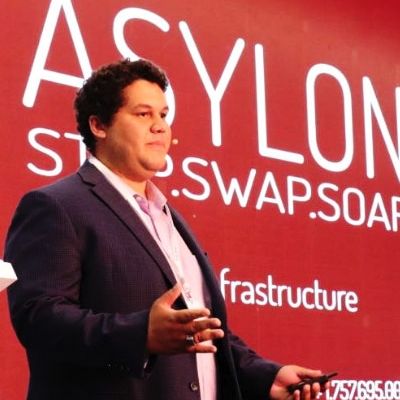
Damon Henry. Aerospace engineer by training, night-shift-abolisher by trade.
Founder / Robotics / Philadelphia
Damon Henry
He decided nobody should have to walk a fence line at 3am. So he built robots that would.
He decided nobody should have to walk a fence line at 3am. So he built robots that would.
Damon Henry runs Asylon Robotics, an American-made perimeter security company where the guards are drones, the patrol dogs are machines, and the humans sit in a command room called the RSOC watching it all happen at once.
Somewhere tonight, on a Fortune 500 loading dock or a Department of Defense installation, a four-legged robot is walking a fence line no person wants to walk. Overhead, a drone lifts off from a weatherproof base, flies a pre-set route, spots a heat signature, and flags it to a person hundreds of miles away. This is a normal Tuesday for Asylon Robotics, and it is exactly the world Damon Henry set out to build in 2015.
Henry is the CEO and co-founder. His pitch is not that robots are cool, though they are. His pitch is that perimeter security has been stuck for decades on a model of tired humans, golf carts, and blind spots, and that most of what a night guard does is repetitive, dull, and occasionally dangerous. Hand the repetition to machines. Keep the judgment with people. That division of labor is the whole company.
What makes it work is not the flying, and Henry figured that out early. Anyone can buy a drone. The hard, unglamorous part is the ground infrastructure: the docking, the charging, the mission planning, the software that ties an aerial camera to a robot dog to a human operator into one coherent system Asylon calls Guardian. Henry bet his company on the boring part. He was right.
The founding story has a familiar shape and one important twist. Henry and his two co-founders, Adam Mohamed and Brent McLaughlin, were dorm roommates at MIT. That is where the resemblance to the standard startup myth ends. Nobody dropped out. All three finished their degrees, became aerospace engineers, and went to work at serious places before they ever wrote a business plan.
Henry graduated from MIT in 2010 with a degree in aeronautical engineering. He spent the next several years in the trenches of big aerospace: management roles at GE Aviation overseeing thrust reversers and military aerospace structures, then Boeing, where he worked on small unmanned aerial vehicles for the military. He also spent time at the Johns Hopkins Applied Physics Laboratory. By the time he founded a drone company, he had already spent years around the actual hardware of flight.
The spark was 2015. Amazon had just announced drone delivery, and the whole industry lit up with visions of packages falling from the sky. Henry looked at the hype and drew a different conclusion. If drone technology was ever going to be truly useful at scale, the entire solution, not just the aircraft, needed to be automated. The flying was solved. Everything around the flying was not.
I went to an event last summer, a New York Tech Week event, and I happen to have met every investor that's in the round at that event.
Asylon does not sell a gadget. It sells a service. The model is Robotics-as-a-Service, priced in the range of $100,000 to $150,000 a year, which means a customer gets robots, software, monitoring, maintenance, and updates as one subscription rather than a box to figure out themselves. Here is what shows up on site.
Autonomous aerial patrol that launches from a weatherproof base, flies set routes, and streams thermal and optical video back to human operators.
A security-hardened Boston Dynamics Spot that walks perimeters, climbs stairs, sniffs for gas leaks, and never once asks to swap a shift.
The command-and-control software plus the Robotic Security Operations Center, a 24/7 human-in-the-loop room where people make the calls robots shouldn't.
Henry is candid about the early blind spot. As a team of engineers, Asylon underweighted sales and marketing at the start. Around year two he made what he calls one of the best decisions of the company's life: bringing in experienced sales and revenue leadership. It is a small admission with a big lesson underneath it, which is that a founder's job is to notice his own gaps and hire into them rather than pretend they don't exist.
He talks about culture the way people who've been surprised by it do. He describes his workforce as passionate engineers who treat the mission as more than a job, and he credits that shared investment for the company's ability to scale through hard moments. The flood was the stress test. The team passed.
There is a through-line in his thinking that goes all the way back to the aerospace years: hardware is a means, not an end. The drone, the robot dog, the base station, they exist to collect actionable intelligence and hand it to a person who can act on it. Asylon is, in the end, a software and services company that happens to own some very capable robots.
The fundraising story tells you something about temperament, too. Asylon's entire $26M Series B, led by Insight Partners with Veteran Ventures Capital, Allegion Ventures, and the GO PA Fund alongside, was assembled from investors Henry met at a single New York Tech Week event the summer before. He works rooms the way he works problems: systematically, and with a clear sense of the outcome he wants.
Robots by the year, not the box. Asylon's RaaS runs roughly $100K-$150K annually and bundles hardware, software, and 24/7 monitoring.
DroneDog is a modified Boston Dynamics Spot, kitted out to patrol, inspect, and detect for security work.
Before founding a robotics company, Henry managed thrust reversers and military aerospace structures at GE Aviation.
Every mission routes through the RSOC, a staffed command room. The robots watch; the people decide.
Asylon's own footage of DroneDog and the Guardian platform on patrol is the fastest way to understand what Henry actually built.