Doug Hapeman scored the winner in Upper St. Clair’s 2012 state soccer final. A year later, he scored in another championship victory. Before there was a company to build, there was a defender who could find his way onto the scoresheet when the occasion required it.
That is a useful place to begin a founder’s story. The usual opening involves a college, a clever idea and a laptop. Hapeman has those, too. But soccer supplies an earlier record of him doing something alongside other people, with a result that could be settled without a pitch deck. A goal is wonderfully resistant to executive interpretation.
Years later, at the University of California, Berkeley, he would meet Matt Milford in computer science classes. They would study together, develop a friendship and start Foresight Mental Health. Hapeman would leave university to pursue the company. His subsequent titles would include co-CEO and chief innovation officer, followed by another co-founder and CEO role at Mozyne Health.
The interesting thread is the distance between understanding a problem and organizing people to do something about it. His public career contains both: technical work and the less tidy business of getting that work adopted. The second required a change of direction.
A defender with an inconvenient habit of scoring
By his senior season in 2014, Hapeman was part of a defense that also included Garrett Blake and Hayden Bernhardt. Upper St. Clair’s midfield included Robbie Mertz and Adam Heil. These names matter because a school team is a collection of particular people, each with a job, rather than a convenient metaphor for a future chief executive.
In November 2014, the team’s record stood at 16-0-1. The draw had been a 5-5 game against Fleetwood. Even an otherwise successful defense occasionally has an afternoon that refuses to behave. The team was approaching the state tournament with an experienced group and the expectation that it could win again.
Another game gives a more precise view of Hapeman’s contribution. In the 2014 WPIAL playoffs against North Allegheny, Stefano Paolina sent in a cross. Hapeman headed it home with 7:29 remaining in regulation, putting Upper St. Clair ahead. It was a lead the Panthers kept.
A defender arriving to finish a cross is a small, concrete piece of a biography. There is timing involved, and a teammate supplying the ball. It would be too neat to pretend that this explains a later business decision. It does establish that his competitive life began well before anyone called him a founder.
Time remaining when Hapeman headed in Paolina’s cross against North Allegheny.
His soccer record continued beyond high school. Berkeley’s men’s club soccer team appears among his university activities. The sport accompanied the move west, even as coursework and a new partnership began to change what he would do with his time.
The classmate who became a co-founder
Hapeman’s Berkeley education ran from 2015 to 2017. He studied electrical engineering and computer science. His listed courses include algorithms, data structures, computer architecture, discrete mathematics and linear algebra. That is a curriculum built around making problems sufficiently precise to solve them.
There is also a course called the A. Richard Newton Lecture Series among the technical subjects. His educational record places entrepreneurship beside the engineering work. A transcript can show what someone studied; it cannot tell you which lecture stayed with him. The later decision to build a company gives those two strands a practical meeting point.
Foresight’s beginnings were shared. Hapeman and Milford first met in a computer science class in Berkeley’s College of Engineering. Long hours studying in the campus library gave way to conversations about problems beyond their assignments. The company grew out of that friendship and those conversations.
The library is a less theatrical setting for a business origin than a garage. It also offers fewer distractions from the actual beginning: two students spending enough time together to discover that they wanted to work on the same problem. A co-founder relationship has to survive more than agreement about an idea. It needs people willing to keep showing up as the idea changes.
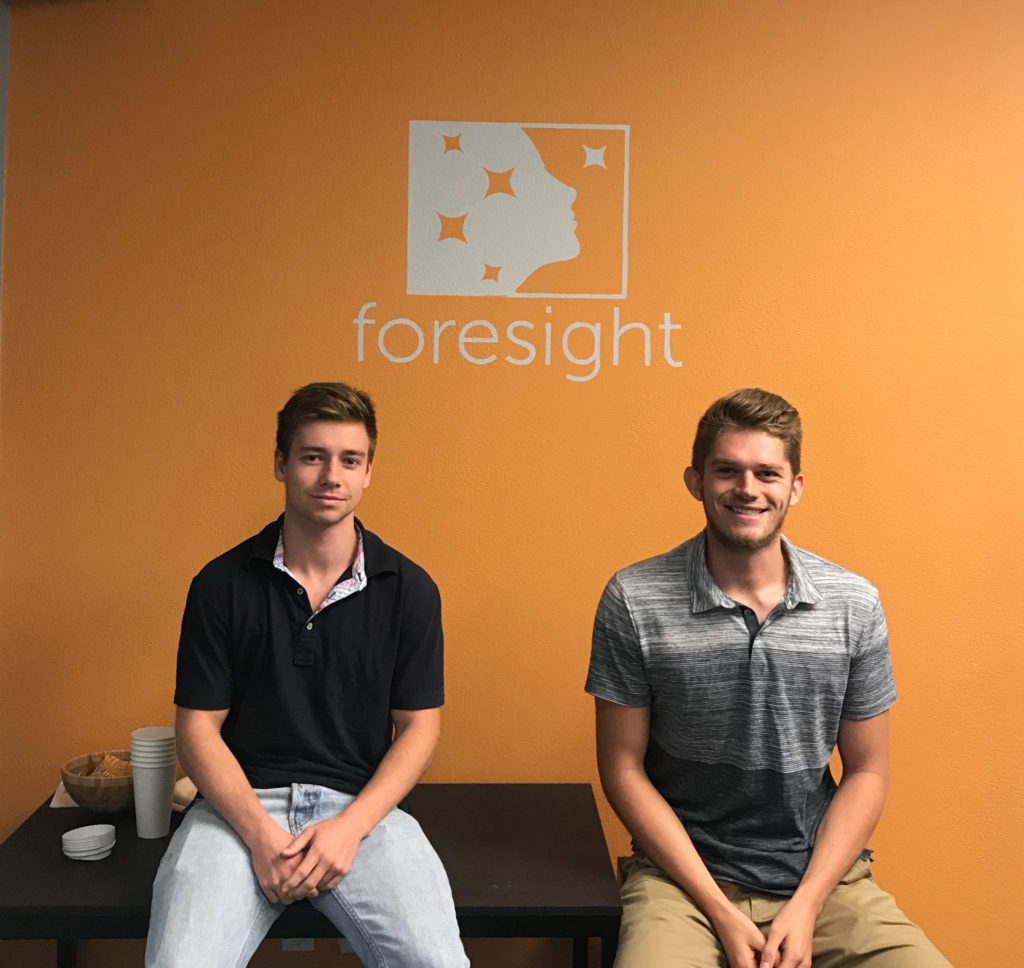
Hapeman left Berkeley to build Foresight. The university later described both founders as having dropped out. That departure belongs in the story without turning it into a rule for anyone else. A degree and a company demand different kinds of commitment, and leaving one for the other makes a choice visible. The choice still has to be followed by the work.
When the software met the sales meeting
In Hapeman’s account, the initial research began in fall 2016. Product development followed over the winter and spring. By summer 2017, the founders were working on it full time and trying to bring it to market. Their sequence was familiar: learn, build, demonstrate, sell.
The difficult part was adoption. Engineering backgrounds had helped them make the product, but a functioning product did not automatically become a functioning business. Workflows and incentives entered the picture. So did the habits of the people expected to use what they had built.
“In hindsight, I think we were focused a little bit too much on building the technology.”
Doug Hapeman · 2020 interview
It is a plain admission, and a more useful one than a polished claim that every detour was planned. There is a difference between knowing how to build a tool and understanding the circumstances in which another person will pick it up. The first can be demonstrated on a screen. The second tends to emerge in conversations that do not end with a sale.
In 2018, the founders changed the operating model, bringing the technology into an organization they ran themselves. The business acquired responsibilities beyond software. For Hapeman, the move made operations part of the engineering problem: the surrounding organization had to work, too.
- Fall 2016Research begins at Berkeley.
- Summer 2017Full-time product and market work.
- 2018A change in operating model.
A programmer’s interest in the people behind the data
An early programming project offers another angle on Hapeman’s technical interests. He developed a natural language processing algorithm to estimate a person’s presidential candidate preference from their Twitter account. He described the appeal as drawing conclusions from publicly available data.
The project also prompted him to think about companies’ data-mining practices, particularly in advertising. That observation is worth keeping beside the code. A technical exercise can teach someone how a method works while opening a question about who uses it, for what purpose and with whose information.
Hapeman’s early profile presents him as someone with a software background who wanted his work to have a lasting effect. The project makes that background concrete. Before the executive titles, he was writing an algorithm and thinking about the relationship between public information and the conclusions a company could draw from it.
Jordan Epstein, an early observer of the founders, described their “energy and curiosity” in a 2017 recommendation. He had watched them learn an industry, ship code and assemble support. The observation was about the pair. Their early reputation, like their company’s origin, was a shared one.
More than one job title
Mozyne’s current team biography identifies Hapeman as co-founder and CEO. It also records his progression at Foresight from co-CEO to chief innovation officer. Malaz Boustani is his fellow co-founder at Mozyne. The career now includes a second founding partnership and a different executive role.
Those titles describe different assignments. A CEO has responsibility for the organization as a whole. An innovation role places emphasis on what the organization might develop next. Moving between them broadens the biography beyond the single moment when a student decides to become an entrepreneur.
There is also a pleasingly ordinary detail in his company biography: Hapeman enjoys traveling and allows the Pittsburgh Steelers’ results to affect his mood more than he thinks they should. A professional page can be careful about nearly everything and still confess that a football team has retained unauthorized influence.
The next problem, and the next place
Hapeman now lists New York as his base, with frequent time in San Diego and Pittsburgh. Pittsburgh remains visible through sport; Berkeley remains part of his professional beginning. New York is where he says he is based today. Those places give his story a geography without requiring a tidy claim about where he belongs most.
His stated professional interests extend to assistive robotics, teaching robots useful skills, company formation, K-12 education and postgraduate retraining. These are interests, rather than a list of completed ventures. They point toward the kinds of problems he wants to spend time on next.
A robot learning a useful task and a person learning a new occupation are very different projects. Both make the question of practical use unavoidable. The value of learning becomes apparent when something can be done with it. That question has already appeared in Hapeman’s career, when software development ran into the work of adoption.
The soccer record supplies a satisfying final image: Paolina’s cross, Hapeman’s header, a lead that held. Business offers fewer clean endings. A company changes its model; a founder changes his assignment; another partnership begins. Hapeman’s story continues in those decisions, after the whiteboard has been filled and someone has to decide what to do next.
Follow the next chapter
Find Hapeman’s own updates and explore the conversations behind his career.