The spreadsheet has suffered a great injustice. It is asked to hold budgets, inventories and lists of people who have not replied. Its little rectangles sit beneath the fluorescent weather of office life. Then Frederick Kim and two collaborators at the University of California, Berkeley gave those rectangles a more interesting occupation: making pictures of ruined cities, scorched highways and whatever else a text-to-image model might dream up.
Their project was called DreamSheets. The name had the neat double meaning of a joke that does not insist on applause. It was a spreadsheet, certainly, but it was also a workbench for generative images. A prompt could sit in one cell, a random seed in another, and the result in the next. Drag a formula across a row and the machine produced variations. Change a phrase down a column and the whole visual field shifted. The user did not have to remember every detour because the detours remained on the sheet.
That mattered in 2023, when Kim completed his master's degree in electrical engineering and computer sciences at Berkeley. It matters more now. Generative systems are very good at producing an answer and rather less considerate about showing the route. Kim's research treated that route as part of the creative work.
Rows, columns, possibilities
DreamSheets began with a plain observation. Making an image with AI is rarely a one-prompt affair. People edit wording, change seeds, adjust guidance settings, compare outputs and return to an earlier idea that suddenly looks better in retrospect. A chat window can turn that process into a scroll of half-remembered attempts. A spreadsheet can lay the attempts beside one another.
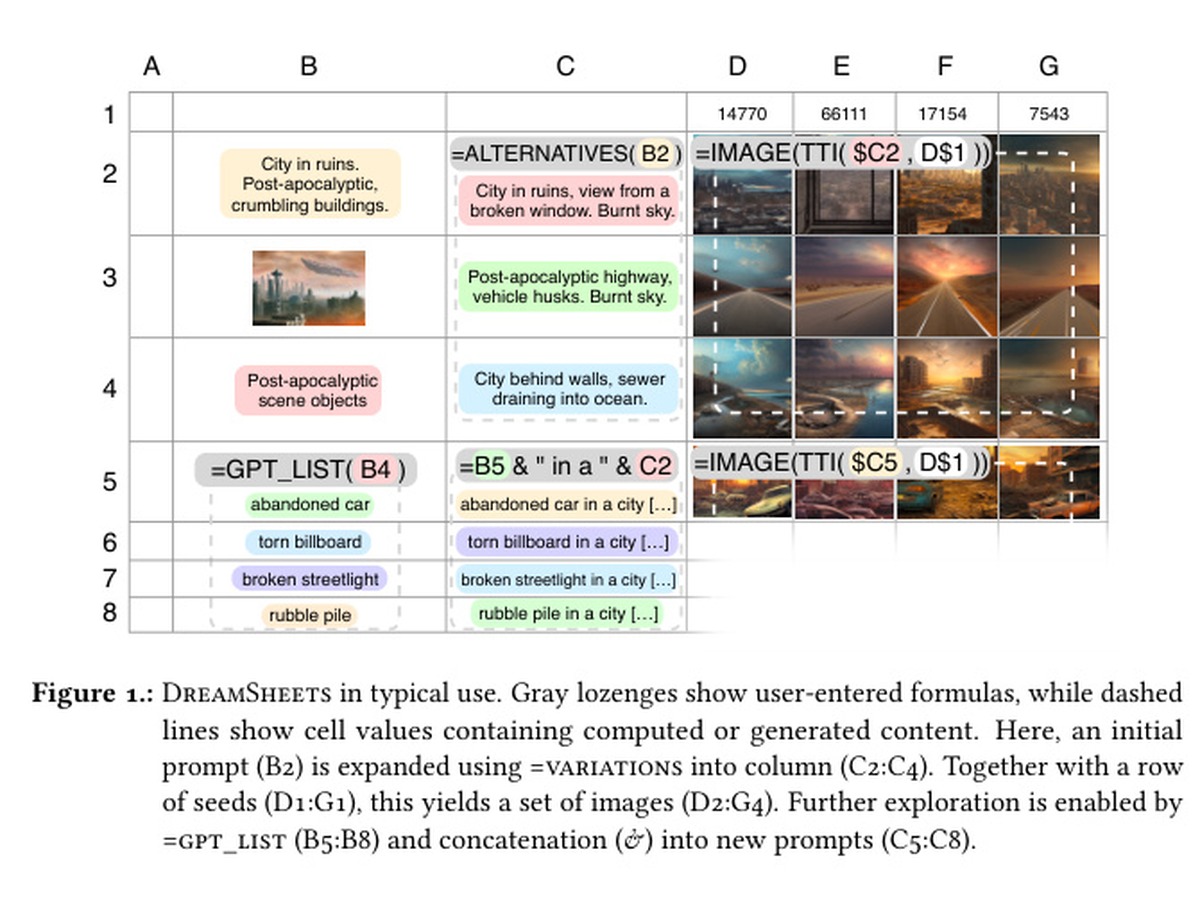
The prototype joined a large language model to a text-to-image system. Custom functions could suggest alternatives, embellish a sentence or generate a list of related words. The sheet then combined those words with prompts and sent the results to an image model. A user might place four random seeds along the top, three prompt variations down the side, and inspect twelve outcomes at once. In the jargon of visualization, these are small multiples. In ordinary life, it is the relief of seeing your options without opening twelve tabs.
There was a fine piece of restraint in the design. Because the model's output could change unpredictably, users were taught to copy a value rather than its formula when they wanted to keep it. The act froze the result. Surprise remained possible, but it no longer had the right to redecorate the room without permission.
The clever part was not making the model generate more. It was giving the user somewhere to think.On the design logic of DreamSheets
A spaceship refuses to appear
Kim's report did not polish away the awkward moments. The research team recruited twelve participants for a formative study and asked them to imagine directing a film. Starting with an image of a post-apocalyptic Seattle, each participant had to create three additional reference shots. Everyone managed to generate and select at least one image they considered reasonable. Eleven said they would use DreamSheets again.
Yet the sheet was not a fairy godmother. Several participants tried to summon a spaceship and failed. One settled for an image that was, in the participant's wonderfully dry assessment, missing the spaceship and entirely the wrong color. Another liked an unexpected result precisely because the model had ignored the brief. The tool exposed an enduring truth of generative software: the machine's misunderstanding may be a defect, a suggestion or both.
The spreadsheet brought its own manners and mischief. People comfortable with formulas could split a prompt into pieces, vary a verb here and an adjective there, then create a matrix of combinations. Less experienced users sometimes abandoned concatenation after a try or two and simply typed a new sentence. One participant admired the flexibility and disliked it at the same time. Freedom, after all, arrives without assembly instructions.
This honesty made the project more useful. DreamSheets did not prove that everybody wants to be a spreadsheet programmer. It showed that visible history, side-by-side comparison, copy, paste, undo and redo can make an opaque model easier to study. Those are not glamorous features. They are the furniture of thought.
They also changed the rhythm of prompting. Instead of asking for a masterpiece and waiting for judgment day, a user could make a modest hypothesis: perhaps this camera angle works, perhaps that artist's name changes the texture, perhaps a lower guidance value gives the composition room to breathe. Each result became evidence for the next move. The sheet made room for curiosity without requiring faith in the machine.
The engineer behind the interface
Kim's public biography is spare, but the work leaves a readable trail. His full name is Kyu Won Frederick Kim. He is bilingual in Korean and English and is based in the San Francisco Bay Area. Years before DreamSheets, he built Mathe, a small app meant to help elementary students improve mental arithmetic through quick, accurate practice. A later professional recommendation credits him with building most of the Ruby on Rails back end and internal tools for Blueprints, a project at Unloop.
At Berkeley, Kim worked in human-computer interaction, the discipline that notices when a technically impressive machine makes a person feel foolish. His advisers and collaborators included Björn Hartmann, J.D. Zamfirescu-Pereira and Shm Almeda. He also worked with researcher Jeremy Warner on visual style transfer for vector graphics.
That second project became VST: Interactive Flexible Style Transfer for Vector Graphics, presented at UIST 2023. Where DreamSheets organized the search through generated images, VST addressed a related problem: helping people transfer visual style while retaining interactive control. In both projects, the model does not receive the last word. It offers material; the interface lets a person inspect, adjust and decide.
VST's examples make the distinction concrete. A designer could take the arrangement of one vector graphic and borrow selected visual qualities from another. The software proposed correspondences between elements, but the designer could tune those matches, choose which objects to restyle and decide which attributes should change. The output kept the target's structure while taking on qualities of the source. Automation supplied speed; customization protected taste. That balance is difficult because style is subjective by definition. A system that transfers everything may be efficient and still feel wrong. VST treated disagreement with the machine not as an error state, but as a normal part of design.
The sequence suggests an engineer drawn to the seam between capability and comprehension. A math app needs to turn practice into feedback. A vector graphics tool needs to make a model's style operations steerable. A generative image system needs to preserve the evidence of what changed. The technical subjects differ, but the social bargain stays much the same: the software may be clever, yet the person should not have to guess what happened.
From campus prototype to AI infrastructure
Kim now works as a founding engineer at Handshake AI. Handshake introduced the service in 2025 to connect specialists with frontier AI labs for model evaluation, expert feedback and technical systems. It is a notable turn for a company known for linking students and employers. The career network is now also concerned with the labor inside AI: the human judgment required to test outputs, write difficult prompts and decide whether a model's answer is any good.
The scale is different from a twelve-person Berkeley study, but the connection is clear. DreamSheets asked how users could learn what an image model knew. Handshake AI is built around people applying expertise to what models know, miss and misunderstand. Both situations reject the fantasy of intelligence as a sealed box that improves by itself.
There is also a pleasing loop in Kim's route. Handshake began as software for students navigating opportunity. Kim's earlier projects sit close to learning: arithmetic practice, user interfaces, model literacy. Now he is building within an organization that places students, graduates and experts in the process of shaping AI systems. The spreadsheet has become infrastructure, metaphorically speaking. Human judgment still occupies the cells.
A model can produce the variation. A good interface helps a person acquire taste about the variation.The thread through Kim's research
It would be easy to make Kim's story about prophecy: the graduate student who anticipated the present. The more interesting reading is about temperament. DreamSheets was not dazzled by generation alone. It cared about comparison, memory and control. Its report recorded the failed spaceship, the cumbersome formula and the participant who preferred Photoshop. The prototype was permitted to be useful without pretending to be complete.
That is a sound instinct for an engineer working on AI. Models change quickly. Product fashion changes quicker. People remain stubbornly attached to understanding their own work. Give them a visible history. Let them compare. Allow them to keep the happy accident. And when the spaceship refuses to appear, make it obvious which box to open next.