Leonardo AI is for the person who has an image in mind and little patience for changing tabs. A game designer can sketch a prop, a marketer can turn a product cutout into a campaign scene, and a filmmaker can test a frame before sending it into motion. The platform now covers images, editing, video, upscaling, reusable workflows, 3D and an API. Its real pitch is continuity: the rough idea and the polished asset can live in the same workshop.
That makes Leonardo useful to two groups that usually get separate software. Beginners get presets, automatic model selection and Blueprints that hide the plumbing. More technical creators get seeds, reference images, custom model training, private generations and a catalog long enough to cause a small identity crisis. If you only want one handsome image from one prompt, simpler tools exist. If you expect to iterate, art-direct and reuse the result, Leonardo starts making sense.
A toolbox that began with goblin swords
Leonardo launched in Sydney in December 2022. Its founders had met in the games industry, and the first plan was specific: help studios create video-game assets. Users quickly pulled it into fashion, architecture, advertising and film concepting. That widening appetite shaped the product. Instead of remaining a generator with a prompt field, it became a production suite with several ways to steer, fix and export an idea.

The numbers moved quickly. Leonardo reported 19 million registered users and more than one billion generated images when Canva acquired it in July 2024. Forbes Australia put the count at 29 million in January 2025; by 2026 the company was describing a community of more than 40 million. Canva bought the business with an undisclosed mix of cash and stock. Leonardo kept its name, team and separate product, while its technology began feeding the larger Canva family.
The model buffet is the feature
Leonardo makes its own models, but it no longer asks them to carry the entire menu. Lucid Origin is the house generalist, trained for Full HD output, broad visual styles, prompt adherence and legible text. Lucid Realism leans toward cinematic frames that can move into video. Phoenix, released in 2024, was the company’s first foundation model and remains available.
Beside them sits a revolving guest list: OpenAI’s image models, Google’s Nano Banana family, Black Forest Labs’ FLUX, Ideogram, Seedream, Recraft and Krea for stills; Kling, Seedance, MiniMax, Veo, FLUX Video and other systems for motion. Models arrive and leave. Sora 2, for example, disappeared from Leonardo in July 2026 after a provider-side change. A subscription buys access to the counter, not a promise that every jar stays there forever.

| Job | Start here | Why | Watch for |
|---|---|---|---|
| Fast concept boards | Flow State + Lucid Origin | Many visual directions from one seed idea | Pick a lane before generating endlessly |
| Precise image edits | Omni Editor + Nano Banana or FLUX Kontext | Prompted changes with references | Small edits can still shift details |
| Cinematic keyframes | Lucid Realism | Built around mood, light and motion-ready frames | Test faces and continuity early |
| Short video | Kling, Veo or Seedance | Different strengths in audio, control and duration | Video can consume tokens quickly |
| Repeatable production | Blueprints + API | Packages several steps into one workflow | API billing is separate from web plans |
“Leonardo is a good platform, but I find the pricing too confusing.”Recent Trustpilot reviewer
The controls make it feel like work, in a good way
The most persuasive feature is Realtime Canvas. Draw a blunt pink flower on one side and the generated interpretation changes on the other as you add strokes. Guidance controls decide how obedient the output should be; a fixed seed helps preserve the basic result while you adjust it. This is closer to pushing material around than asking a slot machine for another pull.
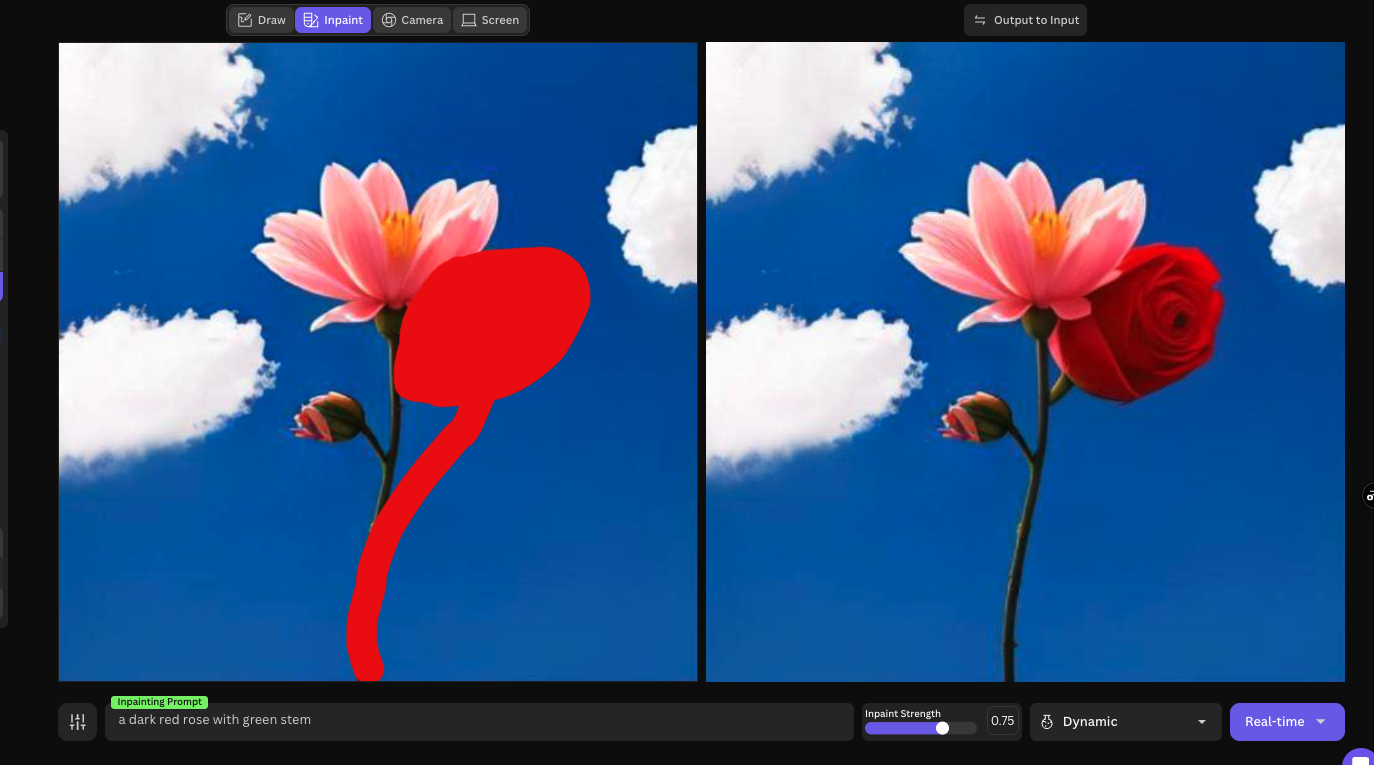
The newer Editor handles object removal, expansion and described changes. Flow State sprays out quick variations, useful when your problem is “I know it when I see it.” Blueprints tackle jobs with several hidden steps: furnish a room, relight a portrait, resize an asset, transfer a style, place a product in someone’s hand or turn a still into a rotating product video. They are the difference between owning ingredients and receiving a recipe card.
At the far end, Pro Upscaler enlarges images from 2x to 8x and claims output up to 105 megapixels. Its useful idea is not simply size. Leonardo says the pipeline is trained to recognize synthetic grain and AI artifacts that ordinary photo upscalers may sharpen into fresh weirdness. As with any generative enhancement, inspect text, fingers, product labels and tiny repeated patterns before approving print.
Tokens: where the fun meets accounting
The free plan is genuinely usable for learning. It grants 150 fast tokens each day, but creations are public and quality, guidance and collections are limited. Essential costs $12 per month with 8,500 monthly fast tokens and private work. Premium is $30 with 25,000 tokens and relaxed, unlimited image generation on selected models. Ultimate is $60 with 60,000 tokens and relaxed image and video generation on selected models. These were the monthly prices displayed in September 2026, before tax.
“Unlimited” needs its footnote. It means selected models running in a slower relaxed queue, and Leonardo may throttle that queue when demand is high. Frontier video models can cost thousands of tokens for a single result. This is why a plan that looks roomy for images can feel tight for motion. Team plans and API credit use different meters; API access is not bundled into the web subscription.
A token-saving workflow
Draft at small sizes with a cheaper or relaxed model. Lock the composition before adding references. Use Flow State for direction, not final delivery. Test a short motion clip before paying for longer duration or audio. Upscale only the keeper. Most wasted credit comes from purchasing finish before deciding what the picture is about.
What users praise, and what makes them sigh
Public reviews are unusually split by task. Image makers praise range, fast support and the ability to keep editing inside one app. Trustpilot showed a 4.6 rating across more than 1,400 reviews when checked, with recent reviewers frequently mentioning helpful billing support. On Reddit, longtime users often single out Realtime Canvas and the steady arrival of new tools.
The recurring complaints are more concrete than “bad AI.” Users struggle to translate tokens into a predictable number of video clips. Moderation can reject a prompt after work has gone into it. Interfaces move as the product changes. Older discussions describe weak support, while newer Trustpilot reports often praise named support agents. Both can be true in a fast-growing service, and neither guarantees your own result.
Buy it if
- You move between concepting, editing and delivery.
- You want several model vendors in one account.
- You need private generations or reusable workflows.
- You prefer visual control to prompt-only chat.
Skip it if
- You need a fixed monthly count of video minutes.
- You only generate a few simple images.
- You want a local, offline pipeline with no meter.
- You cannot tolerate model catalog changes.
Commercial work needs one privacy check
Leonardo allows commercial use, but visibility matters. On paid plans, private generations receive stronger ownership treatment under Leonardo’s terms. Public generations give Leonardo broad rights to use inputs and outputs, and the community can see the work. A brand prototype, unreleased character or client product should begin in private mode, not become private after it has already visited the feed. Copyright status for AI output also varies by country, so permission to use an asset is not the same as guaranteed copyright protection.
For developers, the Production API exposes models, upscaling, background removal and Blueprints through REST endpoints, with synchronous and asynchronous jobs plus webhooks. The August 2026 move of remove.bg’s API into Leonardo is revealing: a plain background-removal call can now lead directly to a new scene, a product clip or a reusable pipeline under the same account. That is the larger strategy in miniature.
The verdict
Leonardo AI earns its place when making one asset creates the next job. Generate a bottle, correct the label, place it on a beach, animate the camera and enlarge the final still without packing five separate accounts. The platform’s tactile tools keep it from feeling like a model directory with a prettier checkout page.
The tradeoff is attention. You must learn which models are temporary guests, which relaxed queues count as unlimited, and what a token means for the exact format you make. Treat the free tier as a laboratory. If your keeper rate rises and the editor saves real handoff time, Essential or Premium is easy to justify. If the meter makes every experiment feel expensive, use Leonardo for direction and finish elsewhere. The cart is convenient; you still have to read the shelf labels.