A product photograph can be beautiful and useless. The light is lovely. The background suggests a weekend somewhere expensive. Unfortunately, the bag has acquired a second handle. For a retailer, that tiny hallucination is the whole story. Generative AI can produce a picture in seconds; someone still has to decide whether it shows the thing being sold. Stability AI’s next business is taking shape in that gap.
- Downloadable models give builders room to customize.
- APIs and Brand Studio put those models to work.
- The hard part is control: the right product, brand and edit.
01The file that left the building
In August 2022, Stable Diffusion arrived as something people could download. That mattered. An image generator could live inside somebody else’s application, run on compatible local hardware, or become the starting point for a customized model. The public release specified 6.9 gigabytes of graphics memory. A technical footnote carried a commercial proposition: the machine making the pictures could be yours.
Stability AI, co-founded by Emad Mostaque and Cyrus Hodes, became associated with that freedom. Stable Diffusion emerged from a wider research collaboration; treating it as one company’s solitary invention misses the point. Developers and creators could extend the work. The company’s place in the market grew around access, adaptability and a community capable of building things it had never planned.
Today its catalog spans images, audio, video and 3D. Customers can use hosted services, cloud platforms or eligible downloadable models. Against alternatives such as Midjourney, Adobe Firefly and FLUX, the buying question becomes specific: which combination of output, control, deployment and commercial terms suits this job? A model’s availability is only the beginning of that answer.
02The invoice arrives
Access did not settle the economics. Stability announced $101 million in funding in October 2022. By April 2023, Semafor was reporting that revenue was struggling to offset computing costs and hiring. Popularity and a sustainable company were proceeding at different speeds. The expensive part of distributing a powerful model is that the research bill remains even after somebody downloads it.
Prem Akkaraju, formerly CEO of Weta Digital, became CEO in June 2024 alongside new investment. Then came a revealing admission. In July, Stability acknowledged that SD3 Medium had disappointed its community and that the commercial license had caused confusion. Its announcement used an unusually plain heading: “We fixed the License”. SD3.5 followed in October, after further development informed by feedback.

The current arrangement makes eligible Core Models free for commercial users below $1 million in total annual revenue. Larger commercial organizations need an enterprise license. That threshold concerns the organization’s revenue, including business unrelated to the model. Downloading weights also leaves hardware, electricity and maintenance on somebody’s desk. Hosted APIs move those chores to the supplier, with a meter attached.
For a simple budget exercise, 1,000 Stable Image Core generations at the posted rate cost $30. That buys attempts. If only half pass review, the generation charge per accepted image doubles before anyone counts editing or staff time. A useful pilot therefore measures acceptable assets delivered, with the same quality standard used for the existing process.
03One object, one change
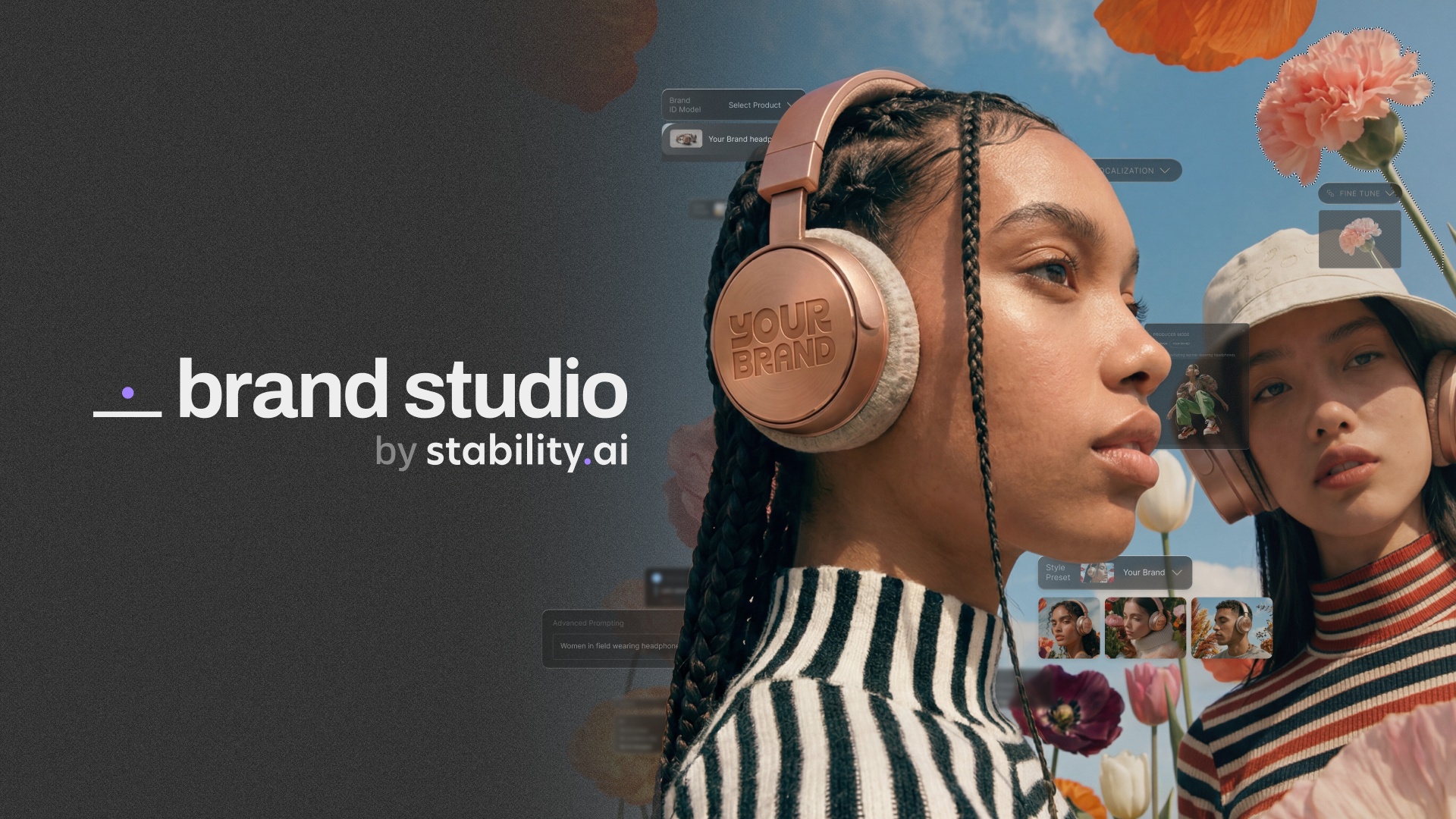
Brand Studio, announced in April 2026, goes directly at the troublesome handbag. Its tools include product insertion and precision inpainting, which target a particular part of an image. Enterprise teams can train Brand ID models around their visual identity and supply campaign references. The promise is practical: preserve what matters while changing what the brief requires. It sells a production environment around the model.
There is a concrete customer example. Mercado Libre worked with AWS partner Mutt Data on GenAds, using Stable Diffusion to make backgrounds for product advertisements. Claude helped construct prompts; quality controls checked the results. Stability’s published case study reports more than 90,000 ads across seven countries and a 25% higher click-through rate than traditional ads. Those are reported deployment results, rather than a forecast for every retailer.
Notice the division of labor. A model generates backgrounds. Other software assembles instructions and connects the advertising systems. Controls protect consistency. The useful product is the whole arrangement. HubSpot similarly places Stability’s image tools inside its existing content workflows through Amazon Bedrock, letting marketers request images without becoming infrastructure operators.
04The second take belongs in the session
The same logic now runs through music. Stable Audio 3.0, released in May 2026, includes downloadable models and a larger enterprise offering. Stability says the family was trained on fully licensed data. In August, it added a beta macOS plugin that brings generation into digital audio workstations, including Logic Pro and Ableton Live. Musicians can match a session’s tempo and keep multiple takes.
The team described its goal as “give you the tools to shape a sound, not just generate one”. That is a useful product specification. An almost-right result needs somewhere to go. Browser editing, audio variations and track controls give the user another move besides starting over.
An almost-right result needs somewhere to go.
The relationships around the company have changed too. EA’s partnership embeds Stability’s 3D researchers with artists and developers, with early work including rendering materials. Universal Music Group and Warner Music Group announced music-tool alliances in 2025. In August 2026, EA and those music companies joined Sony Music Group among investors in a $76 million Series B. Stability reported $232 million raised under Akkaraju’s leadership, a period beginning in June 2024.
The production credentials are part of the pitch. Filmmaker James Cameron sits on the board. Visual-effects veteran Robert Legato joined as chief pipeline architect in March 2025. Alongside Akkaraju’s Weta experience, those appointments give the enterprise strategy a recognizable accent: people who have worked inside complicated productions helping decide where the tools belong.
05Copy the constraint
For another business, the useful lesson is to choose a small, repeated problem with a visible standard. Start with a product background, a campaign variation or a sound effect. Specify what must survive unchanged. Count the review time alongside the generation cost. A cheap picture that needs lengthy repairs can become an expensive picture.
There are limits. Stability’s SD3.5 documentation explicitly acknowledges output variability and weaker results from vague prompts. Self-hosting needs suitable equipment and technical care. Commercial permissions depend on the particular license. A workflow demanding exact output without review may gain little. The persuasive test is wonderfully ordinary: can the team get the next usable version with less work? That is the second draft Stability AI wants to own.