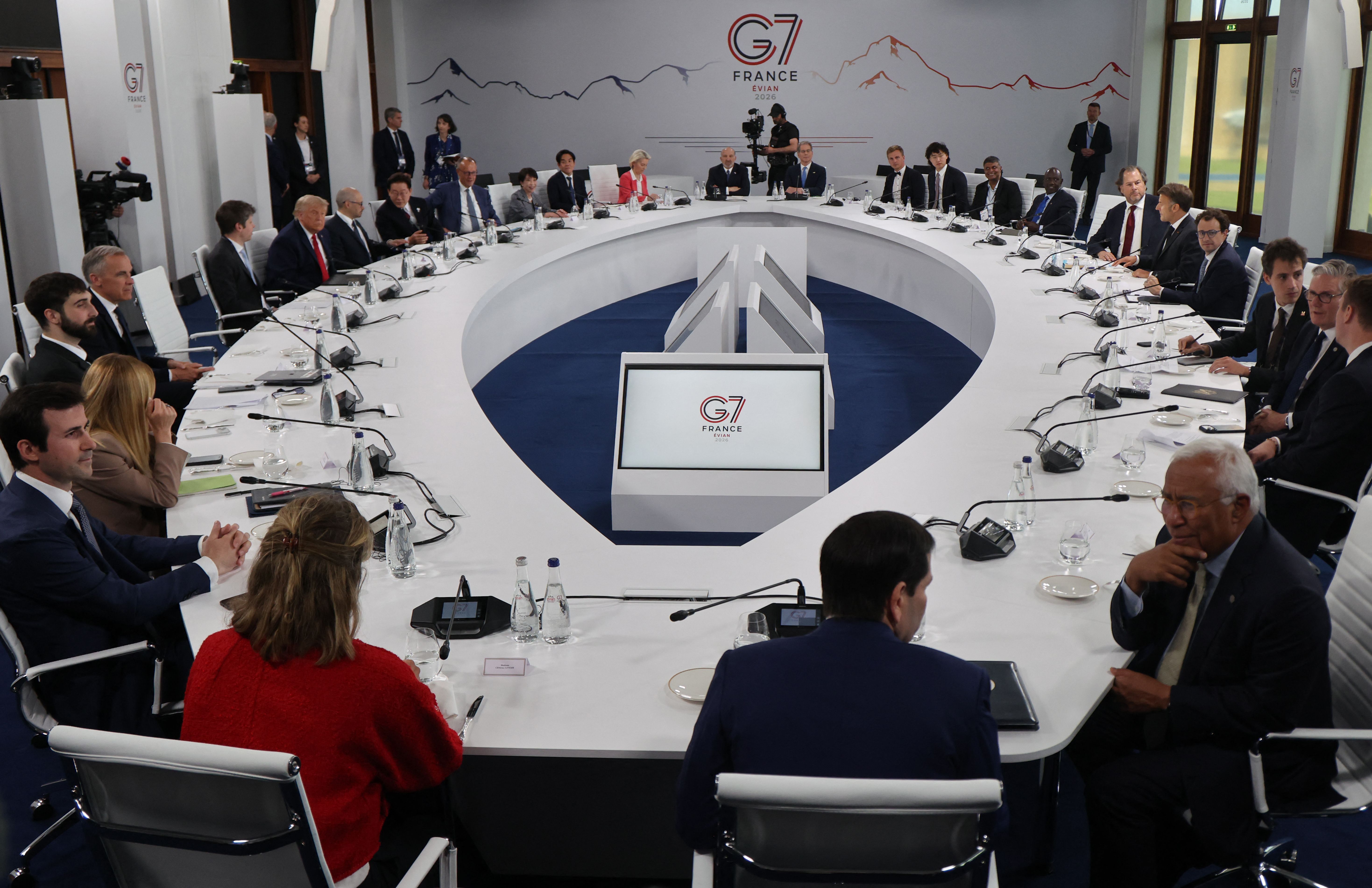
At a G7 meeting in France in June 2026, Robin Rombach faced a table of presidents, prime ministers and senior officials. He began with a modest observation: “I think I represent the youngest company in this room.” Black Forest Labs was barely two years old. The person speaking for it had already spent much longer thinking about how a computer might make a picture.
The room was far from Freiburg, the German city where he was born and where his company is based. Around that table, Rombach described an AI lab operating on both sides of the Atlantic and argued that visual models could become part of the world's economic infrastructure. It is a striking destination for a research question that started with pixels, computing costs and the stubborn difficulty of making images well.
Rombach's route has an unusual loop in it. He left home to study physics in Heidelberg. He followed a computer vision research group to Munich, helped create the technology behind a boom in AI images, spent two years leading research at Stability AI, and returned to Freiburg to start a company with people he already knew. The Black Forest in its name is geography, not decoration.
A picture is an expensive place to work
At Heidelberg University, where he studied physics from 2013 to 2020, Rombach became interested in a problem with a beautifully awkward shape: how could a model generate images without spending so much computation on every pixel? When Björn Ommer's computer vision group moved from Heidelberg to LMU Munich, Rombach's doctoral work went with it. The question followed too.
Images contain a great deal of information, but much of it is redundant. A generator that labors directly over the full pixel grid pays for every detail, even when the structure of a scene could be handled more economically. Rombach and his collaborators worked in a compressed representation, called latent space, and decoded the result back into an image. The idea demanded a careful balance: compress too much and the picture loses useful detail; compress too little and the computational savings disappear.
Their 2022 paper, High-Resolution Image Synthesis with Latent Diffusion Models, set out that tradeoff. Rombach was its lead author, alongside Andreas Blattmann, Dominik Lorenz, Patrick Esser and Ommer. The work also used cross-attention to steer the generation with inputs such as text. In plainer language, the team found a way to make high-quality pictures with less work and more control. It offered a practical route for systems that would soon reach people well beyond computer vision laboratories.
Stable Diffusion grew out of that research and the team's subsequent work. Rombach helped develop it, and its public release brought image generation into a much wider community of artists, developers and hobbyists. His GitHub profile still points to repositories for latent diffusion and Stable Diffusion. The code tells a compact version of the story: academic ideas made inspectable, then handled by people who had never met the researchers.
The team that kept moving
Rombach became research director at Stability AI, the London company associated with Stable Diffusion. The period was brief in calendar terms, about two years, but it put him and several collaborators near the center of a new market. They had seen a research model become a public tool. They had also seen the tension that follows: people want open access, and increasingly capable models need costly training, distribution and careful release decisions.
In March 2024, he founded Black Forest Labs with former colleagues, including Blattmann. Patrick Esser, another author on the latent diffusion paper, is also among its founders. The enterprise began in Freiburg, where Rombach's roots gave the company a literal home address. There is a San Francisco office as well. He has spoken about combining European research culture with American experience in building and scaling products. He has even brought investors to Freiburg to show them the local research environment rather than asking the place to disappear from the pitch.
A small scene from a 2025 Swiss startup conference captures the contrast. Rombach, dressed mostly in dark clothes with an orange rucksack, drew a crowd eager to speak to him. It is the sort of attention usually lavished on a product launch. In his case, much of the interest came from a long chain of papers, code repositories and colleagues who had worked together before the company had a name.
The first FLUX models appeared in August 2024. The names were plain enough to read as a product family: a professional version, a developer version with accessible weights, and a faster version called schnell, German for fast. That last word is a small wink from a company whose global ambition has never required pretending to be from California.
The business of leaving a door open
Rombach and his co-founders have kept openness in their public case for Black Forest Labs. The company offers some models with downloadable weights and sells managed access and commercial services around others. This is an arrangement shaped by the price of frontier research: sharing a model can invite independent work and scrutiny, while revenue pays for the next training run and the people behind it. The exact balance changes with each release.
The releases also reveal how the team's questions have grown. FLUX.1 made and edited images. FLUX.1 Kontext brought text-guided editing and generation together. FLUX.2, released in November 2025, added support for multiple reference images and more demanding production tasks such as typography and consistent visual identity. A model that once answered “make a picture of this” was being asked to preserve the right character, product, logo or layout while changing the scene around it.
That sounds like a modest refinement until a working designer tries to use it. A beautiful one-off picture may be enough for a demonstration. A campaign needs the same product to remain recognizably the same product in every frame. The difference is the distance between an interesting sample and a tool someone can rely on Tuesday afternoon.
Open technology is vital for transparency, competition, and strategic independence in AI.Robin Rombach, G7 remarks, June 2026
At the G7, Rombach brought that product argument into public policy. If visual AI becomes a layer of economic infrastructure, he reasoned, businesses should have room to build their own systems rather than depend entirely on a few providers. He also acknowledged that releasing powerful models brings responsibilities and called for technical safeguards, evaluation and targeted rules. The point was practical: access is valuable only if a wider community can use it with confidence.
A forest, a bay, and a wider canvas
The company's map now joins Freiburg to San Francisco, but its technical map has spread farther. In July 2026 Black Forest Labs introduced FLUX 3, a model family designed to learn across image, video and audio. The underlying idea is easy to picture. A still image shows where things are. Video shows how they move. Sound offers another clue about what has happened. Taken together, these signals can help a model form a more useful account of a scene.
By September, the company had announced FLUX 3 Action, an open-weight model directed at robot control. Company benchmarks are an early measure, and the practical reach of the work will be decided in real settings. Still, the direction is clear. Rombach's first widely known research asked how to make an image efficiently. His current company is asking how a model might perceive and predict a changing world, then help act within it.
There is a pleasing continuity in the people as well as the ideas. The co-authors and colleagues who helped turn a technical paper into a widely used image model later became partners in a company. The medium changed from academic publication to commercial release, but the habit of making research available remained visible. Rombach's public appearances are comparatively rare, which makes his G7 remarks a useful window into what he thinks the work is for.
In a September 2026 interview, he urged Europe to approach AI with more optimism about what it could build. He has made a related argument for Freiburg itself: a frontier company can grow outside the familiar centers, even while drawing on global capital and customers. That belief is being tested every day by hiring, training costs, commercial deadlines and the pace of other labs. It is easier to admire a postcard of the Black Forest than to run an AI company beside it.
Yet the setting matters. Rombach's story began there, took him through Heidelberg and Munich, crossed through London, and came back to a city near the edge of the forest. At the G7 he spoke for a 90-person lab. The size was small compared with many names around the table; the question he brought was large. Who will be allowed to understand, adapt and build the visual systems that may shape the next generation of tools? His career has been one long attempt to make that question concrete.
Follow the work