A spark icon, a five-second wait, and a meeting that doesn't end in a sigh
It is a Tuesday at 9:47 a.m. Somewhere, a product manager pastes three paragraphs of strategy into a blank browser tab. A small spark icon appears at the edge of the page. She clicks. Five seconds later, the strategy is a diagram - boxes, arrows, the right amount of color, the wrong amount of fuss missing. She drags it into Notion. Standup starts at ten.
This is the small, unspectacular miracle Napkin AI sells. Not the kind that wins keynote slots or trends on X for an afternoon. The kind that quietly replaces the worst hour of someone's workday - the hour spent wrestling SmartArt menus, Googling "flowchart maker," or asking the design team for "just a quick visual" by end of day.
The Los Altos startup, founded in 2022 by a pair of ex-Google engineers, builds one thing: a tool that turns text into editable visuals. Diagrams, flowcharts, mind maps, infographics, timelines, comparison charts. You select a sentence. Napkin makes a picture of it. You edit, restyle, export. Move on.
What makes it interesting is not the output. Other tools make diagrams. What makes it interesting is the architecture behind the spark icon: an orchestrator LLM running what the team calls an "agency of agents" - a copywriter, a designer, an illustrator, a brand stylist - each handling its piece of the visual the way a small studio might.
By August 2025, one year after open beta, five million people had signed up. Most of them found it by accident. Most of them have, at some point this week, clicked the spark icon and breathed out.
Two engineers, one second act
Pramod Sharma and Jerome Scholler met at Google more than a decade ago. In 2013 they left to build Osmo, the AR learning platform that turned an iPad and a stack of cardboard tangrams into a generation of kids' favorite afternoon. Byju's acquired Osmo for $120M in 2019. The two stayed in education. Then they got curious about adults.
Pramod Sharma
Engineer-turned-founder. Built Osmo's computer-vision platform for children before turning the same playful design lens on consultants, marketers and execs. Lives in Los Altos.
Jerome Scholler
Previously at Google, Ubisoft and LucasArts. MSc from ENSEEIHT. Runs Napkin's engineering org from Montpellier, France - the European leg of a quietly distributed team.
What it does, without the marketing
Text in
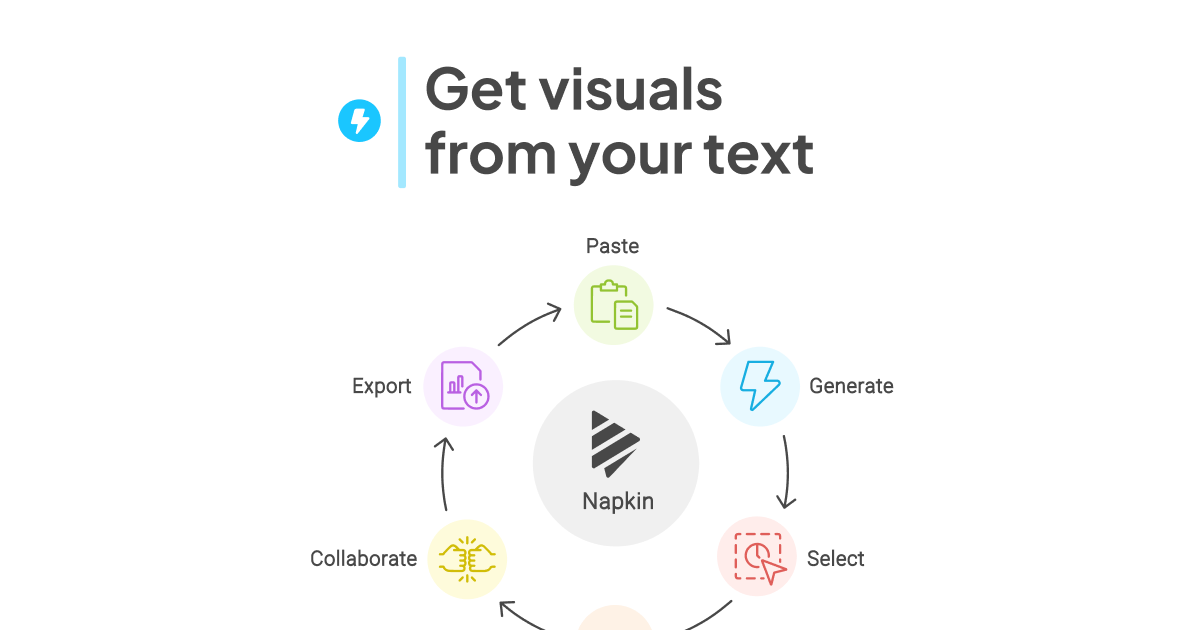
Paste a paragraph - a brief, a plan, a memo, a Substack draft. A small spark icon appears next to it.
Agents work
An orchestrator LLM hands the job to specialists: a copywriter, a designer, an illustrator, a brand stylist. They collaborate.
Five seconds later
You get multiple visual options. Diagrams, flowcharts, mind maps, timelines, Venn diagrams, data charts. All editable.
Drop anywhere
PNG, PDF, SVG, PPT, or a shareable URL. Lands in Google Docs, Slides, Notion, Confluence, Canva, Word, PowerPoint.
The shipping pace, in bars
// IMPROVEMENTS SHIPPED, JANUARY 2025
Three pivots before the spark
Napkin did not arrive fully formed. It arrived after the founders tried two other ideas and threw them away.
Version one was an AI mouse-sketcher - you'd start drawing, the model would finish. It worked. Nobody wanted it. Drawing, it turns out, is the part most people are happy to skip entirely.
Version two was a framework library. Pick a template - 2x2 matrix, funnel, Venn - then fill it in. Closer. Still asked too much of the user. The friction was not the drawing. The friction was the deciding.
Version three is the one in market. The user does what they already do: writes. Napkin handles the rest. The lesson was almost embarrassingly simple. Don't ask people to think differently. Ask them to do less.
It is the kind of insight that looks obvious in hindsight and isn't. Most generative-AI products still ask users to learn a new ritual - a prompt syntax, a sidebar, a menu of "modes." Napkin is the rare one that meets the user inside the workflow they already had.
Two years, six shipments
A clean seed round, two repeat investors
Accel partner Rich Wong led the round - he was also one of the earliest investors in Osmo. A second bet on the same founders, by the same partner, on a totally different product. Reported ARR sat around $1.7M as the team transitioned from open beta toward paid plans in 2025.
A crowded category, a different angle
Gamma is the nearest neighbor. Canva's Magic Design is the giant down the street. Beautiful.ai, Piktochart, Venngage, Miro and a long tail of presentation tools all live in adjacent zip codes. Napkin's bet is that its sweet spot is narrower and stickier: not the deck, not the doc, but the visual itself - generated from the words the user already wrote, dropped wherever those words live.
Demos & interviews
9:47 a.m., one year later
Same Tuesday morning, different product manager. She is not the one from the opening scene. She is one of the five million who arrived in the year since.
She doesn't think of Napkin as a tool. She thinks of it as a step - the step between writing the thing and shipping the thing. The spark icon is muscle memory now. So is the small huff of relief that follows it.
Multiply that small moment by five million accounts and a workweek. That is the company Sharma and Scholler are quietly building. Not a slide app. Not a design platform. A small subtraction from the daily friction of being a person who has to communicate ideas for a living.
Standup starts at ten. The diagram is already in the doc. Nobody notices, which is the whole point.