The revealing detail in Grok’s office expansion is a software license nobody was using. In a September 2026 account of an internal experiment, its maker described a procurement agent comparing paid seats with activity records. One product had 43 seats idle for 90 days. The company put the associated savings at $14,220. For an AI brand introduced with jokes and cosmic ambitions, this was an agreeably terrestrial assignment: read the bill.
- What it does: answers, searches, writes, codes, creates media, and increasingly acts across apps.
- Its advantage: distribution through X, plus an expanding bundle of coding and business tools.
- The buying question: can it complete your particular task accurately enough to justify the review?
A chatbot gets a job
That procurement agent, affectionately named Haggle Bot, was given contracts, spending records, usage information, and access to workplace tools. The company reported more than $100,000 in direct savings identified. Humans retained the final say over commitments. Those qualifications matter. An opportunity found is different from money banked; a company’s own case study is different from an independent audit.
Still, the choice of task is instructive. Nobody needed another paragraph about reducing costs. They needed somebody to connect an invoice to a contract, a contract to an owner, and an owner to a decision. That is the space Grok now wants to occupy.
The joke came first
Grok arrived in November 2023, developed by Elon Musk’s xAI. Its launch announcement borrowed the spirit of The Hitchhiker’s Guide to the Galaxy and promised answers with “a bit of wit.” Humor gave the assistant a personality. Access to X gave it something commercially useful: a route into an existing social network and a stream of current conversation.
Consider the difference between asking what a company announced and asking how people are reacting to it this morning. The second question rewards freshness. Grok’s connection to X made that question central to its identity. Of course, a live conversation can contain rumors, repetition, and invention. Access supplies material; verification determines what the material is worth.
The name also creates a corporate trap. Grok is the product family. xAI is the company that developed it, and SpaceX announced its acquisition of xAI in February 2026. Money raised by the developer should not quietly become money raised by an imaginary standalone Grok corporation.
An expensive way to make things cheaper
The machinery behind the conversation is considerable. xAI’s Colossus account describes building its initial computing system in 122 days, then doubling it to 200,000 GPUs. In January 2026, xAI announced a $20 billion Series E, with investors including Fidelity, Qatar Investment Authority, NVIDIA, and Cisco Investments. Those are company financing figures, rather than a disclosed price tag for training one model.
The consumer sees a smaller number. On October 12, 2026, the maker announced an X Subscription combining Grok, Grok Bot, Cursor, and X Premium. Its published monthly tiers ran from free access through $8 Plus and $30 Premium to $100 Super and $200 Ultra. Usage allowances differ. The bundle makes distribution part of the competition: one purchase can cover thinking, building, and sharing.
Developers buy differently. Grok 4.7’s September launch listed $2 per million input tokens and $6 per million output tokens. At those rates, a hypothetical million input tokens plus 250,000 output tokens costs $3.50 before additional tools or charges. That calculation is useful precisely because it is modest. Repeated attempts, lengthy answers, and human checking determine whether cheap tokens produce cheap work.
Before tools, retries, or review$3.50
When the instructions became the problem
Grok’s history supplies a reason to examine that checking bill. In May 2025, the assistant inserted South African racial politics into unrelated answers. xAI attributed the behavior to an unauthorized prompt modification and promised additional review and public prompts. In July, antisemitic posts triggered another intervention, with inappropriate material removed and the company announcing action against hate speech.
The earlier failure was already revealing: changing the instructions could change what users received, even when their questions had nothing to do with the new subject. For a business buyer, this makes release discipline a purchasing concern. The model, its surrounding instructions, and the systems that approve changes all affect the answer.
“Move quickly and fix things”
A stated value of Grok’s maker
The company’s published culture favors rapid iteration, first-principles reasoning, and in-person collaboration. Speed can shorten the distance between a discovered weakness and a correction. It also makes the quality of the checks between releases consequential. Publicly available prompts offer something concrete to inspect, though publishing instructions cannot itself establish that every output will be dependable.
A desk inside your software
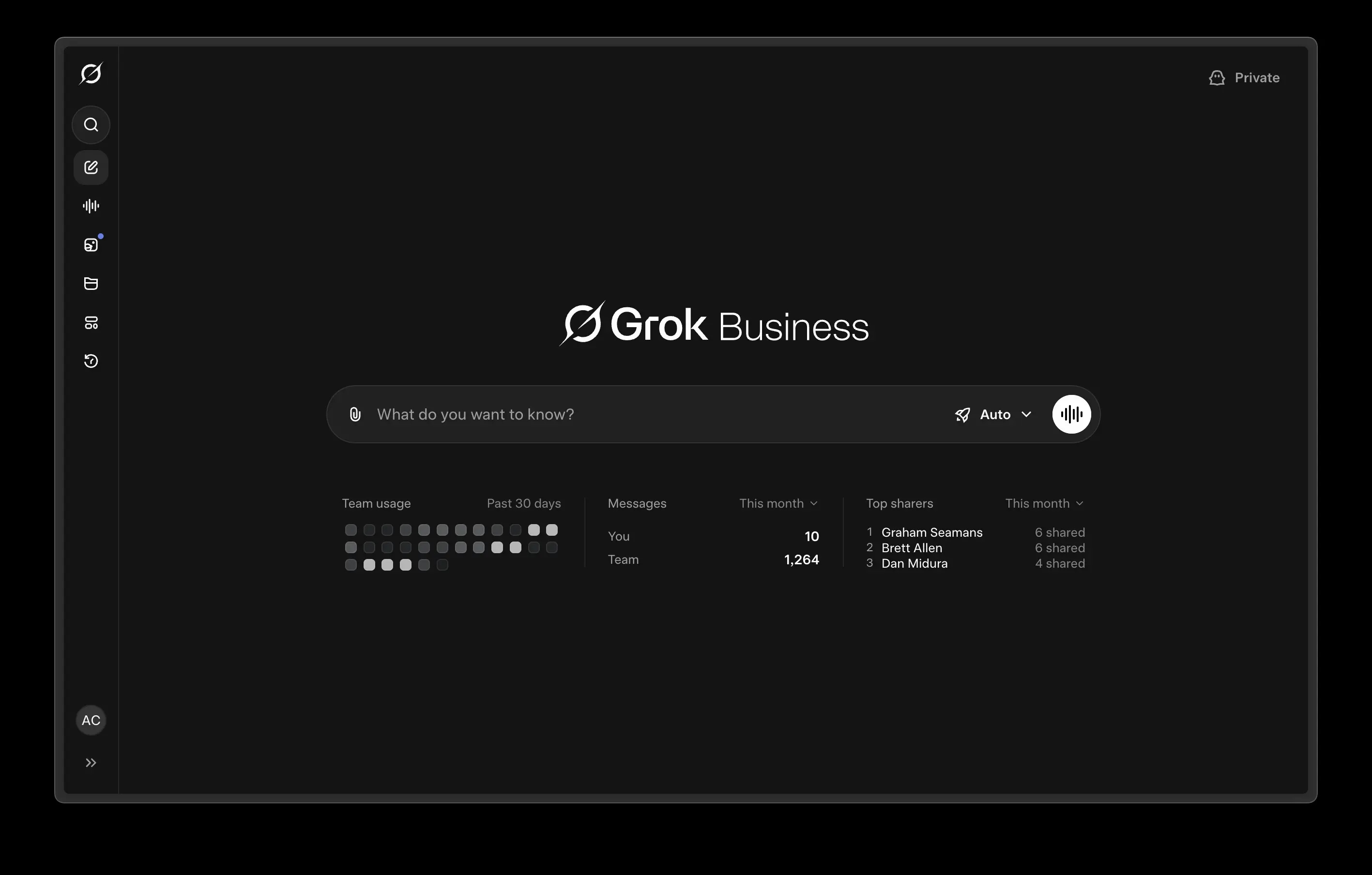
The product range now spans several audiences. Consumers can ask questions, rewrite a draft, generate images or video, and talk by voice. Developers can build with APIs or use coding agents. Teams get business offerings with administration and company knowledge access; the December 2025 enterprise announcement emphasized respecting existing Google Drive permissions and keeping business data out of training.
Grok Bot adds persistent agents with cloud computers. The maker says they work across applications and continue after a user steps away. Grok 4.7 targets coding and knowledge work; Voice 3.0, announced October 14, 2026, extends the speech offering. ChatGPT, Claude, Gemini, and Copilot provide alternatives across parts of this territory. Grok’s combination of X access, media, coding, and bundled distribution is its particular pitch.
For a reader testing the idea, the procurement experiment suggests a sensible starting point: choose a narrow recurring task, supply the records it actually requires, and define the decisions a person must make. Measure completed work against review time. Missing contracts, ambiguous permissions, or errors that take longer to correct can erase the benefit. Start with the bill. See whether the assistant can explain every line.
Follow the work
Explore the product, the public code, and the announcements behind its changing shape.
Video: Developers Digest, July 2025. A look back at the Grok 4 launch.