A mango has a short biography. It grows, it travels, somebody eats it. For Do Van Long, the interesting part was everything the buyer could not see: who grew it, how it was handled, and whether the name on the label belonged to the fruit beneath it. Those questions gave a technology usually discussed in the language of digital money a rather more fragrant assignment.
In 2018, the My Xuong cooperative in Dong Thap was dealing with imitation products carrying forged Cat Chu labels. Its response included a pilot with Infinity Blockchain Labs that traced a batch of 500 mangoes. Long, then a strategy director at IBL, explained how a QR stamp could connect a physical fruit to records of its movement. The label was small. The argument attached to it was considerably larger.
He also supplied the caveat that makes this episode worth remembering. Farmers were entering information manually, so mistakes could enter the system. “So the transparency of initial data is entirely dependent on farmers,” he said. A durable record could preserve an error as faithfully as a fact. He distinguished tracing origins from preventing counterfeiting, giving the project a boundary as well as a purpose.
That early explanation offers a useful way into his career. Long works on the records that sit behind transactions: the credentials, histories and identifiers that help strangers decide whether to deal with one another. The mango was an unusually approachable exhibit. You could hold the business problem in your hand, although doing so would make a conference presentation slightly sticky.
A record is only as useful as the information that enters it.
The question behind traceability
Before the QR code, the enterprise plumbing
Long arrived at blockchain with a background in the less photogenic parts of business software. His work has covered enterprise resource planning, customer relationship management, supply-chain management and business intelligence. These systems concern the everyday coordination of a company: what it owns, what it sells, whom it serves and where things are supposed to go. A misplaced record can make an otherwise ordinary working day surprisingly expensive.
His career has included technology and executive responsibilities across travel, hospitality, e-commerce and finance. At Infinity Blockchain Labs he moved through fintech director and president office director roles before becoming regional chief strategy officer. By the 2019 Future of Finance Vietnam event, his brief included business development, strategy, community education and relationships with universities and prospective partners. Explaining the technology was part of the job, alongside finding something useful for it to do.
At the Vietnam Blockchain Summit in Hanoi on June 8, 2018, he shared an opening session with Nguyen Thanh Hung, president of the Vietnam E-commerce Association. Their discussion addressed what blockchain was, how it might be used and how policy fitted around it. Government, academic and business participants were in the same conversation. Long was working at the junction where a technical proposition has to become intelligible to institutions.
The same year, he presented Fruitchain at Vietnam ICT Outlook in Ho Chi Minh City. The agricultural example gave audiences a route into product histories and shared records without requiring them to begin with a token price. It also connected his older enterprise interests to his newer blockchain work. Supply chains already had the problem; the technology offered another way to organize the evidence.
- 01GrowerRecord the activity
- 02CooperativeIdentify the batch
- 03DistributorRecord the handover
- 04BuyerRetrieve the history
A conceptual view of traceability. Every handover needs an entry.
Agriculture earns a credential
The name Agridential combines agriculture and credential. It is a neat bit of naming for a project concerned with giving Vietnamese produce an identity that survives a journey through several organizations. The solution follows GS1 standards and uses QR identification to make information available along the chain from production to consumption. Growers, cooperatives and distributors each have a part in the record.
In a 2019 interview, Long pointed to an export milestone: “In April 2019, the first eight tons of Vietnamese mangoes were successfully exported to the American market.” His discussion of My Xuong put traceability alongside the work of meeting production and export requirements. A digital stamp cannot do the growing, packing or shipping. It can help the information about those activities accompany the goods.
By December 2021, Long was describing a business with revenue dating from 2020, with Agridential providing its main revenue stream. At an ICT Investor Bootcamp organized through VINASA and its partners, he discussed the application of blockchain to agriculture and the broader possibilities for enterprise use. The company had also introduced VBChain as a platform for businesses.
That sequence matters because it moves the story beyond a demonstration. A pilot asks whether something can work. Revenue asks whether somebody considers the work worth paying for. Long’s account placed customers and partners who understood the application at the center of that transition. For a founder selling an unfamiliar technology, comprehension is a practical part of the sales process. A clever system still needs a buyer who recognizes the problem.
2018My Xuong mango-tracking pilot
2019Agridential and export traceability
2020Revenue begins, per Long’s 2021 account
A company built around more than one discipline
Vietnam Blockchain Corporation’s team brings Long into contact with engineers, researchers and business colleagues. Its public leadership roster includes Kisho Onishi, To Tan Dung and investment director Ryo Sumihara. Its advisory group includes Huynh Tuong Nguyen and Tran Van Hoai, alongside other academics. This is a useful context for his work: building enterprise systems involves decisions about software, operations and the organizations that will use them.
The academic connection is also personal. Long holds a bachelor’s degree in computer science from Ho Chi Minh City University of Technology and a doctorate in business administration from the Swiss School of Business and Management. He studied for an MBA at Columbia Southern University, whose alumni magazine identifies him as a 2020 graduate. Computer science and business administration make a fitting educational pairing for work that must function in code and make sense in a budget.
Columbia Southern’s alumni account also records his inclusion among the top ten individuals and organizations supporting startups at I-Star 2022. The recognition concerned contributions to digital transformation for Vietnamese enterprises. It places a second strand beside product development: helping other businesses make use of technology. The founder’s work includes explaining and connecting, as well as directing a company.
Mangoes, baggage and a water network
Long’s interests extend beyond the farm. A 2021 paper with co-authors explored blockchain’s potential in aviation supply chains, including luggage, cargo and parts tracking, identity management and smart contracts. These were applications under discussion, rather than a claim that Long had deployed all of them. They show how the same record-keeping questions can travel from an orchard to an airport.
A suitcase is an effective reminder of the stakes. Its owner wants a fairly modest outcome: the bag should arrive where the person arrives. Behind that wish are handovers between organizations, changes of custody and records that need to agree. The aviation paper examined how technologies including RFID and blockchain might improve visibility across those handovers. The subject fitted Long’s previous experience in travel and enterprise systems.
In 2024, he took part in the Central and Central Highlands Water Supply Association’s conference and congress. Vietnam Blockchain Corporation worked with N.T.P on a presentation about digital technology for managing smart equipment in the water industry. The discussion covered monitoring equipment and distribution networks, management efficiency and customer service. Pipes are unlikely to become a glamorous keynote prop, but they give technology a demanding operational setting.
He also presented Agridential at Blockchain Festival Singapore 2024 in a session on enterprise growth and innovation. Taken together, these appearances show the range of rooms his work enters: an industry conference concerned with physical infrastructure, and a blockchain event concerned with enterprise adoption. In each, the application needs to be explained in the vocabulary of the people expected to use it.
The next handover crosses an ocean
Long’s current public profile places him in Sydney. Alongside Vietnam Blockchain Corporation, he leads AusChain Pty Ltd. The Australia Vietnam Policy Institute’s 2025 Hanoi forum described his work as developing blockchain services in agriculture, logistics and fintech, while building connections between the two countries. The geography expanded; product provenance and enterprise coordination remained recognizable concerns.
On May 9, 2025, he spoke at the Vietnam-Australia Investment Forum in Sydney, in the session on technology as a platform for cooperation. His presentation addressed traceability and a proposed digital history for property, recording stages in a building’s development. The property idea brought another physical asset into view. A buyer might reasonably want to know what happened before the keys changed hands.
The forum presentation also described a traceability software suite with an enterprise dashboard, a producer mobile application and a consumer portal. Each serves a different participant. A producer records an activity; an organization monitors operations; a customer retrieves information. Keeping those users in view gives the system a more concrete shape than the word blockchain alone can provide.
At the center of this cross-border work is a familiar commercial problem. A product can travel farther than the buyer’s knowledge of its maker. A firm can approach a partner who has never met its team. Records become part of the introduction. The ambition of Long’s work is to make that introduction carry something a counterparty can examine, rather than asking a distant buyer to take everything on confidence.
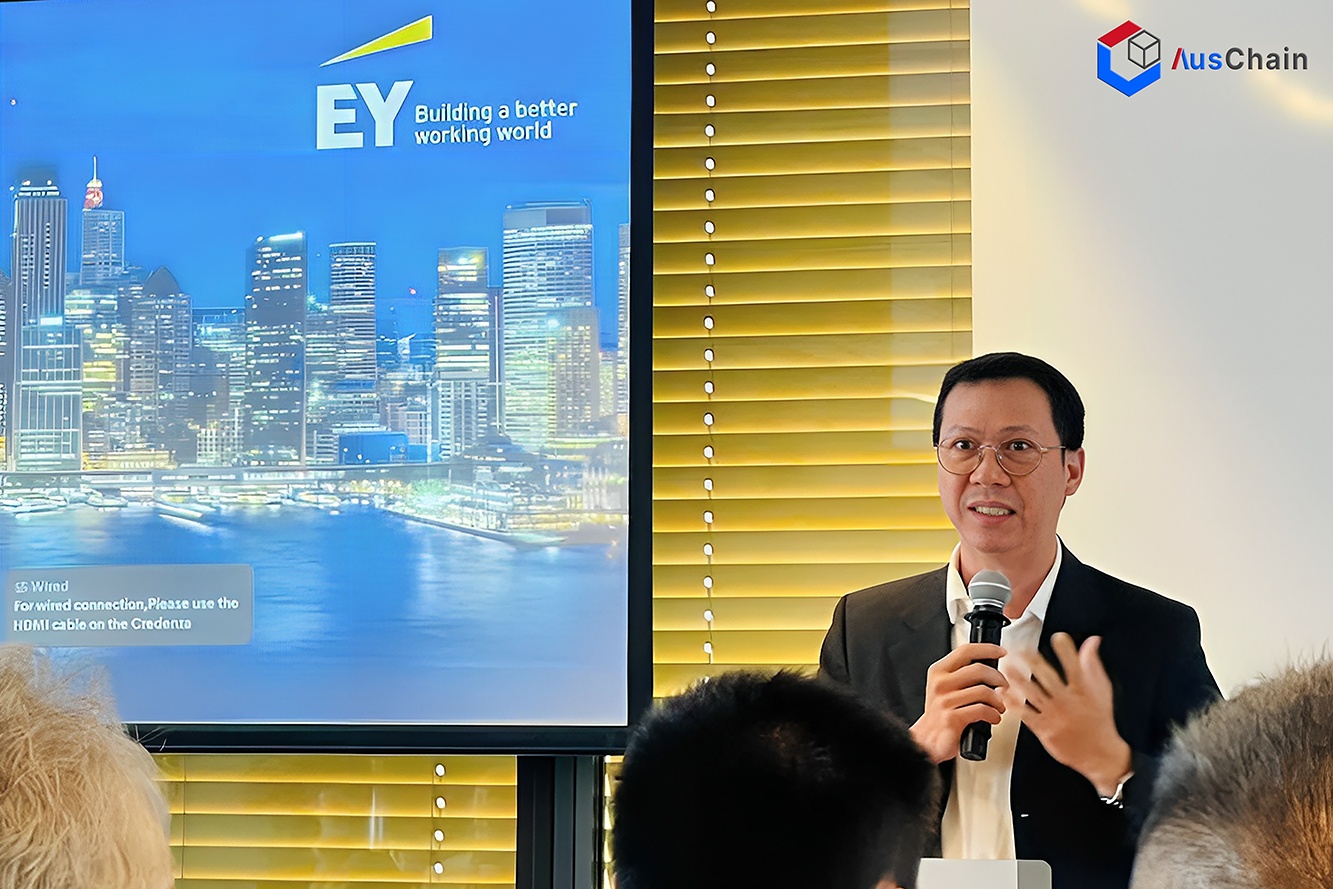
The useful part of a trade fair happens after hello
In February 2026, speaking in Sydney about Vietnam’s Spring Fair, Long set out both opportunities and obstacles in bilateral business. He highlighted Vietnam’s manufacturing and agricultural strengths and Australia’s standards and governance experience. He also identified differences in product requirements, regulations, inspection procedures, consumer culture and market-entry approaches. The list was a reminder that an international opportunity comes with homework.
His recommendations for trade fairs were similarly specific: business matchmaking, briefings on export standards, traceability and technology support for market entry. A handshake is a pleasant beginning. Someone still has to work out what the buyer requires and whether the seller can deliver it. For startups, he pointed to initial investment, compliance costs and long entry timelines as additional pressures.
This discussion gives his aspirations an operational form. Cooperation requires more than agreeing that two economies complement each other. Businesses need information, preparation and a route through unfamiliar requirements. Long’s emphasis on practical follow-through belongs beside the early mango caveat: both concern what must happen around a system for its promises to mean anything.
A company needs a biography, too
By the Australia Vietnam Policy Institute’s 2026 conference, Long’s portfolio included BlockID.au, an AI- and blockchain-enabled business verification and capability platform. His work there concerns digital trust, identity and assessment of early-stage businesses. The aim is to help enterprises demonstrate verified capability and give partners and investors across Australia and Vietnam more confidence in engaging with them.
His agricultural research has continued alongside that newer direction. He is a co-author of a proposed blockchain framework for authenticity and traceability in Vietnam’s domestic pepper supply chain, published in Economia agro-alimentare. Pepper is another product whose origin and passage through intermediaries matter. The research keeps his enterprise ambitions attached to a specific commodity and a specific chain of participants.
The connection across these projects is easy to follow. A mango needs an account of where it came from. A building needs an account of how it came to be. A young company needs an account of what it can actually do. Long has spent years working on ways to make those accounts accessible across organizational boundaries. Each application changes the details of the record and the people responsible for it.
The human question remains comfortably old-fashioned: can I trust this? Long’s career brings software, business strategy, research and international networking to bear on that question. His early warning about farmers’ data still belongs in the picture. Proof depends on people doing the work of recording and checking. Even a mango with an elaborate digital biography has to begin with somebody telling the truth.
Follow the work
Projects, public appearances and further reading.
- Vietnam Blockchain Corporation ↗
- AusChain ↗
- Do Van Long on LinkedIn ↗
- Agridential ↗
- HTV9 interview on YouTube ↗
- Australia-Vietnam trade interview ↗
- 2026 AVPI speaker profile ↗
- Mango traceability in 2018 ↗
- Enterprise strategy background ↗
- Agridential in 2019 ↗
- ICT Investor Bootcamp ↗
- Columbia Southern alumni magazine ↗
- VBC leadership and advisers ↗
- 2025 investment forum ↗
- Pepper traceability research ↗
- Aviation supply-chain research ↗
- Vietnam Blockchain Summit 2018 ↗
- Vietnam ICT Outlook 2018 ↗
- Singapore festival presentation ↗
- Water-industry conference ↗