Early in 2017, Nate Holiday made a phone call that left the person on the other end wondering whether he had heard correctly. Holiday was running sales and services operations at Teradata. He had called Mike Weinberg, a sales coach and author, to discuss an initiative led by executive Karen Thomas. They wanted to put serious attention into the people managing the salespeople.
Weinberg went quiet. Holiday paused to check whether he was still on the line. The coach later described the conversation as one of his most memorable calls in a decade. What surprised him was the attention to management and culture, rather than a request for another round of sales training. A consultant had been offered something resembling his own advice. Naturally, he needed a moment.
The call introduces Holiday, now a co-founder of Space and Time and CEO of MakeInfinite Labs. Long before his work involved cryptographic proofs, he was concerned with the arrangements behind the result: who coached the team, who had the authority to act, and what made an organization capable of delivering what it promised.
The machinery behind the sale
Holiday’s enterprise career put him close to the less glamorous side of software success. At Teradata, his responsibilities included go-to-market operations and growth. His executive biography describes oversight of the global growth engine and field operations associated with more than $2 billion in annual revenue, including the cloud business. He also held a senior role in fintech at Alegeus, a Vista Equity Partners portfolio company.
Annual revenue associated with the Teradata operations in Holiday’s executive remit.
In his 2017 writing, Holiday argued for managers who developed other people’s abilities. Recruiting talented sellers was useful; making time to coach them was essential to building an organization that could scale. He wrote about incentives that encouraged managers to develop talent, and about the tools and support that allowed a sales team to function. The sales star had plenty of company behind the curtain.
Another piece described the contribution of professional services, product teams and marketing. Salespeople might be the ones facing customers, but their credibility depended on work across the business. His third installment turned to account planning: understanding where a customer stood and where the relationship could go. The trilogy was concerned with a practical question. How do you organize people so that competence becomes repeatable?
Holiday earned a Bachelor of Arts in linguistics at Brigham Young University. Later, his work on Teradata’s cloud and go-to-market business appeared in Weinberg’s Sales Truth. The degree and the career sit beside each other rather pleasantly. In the database business, as in a sales organization, translating complicated things into language someone can act on is a considerable part of the job.
Holiday has also publicly credited the women who raised him and the women he has worked alongside. In March 2023, he described his gratitude to colleagues, friends, bosses, family, partners, investors and customers, recognizing their determination and work. That acknowledgment adds a personal dimension to his writing about organizations. When he talks about the people behind a result, the circle extends beyond an executive team or a reporting line. It includes people he says he has had the opportunity to learn from.
A database with a receipt
In 2022, Holiday and Scott Dykstra co-founded Space and Time. The business addressed an awkward gap in blockchain applications: a smart contract could rely on data processed somewhere outside the blockchain, yet lack a way to check the processing. Building an application around that answer required confidence in the database and whoever operated it.
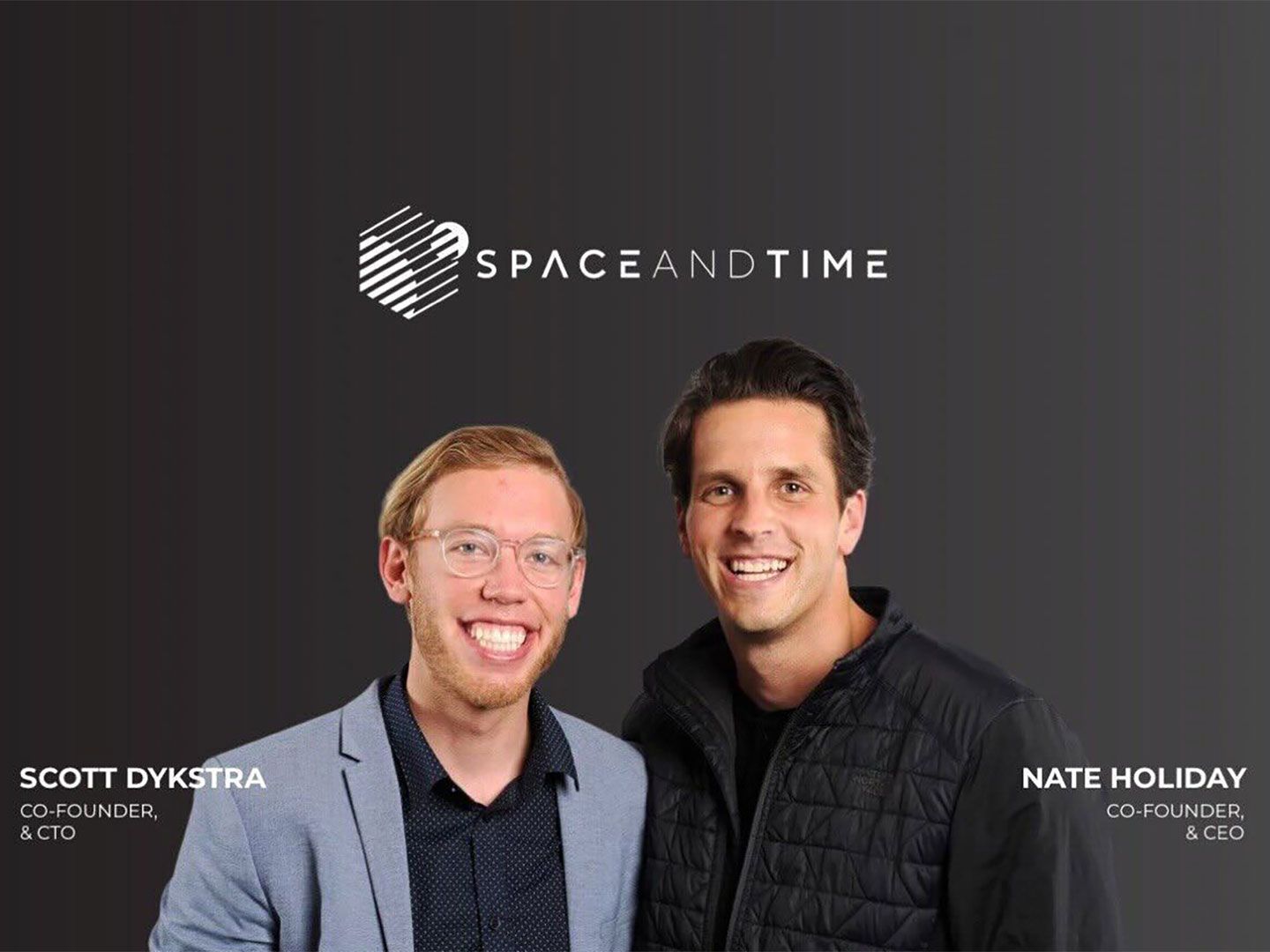
Space and Time’s answer was to combine database work with cryptographic evidence. Proof of SQL verifies that a query was executed correctly against data represented by cryptographic commitments. A result arrives with something to check. The distinction matters when that result becomes an instruction: release a payment, calculate a reward, or execute a financial contract.
Consider a game that distributes rewards according to activity recorded outside a blockchain. The reward calculation could depend on several pieces of information. Processing those records in a database is useful. Sending the resulting number to a smart contract creates a question about the path it took. Query verification supplies evidence about that computation.
- 01Commit the dataCreate a cryptographic reference.
- 02Run the queryCompute the requested result.
- 03Attach a proofProvide evidence of execution.
- 04Check the resultVerify against the commitment.
Simplified view of Proof of SQL. Verification concerns the committed data and computation; an input still needs to represent what it claims.
The receipt analogy has a boundary. Proving a calculation does not make every statement fed into it true about the outside world. It establishes something narrower and useful about the data and the operation. That precision is part of understanding Holiday’s business. The technology is concerned with evidence at a point where applications otherwise have to accept an answer.
In December 2023, Dykstra and Google Cloud’s Lucas Fontaine described how Proof of SQL could work with BigQuery. Existing database infrastructure could be part of the arrangement. For Holiday, that widened the audience beyond blockchain-native developers: the verification problem could matter wherever database results drove applications.
“Most people, when they hear about it, understand it’s needed - but they assume it already works.”
Nate Holiday, on database verification, 2024
That was Holiday’s observation in a 2024 conversation with investor Ray Wu. The difficult part of explaining the product was that people often assumed the protection was already present. His concern extended to AI agents and automated processes accessing consequential information. The more a system could do on its own, the more he wanted visibility into the database work beneath it.
The money, the partners, the name
The company announced a $10 million seed round led by Framework Ventures in July 2022. A $20 million strategic round led by M12, Microsoft’s venture fund, followed in September. In August 2024, a further $20 million Series A brought cumulative funding to $50 million. Framework Ventures, Lightspeed Faction, Arrington Capital and Hivemind Capital led that round.
$50 million cumulative funding by August 2024. Bars show individual round sizes.
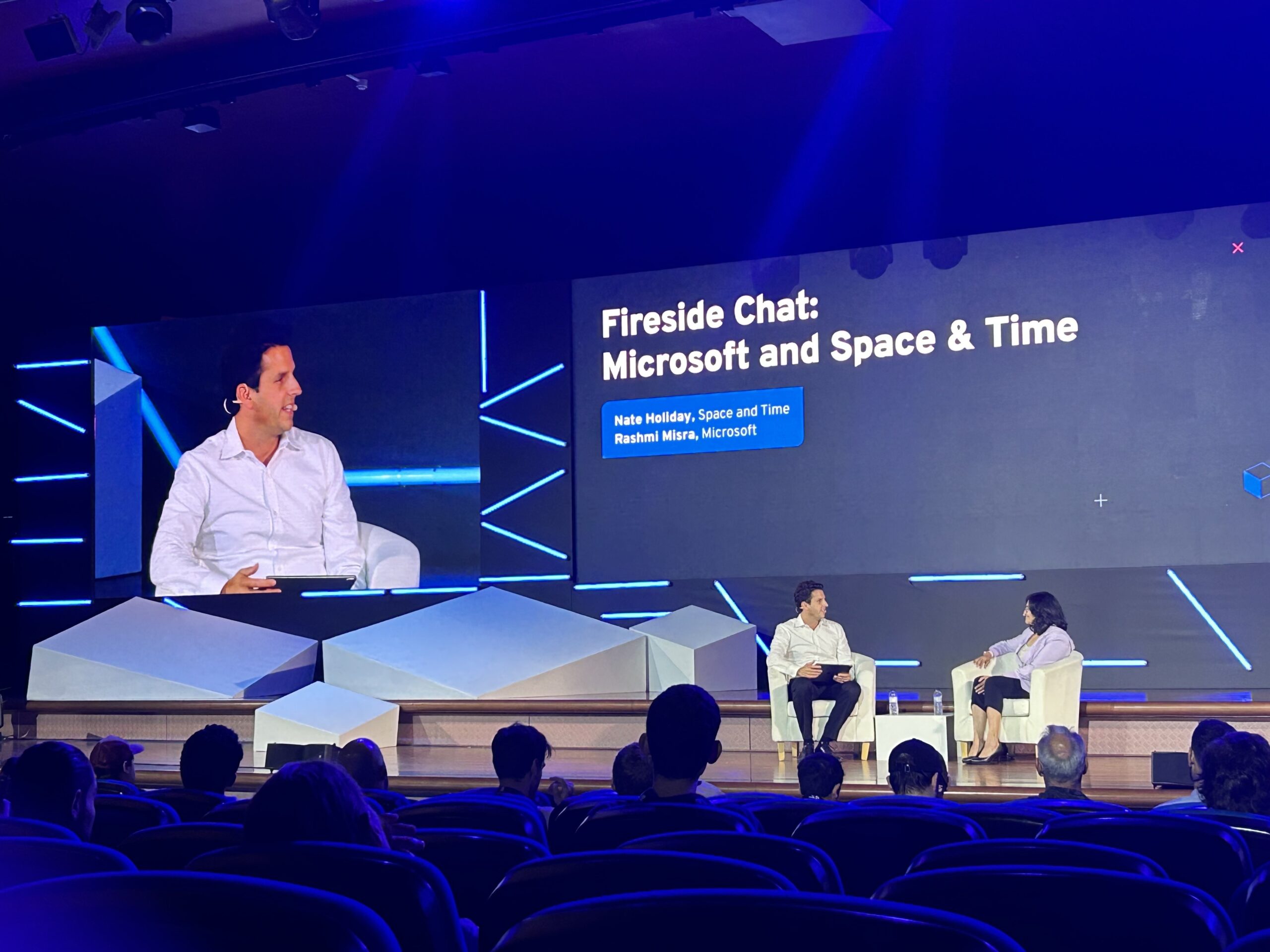
Microsoft also became part of Holiday’s public working world. At SmartCon 2023 in Barcelona, he sat down with Microsoft’s Rashmi Misra for a fireside conversation about verifiable data and computation for AI. The subject suited the setting: organizations were preparing to delegate more work to software, while the question of how to check that work remained very much open.
By April 2025, the organizational map was changing. Space and Time Labs became MakeInfinite Labs. Holiday continued as CEO of the software development and research company, which remained a contributor to Space and Time. An independent Foundation took on a mandate to support the network’s development, adoption and decentralization. Dykstra moved into engineering leadership there, with Catherine Daly leading ecosystem growth.
Space and Time launched mainnet in May 2025. The distinction between the network, its Foundation and its original development company became part of following Holiday’s career accurately. His company could continue research, enterprise integrations and application development while a separate organization supported the wider network. The name above his executive desk changed; the connection to the technology continued.
A business small enough to walk a dog
MakeInfinite Labs’ ambitions also reached people who had never worked with a database. Dreamspace opened public access in August 2025 as an AI app builder using Microsoft AI tools, Space and Time and Base. It was designed to let people describe an application in natural language, generate it, and deploy and monetize it onchain.
At a SmartCon keynote, Holiday gave that ambition a domestic scale. His son was approaching the age when money mattered and said he needed a job. Holiday suggested a dog-walking app. He could offer the service to neighbors and let them sign up and pay. The example had the virtue of involving a recognizable customer and an actual dog.
It also made Holiday’s aspiration easier to understand. He wanted the tools for building a business to reach people with a useful idea, regardless of whether they knew developers or venture investors. An app could help organize the service. The service would still require someone to turn up at the neighbor’s door. Even an AI economy has leads that need clipping on.
His public advocacy returns to the idea that more people should create rather than only consume. Dreamspace puts a user-facing application on top of the infrastructure work. A database co-founder talking about a small neighborhood business may seem like a change of scale. It is also an example of the audience he hopes the infrastructure eventually serves.
Back at the enterprise door
In June 2026, MakeInfinite Labs announced a partnership with Trenez, an Oracle business partner. The work focused on modernizing enterprise systems and connecting data across platforms. Trenez would lead engagement strategy and enterprise architecture; MakeInfinite Labs would deliver Azure integration and data engineering. The division of responsibilities was explicit.
“Enterprise modernization succeeds when the right expertise comes together under accountable teams,” Holiday said. The language could have belonged in that earlier conversation about sales operations. This time the teams were connecting older systems with newer infrastructure, but the emphasis on responsibility was familiar.
His stated approach to managing his own company follows the same practical inclination: “We empower everyone to make decisions and act.” He has described learning, ownership and quick decisions as necessary to product delivery. He has also argued that technical industries need stronger business understanding. Useful inventions still have to reach someone who knows what to do with them.
Holiday’s public career gives that argument a shape: the frontline manager, the database operator, the enterprise customer, the person trying to start a business. Each occupies a different place in the machinery. He has spent his career moving among them. The phone call that went quiet is an apt beginning. He was asking how people could do better work together. The database now gets asked to show its work, too.