The oldest trick in computing is to make a complicated thing look like a simple answer. A database receives a question, shuffles through millions of rows and returns a number. Most of us accept the number because the server belongs to a bank, a retailer or a cloud provider with something to lose. A smart contract is less sociable. It cannot shake hands with the database owner, read an auditor's letter or decide that the logo looks reputable. It needs a result it can verify.
That awkward seam is where Space and Time has built its company. Founded in 2022 by Nate Holiday, Scott Dykstra and Jay White, the globally remote startup combines blockchain indexing, a relational database, API infrastructure and a zero-knowledge coprocessor called Proof of SQL. The basic pitch is pleasingly unfashionable: developers keep using SQL, the workhorse language of corporate data, but the answer comes with cryptographic evidence that the query was performed correctly against committed data.
This is not an exercise in making a spreadsheet sound cosmic. Blockchains are good at preserving a shared current state and enforcing rules. They are expensive places to store a data warehouse or scan years of transaction history. Traditional databases do those jobs quickly, but they are mutable and operated by someone. Space and Time moves the large computation away from the smart contract, proves it, then lets the contract inspect the proof before acting.
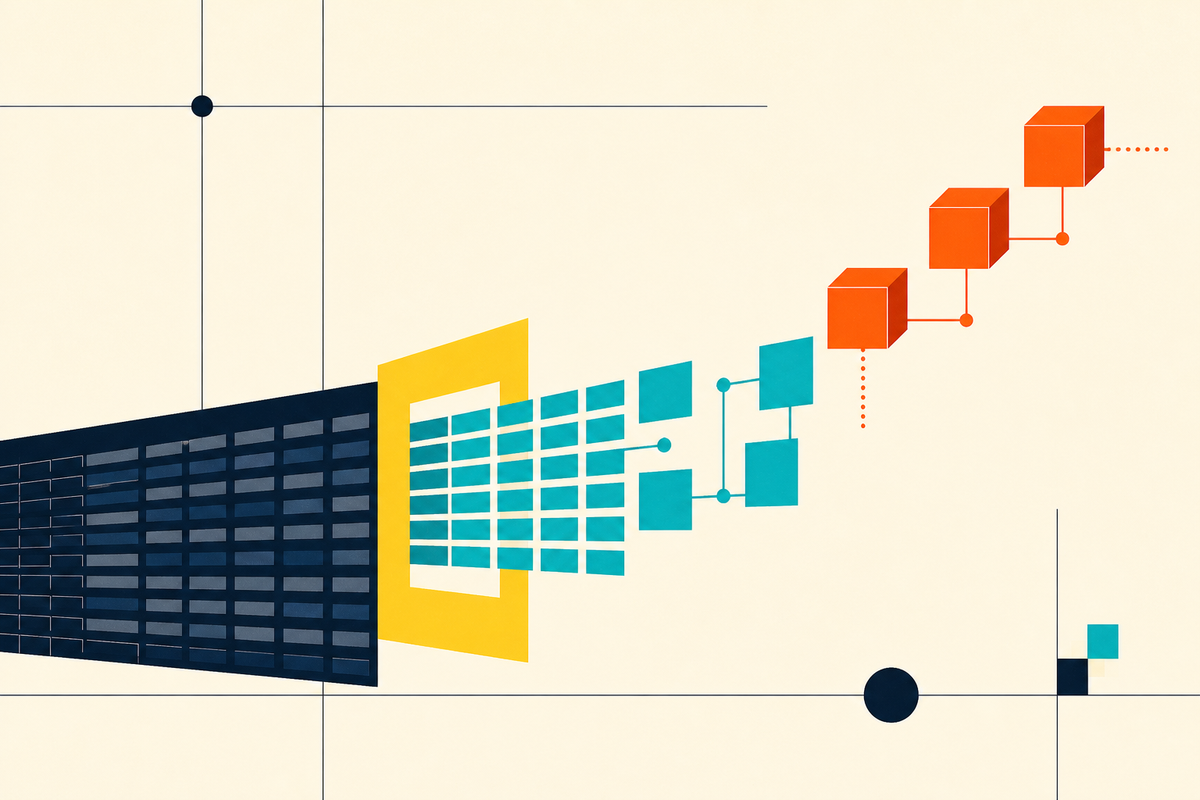
The answer is not the product. The evidence is.
Proof of SQL has two principal pieces. A prover executes the requested SQL and generates a compact proof. A verifier checks that proof against cryptographic commitments representing the state of the underlying table. If data changes, its commitment changes. If the computation does not match the declared query, verification fails. The clever part is delegated computation: one machine does the heavy work, while many consumers can cheaply check that it did not improvise.
Google Cloud illustrated the architecture in 2023 by placing a Space and Time prover beside BigQuery. A customer could mark selected tables as tamperproof, route their loading through a gateway that creates commitments, and request proofs only for queries that need them. It was a useful demonstration of where this company sits: not as a replacement for every warehouse, but as a proof layer that can live next to infrastructure enterprises already use.
The company keeps SQL, the language everyone knows. It changes what the answer has to bring with it.YesPress analysis
The company's own network is more ambitious. SXT Chain is a layer-1 blockchain organized around data work. Indexers ingest records from chains such as Ethereum and Base. Customers can create tables and load their own offchain data. Validators agree on commitments to those tables. Provers answer queries and generate proofs. The SXT token pays for inserts, queries and proving, while staking gives network participants something to lose if they corrupt the process.
A memory upgrade for smart contracts
Consider a lending contract. It can see a wallet's balance now, but it cannot cheaply ask how volatile the collateral was over 90 days, how often the borrower was liquidated, or what that borrower holds on another chain and at a centralized venue. Those are database questions. Space and Time wants the contract to ask them without quietly reintroducing a trusted analyst in the middle.
That opens a practical set of uses. A DeFi protocol could adjust risk parameters from verified historical behavior. A rewards program could distribute tokens according to months of activity instead of a manually assembled snapshot. A tokenized-asset platform could prove net asset value calculations or reserve coverage. A compliance system could join wallet events to an approved offchain registry. An app developer could use the same indexed tables to feed a dashboard or API without maintaining a separate pipeline.
The request and query figures are company-reported snapshots from its August 2024 Series A announcement, not current audited usage.
The audience, then, is broader than crypto traders. It includes protocol engineers, enterprise data teams, stablecoin issuers, tokenization platforms, game developers, AI builders and institutions moving financial logic onchain. Space and Time said in 2024 that its warehouse had handled more than 5.3 billion database requests, averaged roughly 500,000 queries a month and supported hundreds of projects. It has not published a complete customer list, so integrations and usage claims are more informative than logo collecting.
One stack instead of four subscriptions
The competitive field is crowded because Space and Time crosses several markets. The Graph, Goldsky, Subsquid, Covalent and Alchemy help developers index or retrieve blockchain data. Dune and Flipside make that data explorable. Snowflake, BigQuery and Databricks dominate conventional warehousing. Axiom, Brevis, Lagrange and RISC Zero approach verifiable computation from different technical directions.
Turn raw chain events into data an application can actually request.
Store, join and analyze onchain history beside business records.
Prove the query logic and the committed data behind its answer.
Bundle all three, then deliver results to apps and smart contracts.
Space and Time's distinction is the bundle. It wants to replace a blockchain indexer, a database, a warehouse and API servers with one verifiable pipeline. That can reduce glue code and mismatched trust assumptions. It also asks buyers to adopt a newer network where performance, coverage, tooling and decentralization have to mature together. A specialized provider may still be the better choice for a team that only needs a fast API or a public dashboard.
Its partnerships make the bundle easier to approach. Chainlink can help deliver proven results into smart-contract workflows. Google Cloud made Proof of SQL legible to BigQuery users. Microsoft is both a commercial ecosystem partner and, through M12, an investor. ZKsync technology supports the network's smart-contract execution layer. These relationships are distribution and integration channels, not proof that every partner is a customer.
The business model is written into the workload
Before mainnet, Space and Time looked like an enterprise software company with managed and private deployments. Customers could run the warehouse in a cloud environment and pay for compute. The decentralized model now meters the work itself. Indexing a chain, inserting a dataset, executing a query and generating a proof consume resources settled in SXT. Validators, indexers, provers and table owners can earn fees according to the services they supply.
That structure creates an unusually visible test. Conventional infrastructure companies can describe adoption while keeping revenue private. If meaningful usage settles onchain, observers should be able to watch fees and workloads instead of relying only on launch announcements. The caveat is familiar to crypto networks: token incentives can produce activity that resembles demand. The useful measure is persistent production workload after rewards are stripped away.
The company raised a $20 million Series A in August 2024 led by Framework Ventures, Lightspeed Faction, Arrington Capital and Hivemind Capital, taking disclosed funding to $50 million. Microsoft-affiliated M12 had invested earlier. That capital paid for a difficult combination of database engineering, distributed systems and applied cryptography - disciplines that rarely share an office, particularly when the office is officially “globally remote.”
From broad Web3 utility to the plumbing of finance
Space and Time's message has tightened. Earlier materials ranged across gaming, AI dashboards and general Web3 analytics. Since mainnet launched in May 2025, the company and the independent Space and Time Foundation have increasingly emphasized onchain finance: stablecoins, tokenized assets, DeFi risk, reserves, compliance and institutional credit. The technology did not suddenly change personality. The market story found a sharper customer with more expensive consequences for bad data.
Virtual Vaults, introduced in May 2026, shows that turn. The product is designed for bilateral institutional lending, where a borrower's collateral may sit across exchanges, DeFi protocols and internal systems. A lender needs more than a periodic PDF. Space and Time proposes a continuous, independently auditable picture of positions, with collateral records anchored to its data blockchain and loan rules able to react to verified changes.
That product also reveals the company's real wager. The future it imagines is not one in which every bank database vanishes into a public blockchain. Offchain systems remain, because institutions need privacy, performance and control. Settlement and enforcement move onchain where useful. The connective tissue is a query whose result can cross the boundary with its integrity intact.
A transparent contract fed by an opaque spreadsheet is only half a revolution.The problem Space and Time is trying to solve
There are limits to what a proof can certify. It can demonstrate that a computation matched committed inputs; it cannot guarantee that an offchain fact was honest before ingestion. A perfectly proven inventory table can still begin with a dishonest count. Governance, data provenance, audits and legal accountability do not disappear. Space and Time is strongest when it describes proof as a better trust boundary, not a substitute for reality.
Still, the idea has an elegant economy. Do the expensive work once. Let many parties verify it cheaply. Use a language developers already understand. Give a smart contract a longer memory without forcing an entire blockchain to become a database. Space and Time's fate will depend on execution, customer workload and whether finance truly wants programmable proof. But the question it asks is already useful: when software moves money because a database said so, why shouldn't the database have to show its work?