Accounts receivable is not a phrase known for quickening the pulse. It lives among invoices, remittance data, payment portals and all the quiet machinery a business notices mostly when something jams. Dillon Nugent sees a story in it anyway. When she announced in June 2026 that she had joined Billtrust as chief marketing officer, she described the company’s purpose in human terms: helping financial leaders take control of their cash flow. The sentence is doing the work of a seasoned translator. It turns infrastructure into agency.
Nugent came to that translation job by a long route. More than 25 years earlier, she began in advertising, working on mass-market consumer brands across packaged goods, athletics, fashion and automotive. The medium rewarded cultural fluency, scale and the ability to make a message land before the audience had time to inspect its plumbing. Later came B2B technology, where the plumbing is often the product and the buying committee would very much like a diagram.
Her career sits between those worlds. She has learned the emotional grammar of brands and the operational grammar of software: pipeline, demand generation, account-based marketing, programmatic strategy, product alignment. Her fluency matters because she keeps insisting both belong in the same conversation.
The useful education of a consumer advertiser
Nugent studied marketing at James Madison University’s College of Business, graduating summa cum laude in 1997. Her early work took her through agencies including BBDO, TBWA Chiat Day and Butler, Shine, Stern & Partners. In 2014, T3 hired her as director of client services. Agency life offered a peculiar and useful training: every idea had to survive creative ambition, client reality, media economics and the inconvenient existence of the customer.
That background helps explain why her later B2B language rarely becomes purely mechanical. In a Demand Gen Visionaries interview, she argued that digital tools changed how people purchase, interact with brands and find human connection in daily life. Digital, in her reading, had become one of the places where humanity happened.
“We’ve gotten used to the ability to find human connection through digital.”Dillon Nugent, Demand Gen Visionaries
The observation sounds philosophical until she turns it into a media plan. Her practical advice was to keep changing channels, diversify the portfolio and make the message clear and simple. There is no ceremonial fog around it. A company should not ask one platform to carry its entire future, any more than a sensible investor would stake retirement on a single ticker. Reach is rented. Understanding has to be earned again and again.
A career in three translations
When two companies needed one voice
Nugent moved into Austin’s technology scene and eventually led marketing at Spiceworks, the community and marketplace built around IT professionals. Then came the assignment that clearly reveals her operating style. Spredfast and Lithium merged, combining two software businesses with different histories. In 2019, the result was relaunched as Khoros.
A merger is a legal event before it is a shared identity. The contracts close on a date; the story takes longer. Nugent helped build out demand generation for the combined business, implemented agile marketing and partnered with sales and product on programmatic and account-based strategies. Those details matter because a relaunch can otherwise become expensive stationery. The new name has to connect to how teams prioritize work, how customers understand the product and how revenue moves.
By June 2022, Khoros promoted her from vice president of demand generation to CMO. The company said she had been there from the start and credited her organization with marketing operations, events and significant pipeline responsibility. Nugent framed the promotion less as a personal coronation than a continuation with a team she had worked beside for three years. Her stated mission was “creating customers for life,” a phrase that ties the scoreboard to the relationship.
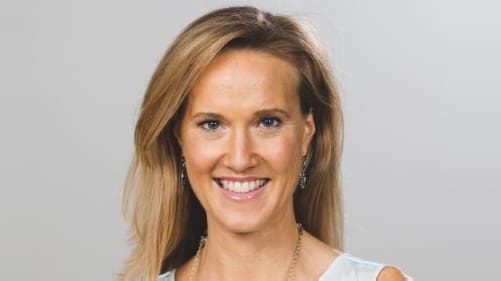
Colleagues’ public recommendations fill in the working texture. They describe a leader who can synthesize complicated data, move between strategic vision and tactical execution, and bring positive energy to teams. Recommendations are naturally generous documents, but the recurring verbs are revealing: synthesize, articulate, inspire, motivate. They describe translation again, this time inside the organization.
The portfolio, not the lottery ticket
Nugent’s view of channel strategy is built for an era that punishes attachment. Platforms change their rules. Buyer behavior migrates. A brilliant campaign can exhaust its novelty with startling speed. Her answer is not frantic novelty for its own sake. It is portfolio discipline: multiple routes to the customer, a willingness to adjust the mix and messaging clear enough to travel.
This is where her consumer past and SaaS present meet neatly. Advertising taught her that culture moves. Enterprise software taught her that attribution demands an answer. The combined practice treats brand and demand not as rival kingdoms but as different time horizons. One creates recognition and meaning; the other gives a buying process momentum. Both fail when the customer cannot repeat the value in ordinary language.
In 2023, Calabrio hired Nugent as CMO. Her scope included global demand generation, corporate communications, marketing operations and business development. She said she wanted to use data-driven insight to create simple, powerful growth strategies and operational discipline that could produce predictable results. It is the sort of sentence in which “simple” represents a great deal of difficult work.
- Consumer advertising and brand work across several agencies and industries.
- T3 names Nugent director of client services.
- Spredfast and Lithium relaunch as Khoros; Nugent helps build the combined demand engine.
- Promoted to chief marketing officer at Khoros.
- Joins Calabrio as chief marketing officer.
- Begins the Billtrust chapter.
Growth as a team sport
The public record outside her executive roles makes the growth theme less corporate. Nugent has mentored through Ceresa, served on the board of Saint Louise House and Northwest Little League Austin, supported children through Student Sponsor Partners, and contributed pro bono advertising to YAI and The Marine Mammal Center. The causes vary. The recurring act is helping another organization or person become more capable.
Her own description of leadership has emphasized growing teams, cross-departmental relationships and network connections. That language resists the heroic executive myth. Marketing at scale is intensely interdependent. Product must supply truth. Sales must supply contact with the market. Customers supply the evidence. Creative teams find the form. Operations keeps the promise from collapsing under its own success. A CMO conducts more often than she solos.
There is a small, telling example in Nugent’s public comments about brand loyalty. She praised a personal note from Dick’s Sporting Goods and connected it to the company’s place in meaningful moments for young athletes in her life. A handwritten gesture was not merely pleasant. It demonstrated that a large brand could still behave as if one customer existed. Scale had not erased specificity.
Making the invisible consequential
Billtrust gives Nugent a particularly clean test of her thesis. The company sells workflow and payment software across the accounts-receivable cycle. Its machinery includes invoicing, payments, collections and cash application. Each category can be explained with features. The stronger story begins one level higher: delayed cash limits choices, manual reconciliation consumes attention and awkward payment experiences strain customer relationships.
In June 2026, Billtrust announced its twenty-first consecutive quarter as a G2 Leader in accounts-receivable automation, with 30 badges in the Summer report. Nugent pointed to the streak as evidence of measurable customer impact and said customer voices should push the company to keep improving what AI-powered AR could do. It was an on-brand interpretation of an award. The badge mattered because users had supplied the votes.
When she announced the role, Nugent said the alignment felt unusually exact: leadership she respected, a growing market and a product solving a meaningful problem. She wanted to tell the brand’s story in a “fresh, bold way.” The phrase is lively; the harder assignment underneath it is sober. Financial software must promise progress without pretending money is simple. It has to make automation feel like control rather than abstraction.
The tools keep changing. The durable assignment is to make complexity useful to someone.The thread running through Nugent’s career
Nugent now brings an agency-trained eye, a merger operator’s patience and a demand leader’s appetite for evidence to that assignment. Her career does not argue against dashboards, AI or automation. It argues for remembering what they are for. Behind every efficiency metric is time returned to a person. Behind cash visibility is a decision someone can finally make. Behind a brand is a promise that must survive contact with the customer.
Marketing has always been tempted by scale because scale is easy to display. Human connection is harder to place in a quarterly chart. Nugent’s long bet is that it belongs there anyway, not as sentiment around the edges but as part of the operating system. The numbers should rise. The message should remain clear. And somewhere on the other side of the software, a person should feel that the company remembered them.