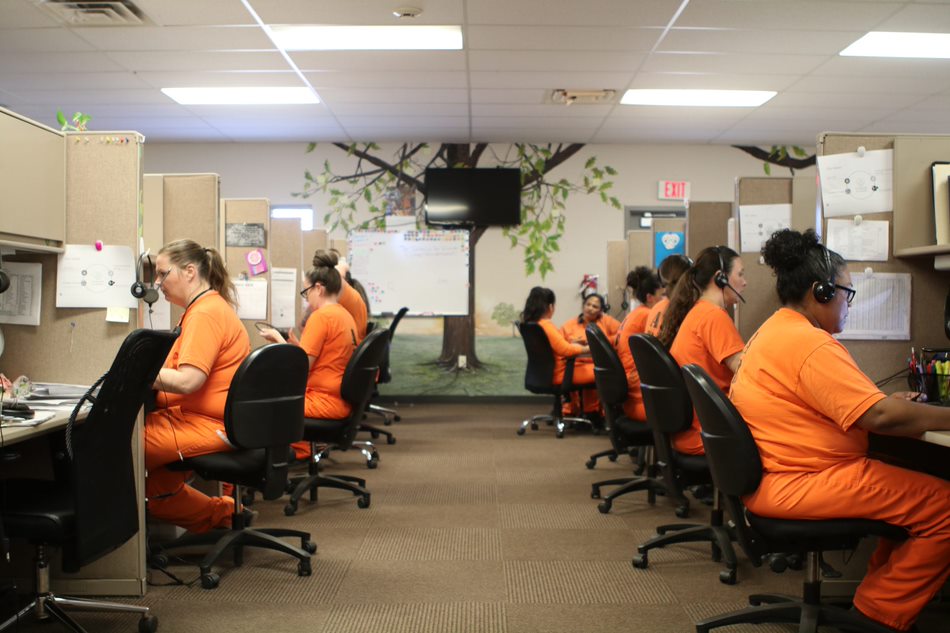
A sales call is an odd place to look for a second chance. The buyer wants someone who understands the product, respects their time and can solve a problem. The caller’s biography usually stays outside the conversation. At Televerde, that small separation matters: some of the women making those calls are serving prison sentences. The work lets them accumulate something a criminal record cannot describe - evidence that they can do a professional job.
- The customer buys: B2B prospecting, qualified meetings, partner support and customer retention.
- The difference: paid client work becomes training for careers after incarceration.
- The useful lesson: measure the handoff, whether it is a sales lead or a person leaving prison.
That is the intriguing bargain behind this Phoenix company. Televerde supplies sales, marketing and customer experience teams to businesses including SAP and Broadcom. Its workforce includes incarcerated and formerly incarcerated women. For customers, the question is whether the team produces useful conversations. For employees, the question is whether those conversations lead somewhere beyond the next shift.
01 A conversation is only the beginning
Imagine an enterprise software company with a crowded prospect database and too few people to work it. Televerde researches accounts, identifies decision makers, runs outreach, qualifies interest and books meetings. Its sales development representatives help bridge the gap between a marketing response and an opportunity a salesperson can pursue. Data, CRM systems and marketing automation support the process; people conduct the conversations.
For a buyer, this means deciding which gap to fill before choosing a service. A prospecting team has a different assignment from a partner helpdesk. Counting calls alone would miss that distinction. The useful measure follows the job: accepted opportunities for sales development, or successful resolution and continued engagement for customer support.
The assignment can continue after the sale. Televerde handles onboarding, customer questions, retention outreach and partner-program support. Its operations in the United States, Argentina and Scotland give it a multilingual delivery footprint. This places it in the market for outsourced revenue and customer operations, alongside specialist agencies, contact-center providers and the option every buyer already has: hiring internally.
02 When the partner network gets confused
Broadcom provides a concrete example. Acquisitions of CA Technologies and Symantec complicated its customer and partner relationships. New processes and contacts created uncertainty. Televerde’s published case study describes a response built around partner communication, onboarding and support, with teams trained to represent Broadcom’s brand. The problem was bigger than finding another name to call. Existing relationships needed attention while the organization changed around them.
The case study reports more than $171 million in pipeline and $87 million in closed/won revenue. The underlying PDF says its figures cover 2018 onward; they should not be read as one year’s sales. These are vendor-published results, useful as an account of a particular engagement rather than a promise about the next one. The operational lesson is straightforward: an acquisition changes the organization chart immediately. Customers still need someone to answer.
03 The price of keeping a team together
What breaks before a business hires help? In Forrester’s November 2024 study, customer interviewees described internal-team turnover, limited bandwidth and changing needs. Televerde commissioned the research. Five representatives of four customers informed a composite enterprise model. It assumed 40 agents at $135,000 each annually, including service overhead. That is a modeled service fee, not an employee salary or a published price.
Across three years, the model estimated $14.3 million in risk-adjusted present-value costs and $24.5 million in benefits, producing 71% ROI. Actual economics depend on scope and execution. The practical purchasing question is whether reliable coverage, product knowledge and better follow-through justify the bill.
Risk-adjusted present values. Forrester’s 2024 composite, commissioned by Televerde. Illustrative, not a quote.
04 The career after the gate
The workforce story has its own test. In April 2026, Televerde reported that 48 women in Arizona and Indiana had completed its training and transitioned out of incarceration during 2025. It said 88% of graduates secured full-time professional employment within 90 days of release, while 93% entered the workforce with active certifications in platforms such as Salesforce and Marketo. The reported average starting salary was $41,169.
Professional employment within 90 days of release.
Televerde-reported result for its 2025 graduates.Those figures describe program outcomes. They do not establish what every participant would have experienced without Televerde. The independent Televerde Foundation, launched in 2020, adds career development and reentry support. That continuation matters: training inside prison and maintaining employment outside it are different assignments.
Pay also deserves precision. In a 2020 KJZZ interview, executive Michelle Cirocco described wages divided among state costs and court obligations, a personal account and savings available on release. Gross compensation was not all immediately spendable. That dated account should not become a universal current pay formula. It does show why any assessment of prison employment needs to examine deductions and usable income alongside training.
05 What travels beyond the prison walls
Researcher Kristie Rogers spent 15 months studying Televerde’s workplace. Her Harvard Business Review article distinguishes respect owed equally to everyone from respect earned through a particular contribution. A manager can supply one and neglect the other. Basic dignity without recognition leaves good work invisible. Recognition without basic dignity makes belonging feel conditional.
“In the B2B world, revenue is only as strong as the talent driving your sales engine.”
Vince Barsolo, Televerde CEO · April 2026
That distinction offers a useful practice for any employer: make ordinary treatment consistent, and praise specific progress. For a revenue leader, the parallel is equally practical. Define a qualified opportunity, agree who accepts it and track what happens after the meeting. Televerde’s model depends on people being trained for real responsibility.
The fit still has limits. An embedded sales team needs product knowledge, usable systems and an internal owner who follows through. As a buying judgment, a company without a clear target customer or enough deal value to support the service should settle those questions first. Outsourcing cannot supply a reason for someone to buy. Televerde’s more persuasive proposition begins once that reason exists: give overlooked people the tools to explain it, and a career in which the knowledge can compound.
Pick up the conversation
The Last Mile Radio, with April Bosworth and Michelle Cirocco.