Some careers begin with a ladder. Anna Rolnicki's began with a gangway. From 2008 to 2012, before the dashboards, demand funnels and municipal acronyms, she worked as an assistant cruise director for Celebrity Cruises. It was an education conducted in public. The audience was always present, the program had to move, and a room's mood could turn faster than the weather beyond the portholes.
A cruise ship is a small city with a better dress code. It has schedules, departments, safety procedures, visitors who need directions and residents who expect the machinery to remain invisible. The assistant cruise director lives near the seam between operations and experience. Nothing about the title predicts a future in government technology. Nearly everything about the work does.
Rolnicki now serves as chief marketing officer at Cloudpermit, a software company that helps local governments manage permitting, inspections, planning, licensing, code enforcement and public works. These are not subjects that arrive with their own applause sign. A building permit becomes interesting only when it belongs to your house. An inspection matters when a project is waiting. A planning workflow matters when a business, home or neighborhood sits on the other side of it.
Her job, viewed plainly, is to close that distance.
The long middle: learning to sell the invisible
After Celebrity Cruises, Rolnicki spent eight years at Mitrefinch, a workforce-management software business later acquired by Advanced. Time-and-attendance systems occupy the same commercial neighborhood as permitting software: consequential, intricate and rarely the star of anybody's day. They shape pay, labor and compliance, yet the best outcome is often that a person barely notices them.
In 2016 she published an article with a title that still gives away something about her method: “Three Myths Surrounding the Biometric Time and Attendance System That Need To Die Already.” It is an impatient headline aimed at a patient task. Find the objections. Name them. Replace vague unease with particulars. Long before she marketed municipal software, she was practicing a useful habit for technical categories: begin where the reader is stuck.
Her public description of her own work emphasizes alignment between marketing and sales, guided by data. The phrase is corporate, but the principle is simple. Marketing cannot live as decoration in one room while sales carries a different story into another. A lead, a customer question and a product claim should belong to one continuous conversation.
“Anna is a fantastic leader in a fast-growing company and connects multiple departments together.”Carly Thackray, public professional recommendation
Former colleagues make that abstract principle more tangible. One credits her with building a high-performing marketing team, expanding Cloudpermit's reach in the United States and connecting departments. Another points to new-market strategy, inbound demand programs and the work of building a healthy sales pipeline. These are testimonials, not audited performance reports. Still, reputations are assembled from repeated observations, and the repeated word around Rolnicki is connection.
Reston becomes the address
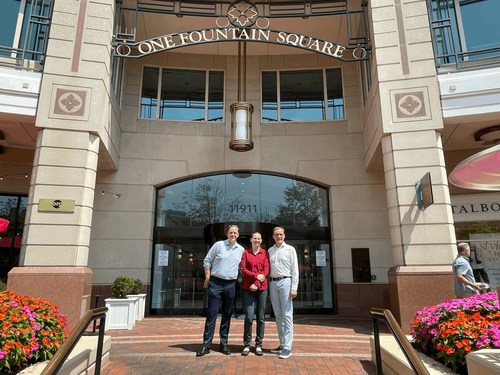
Rolnicki joined Cloudpermit in January 2021 as head of marketing for North America. That September, the Finnish-founded company announced Reston as its North American headquarters. The match between person and company was geographic as well as professional: she is based in the same Virginia city that became the platform's American foothold.
The business then had close to 500 local-government customers across Europe and North America and fewer than ten people in its Reston office. The plan was to double that local team by year's end. Cloudpermit was carrying a product built in one municipal tradition into thousands of jurisdictions with their own rules, language and institutional memory. “Expand into North America” sounds crisp on a slide. In practice it means learning hundreds of ways that a permit can move across a desk.
Rolnicki's title changed almost as quickly as the brief. Head of Marketing, North America became Director of Marketing, North America. In May 2022 she moved up to vice president of marketing. In November 2024 she became chief marketing officer. Four rungs in less than four years can look tidy in retrospect. The work underneath was happening while Cloudpermit launched code-enforcement and planning products, cultivated associations, entered new states and provinces, and turned municipal customers into the narrators of its case studies.
A growing audience
Government customers reported by Cloudpermit in its 2021 headquarters announcement and 2024 investment announcement. The bars compare those two published snapshots.The reported customer count passed 850 by the time The Riverside Company announced a strategic growth investment in September 2024. It would be careless to hand one executive the credit for a company's growth. Product, sales, implementation, support and timing all leave fingerprints. The more revealing point is that Rolnicki's ascent happened inside an organization whose audience was widening, whose product list was lengthening and whose story was becoming harder to tell in a single breath.
The customer gets the best lines
Cloudpermit's published customer work during her tenure gives a sense of the material her team chose to elevate. A village rebuilding after wildfire. A small building department trying to preserve knowledge when one of five employees retires. Inspectors attaching photographs to deficiencies in the field. Residents tracking applications without phoning city hall. The software is present, but it is usually not the protagonist.
That restraint matters. Government buyers are trained to distrust a magic trick. Their systems touch public records, fees, construction, safety and legal obligations. Novelty alone is not persuasive. The marketer has to produce evidence without turning people into props and describe change without pretending institutions can be remade before lunch.
Rolnicki's earlier work makes this approach feel less like a reinvention than a transfer. On a ship, nobody buys the backstage schedule. They experience whether dinner, a show and an announcement arrive in the right order. In workforce software, nobody longs for a biometric database. They want time recorded accurately and pay handled properly. In GovTech, the citizen does not yearn for a configurable workflow. They want to know whether the application moved.
The practical marketer learns to speak about the backstage system in the language of the front-row consequence.
A bigger platform, a harder sentence
Cloudpermit's story has continued to expand since Rolnicki entered the C-suite. The 2024 investment announcement pointed toward building-information modeling, artificial intelligence and public-works functionality. In February 2026 the company acquired CityReporter, adding maintenance management, asset tracking and field inspections to a portfolio already crowded with civic nouns.
This is the CMO's pleasant problem. A company grows by adding capability, while a message often improves by losing words. The organization can now serve more of municipal life, but the audience still needs one clean reason to care. “Community development platform” may be accurate; it does not make a resident lean forward. Faster answers might. Fewer duplicate entries might. An inspector finishing a report before leaving the site certainly does.
Rolnicki's multilingual profile offers a small metaphor for the larger work. She lists English, French and Polish at varying levels of proficiency. Her professional language set is broader still: hospitality, workforce operations, SaaS metrics, municipal process, sales pipeline. Leadership in her corner of software requires switching among all of them without making the listener feel as though they have wandered into the wrong meeting.
There is also a revealing absence of ornament in the public career. Rolnicki attended Brock University from 2003 to 2007, then went to work. No trail of honorary titles or ceremonial side quests crowds the record. What appears instead is duration: four years on ships, eight years at one software employer, then a concentrated rise at another. The pattern is less about collecting logos than staying long enough to learn a system from inside. Marketing rewards novelty in public and repetition in private. The launch may be new; the habits behind it are not. Listen to customers. Test the language. Compare the result. Bring sales back into the room. Begin again. A person who has worked both a live program and a long enterprise buying cycle knows that improvisation is useful only when the schedule beneath it is sound.
Her LinkedIn address carries the phrase “takes the lead,” a scrap of personal branding cheerful enough to risk being corny. The career makes it charming. Rolnicki did not leap into a grand public persona. She accumulated responsibility through increasingly large rooms: passengers, regional markets, two continents, sales and marketing teams, an executive table.
The horizon changed from literal to quarterly. The essential assignment held. Notice who is in front of you. Understand what keeps the program moving. Give people the information they need before confusion becomes the main event.
It is not the loudest version of marketing. For software that sits between a person and city hall, loud would be a peculiar ambition anyway. Clear is harder. Useful is rarer. Rolnicki's path suggests that the unshowy work of translation can carry someone a very long way - even after the ship comes in.