Ashley Emery has a sentence for the ancient quarrel between marketing's poets and its accountants: “You can't do the fun stuff without money, and you can't get the money without the numbers.” It is brisk, practical and mildly mischievous. More important, it describes the career that carried her from expense-management software in Maine to Amazon Web Services, recruiting technology and, in October 2024, the chief marketing officer's chair at VelocityEHS.
The numbers have never been decorative. Emery talks about lead volume, velocity and close-won rate as the three vital signs of demand generation. She insists marketing is responsible for the whole funnel, not merely the bright, busy mouth of it. A lead that vanishes between marketing qualification and a sales conversation is not somebody else's mystery. It is a leak, and the person holding the dashboard ought to go looking for it.
Yet Emery's most interesting work begins where the dashboard stops. In 2026, VelocityEHS released its first brand commercial. The subject was not a software feature or a clever acronym. It was the safety professional whose successful day produces no drama at all: no accident, no alarm, no headline, only people going home. The campaign gave visibility to work designed to make itself invisible.
“You cannot optimize for things you cannot measure.”Ashley Emery, on demand generation
An Excel brain learns to ask why
A former colleague once offered the affectionate theory that Emery's brain is an Excel document. The same public recommendation describes the other half of her style: she could model demand across segments, connect strategy to execution, and still get into the details with the team. The spreadsheet, in other words, had an open-door policy.
Her early public footprint sits at Certify, the expense-report software company, where she worked in marketing and assembled webinars and presentations on the unglamorous business of travel and expense management. In 2016, Certify named her Team Player of the Year. Two years later, she completed a nine-month advanced management program run by K1 Investment Management. Her career then moved to AWS, where she led digital marketing and global campaigns for the Database and Analytics category from 2018 to 2022. Amazon gave her a Team Project Award in 2019.
The AWS chapter refined a useful suspicion. Data, she later explained in an interview, is only one side of the story. The productive response to a clean chart is not reverence but another question: okay, but why? A campaign can be measured precisely and still misunderstand the person it hopes to move. Emery's habit is to keep asking what problem the business is trying to solve, then check whether the data is capable of answering it.
After AWS, and a marketing leadership role at Emburse, she joined Employ in March 2022 as senior vice president of demand generation. Employ was the parent of recruiting brands JazzHR, Jobvite and Lever. There, Emery oversaw demand, operations and channel strategy. In 2023, peer and employee nominations helped make her an APPEALIE SaaS Marketing Leader Award winner. Her own reaction redirected the praise to her marketers. “Marketing is a team sport,” she wrote, followed by a Kansas City Chiefs pun. Even the funnel has room for a dad joke.
The funnel is one job, not four departments
Emery's three recurring measures are volume, velocity and close-won rate. Her broader point is ownership: marketing follows the movement, not just the entrance.
Sixteen thousand hours, with conditions attached
Six months into the VelocityEHS role, Emery published a compact operating manifesto. Sales and marketing would share pipeline and revenue goals. Account-based strategy would give them a common map. Customer experience would sit at the center of the brand and product story. Decisions would begin with data. AI, meanwhile, would serve as an efficiency engine, automating repeatable work and helping the organization scale.
The disclosed result was more than 16,000 hours reclaimed. It is an arresting number, though Emery's language around AI is less about spectacle than architecture. In a conversation about the “dead zone” between marketing-qualified and sales-qualified leads, she called AI a teammate. Start small, solve an actual problem, and automate repeatable early-stage tasks such as demo qualification and follow-up. At a later executive summit, she sharpened the idea into a culinary warning: “Don't make AI crumbs - make a cake.” Isolated tricks do not amount to a strategy.
That preference for integration also appeared in VelocityEHS's 2026 commercial plan. Emery's published roadmap included a move from individual leads toward buying groups, the use of buyer signals for account targeting, and tighter coordination among marketing, sales and customer success. These are operational sentences. They are supposed to be. A chief marketing officer who cannot explain how attention becomes revenue is merely renting the word “chief.”
The product is not the hero
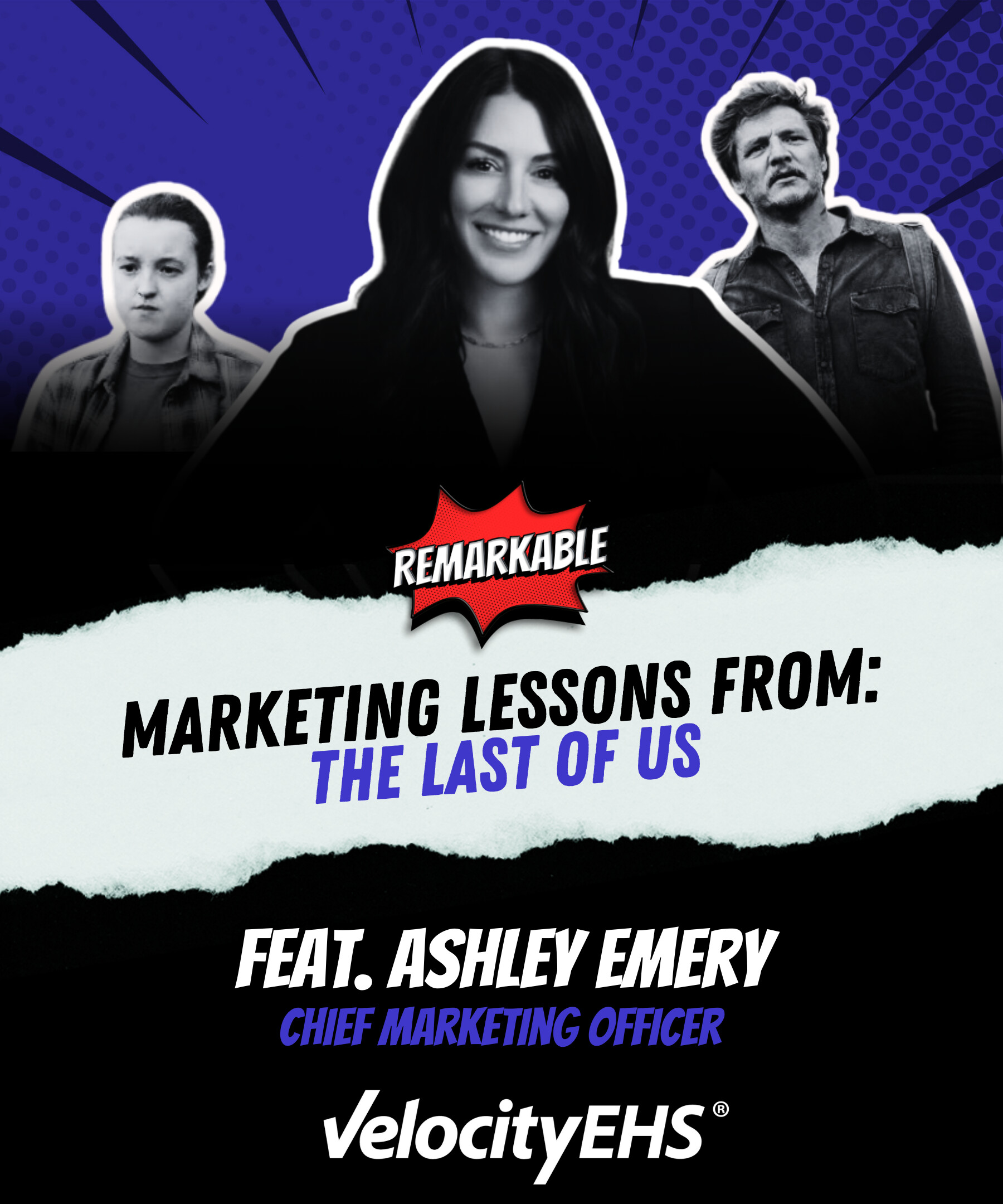
For all the language of conversion and pipeline, Emery is impatient with bloodless marketing. Her unlikely case study is The Last of Us, the post-apocalyptic video game adapted for television. The monsters made the poster, but the relationships made the story travel beyond gamers. The adaptation also changed its form to suit television instead of merely copying the game. Emery saw two instructions for B2B marketers: do not confuse the product with the protagonist, and do not confuse reuse with adaptation.
“Lead with human-centric storytelling. Don't sell features. The product is the enabler, it's not the hero.”Ashley Emery, on customer-centered storytelling
The distinction is especially sharp in workplace safety. Software can manage incidents, audits, corrective actions and risk, but nobody wakes up hoping to admire a module. The human story is the worker, the manager, the family and the ordinary journey home. VelocityEHS's brand commercial follows that logic. Emery wrote that she did not know what to expect when she entered the EHS industry. It took less than a day, she said, to notice how deeply its professionals cared about helping other people get home safely.
The company campaign that followed celebrates those professionals precisely because they rarely get the spotlight. When their work succeeds, prevention leaves no dramatic artifact. That is a difficult proposition for an advertisement and a fertile one for a storyteller. The absence becomes evidence. Quiet becomes the result.
Emery also warns that an audience can escape the boundaries drawn around it. VelocityEHS found that people devoted to minimizing professional risk could be enthusiastic risk-takers away from work. The discovery disrupted a tidy persona. Her conclusion was plain: even if you think you understand the audience, you may not. Firmographic certainty is no replacement for listening.
A leadership style with the seams showing
In September 2025, Emery arrived at a gathering of women executives carrying imposter syndrome. She wrote about it afterward without polishing away the awkwardness. The room included chief marketing officers, founders and board members from companies she admired. What changed the atmosphere was not prestige but candor: conversations about failures, competing obligations and the mental load that leadership biographies usually edit out.
She left with a line that belongs beside all the funnel doctrine: “We don't need to show up perfect to lead powerfully.” It is consistent with colleagues' descriptions of her as approachable, patient and willing to work alongside the team. Since 2020, she has also volunteered as a mentor with Making Connections, a University of Washington Women's Center program helping Seattle-area high school students, especially girls from disadvantaged backgrounds, prepare for college and encounter STEM careers.
The summit supplied lighter evidence too. Wild horses, Emery reported, are not afraid of kayaks. The same dispatch moved from revenue models and AI agents to pajama parties and custom lip gloss without apparent strain. This is not inconsistency. It is the point she keeps making about connection: people rarely experience life in the neat categories that a marketing database prefers.
The quiet result
Emery's career mirrors B2B marketing's expanding assignment. At Certify, the work explained and generated demand for a software category. At AWS, it operated at global scale. At Employ, it became responsible for an integrated funnel across a portfolio of recruiting brands. At VelocityEHS, the remit joins revenue, brand, AI and the moral weight of a safety outcome.
Her approach does not reconcile art and measurement by making either one softer. She wants the numbers precise enough to earn creative freedom and the story human enough to deserve it. She wants AI to remove repetition, then expects people to decide what the recovered attention is for. She wants the product to matter without forcing it into the hero's costume.
There is wit in that arrangement. A marketer obsessed with visible outcomes now works in a field where the finest outcome may be invisible. Nobody was hurt. Nothing went wrong. Everyone went home. The dashboard and the story finally report the same thing, and the best headline is no headline at all.