Enterprise content is the sort of phrase that makes a normal person remember an urgent appointment elsewhere. It suggests archives, cabinets and one more password. Tracy Roccasalva has accepted the task of making it sound like the future.
In April 2026, she became Hyland's executive vice president and chief marketing officer, responsible for global marketing and the company's go-to-market strategy. Her arrival came with a thesis already sharpened: the enterprise market is leaving AI experimentation behind, and content can become the orchestration layer for the work that follows.
This is less a slogan than a problem statement. An AI system can produce fluent sentences all afternoon. A business needs it to know which contract matters, which policy governs, which case is open, which customer gave permission and what action comes next. The paperwork, in other words, would like its dignity back.
The number behind the narrative
Roccasalva has spent her career in markets where products are complicated, buying committees are crowded and acronyms reproduce without adult supervision. She started in senior marketing roles at IBM, then moved through Cisco, Symantec, MapR, FireEye, RSA, VMware, Informatica and Ping Identity. Along the way she also operated Upshot Revenue Marketing as a consultant.
The company names form a compact history of enterprise technology: infrastructure, networks, security, data, virtualization, identity and now content. The common thread is her interest in the machinery that connects a market story to revenue. Hyland credits her with helping shape data-driven buying models in early work with the founder of 6sense and with developing one of the first multi-touch attribution frameworks.
“My marketing focus: use AI to drive real growth applied to segmentation, relevance, and pipeline in ways that move the number.”Tracy Roccasalva, on joining Hyland
That last phrase matters. Marketing often treats imagination and measurement like relatives who should be seated at opposite ends of the wedding. Roccasalva's record puts them at the same table. At FireEye in 2015, her work was recognized for both a website transformation and the operation of a demand center. The polished front door and the pipes behind the walls belonged to one project.
The award list from that year is revealing in its variety. A Golden Bridge honor recognized the FireEye.com transformation and launch. Another recognized the demand center. A MarCom award went to the website remodel, while a Stevie recognized the marketing department. None of these prizes proves a growth formula by itself, but together they show the range of the work she was directing: brand expression, digital experience, organizational design and revenue execution.
She carried that range into RSA Security, where her remit spanned solutions, demand generation, brand, operations, web, digital and content strategy. At VMware, the focus moved through integrated marketing, strategy and solutions. At Informatica, it became growth, campaigns and digital marketing. The titles changed, yet they kept gathering more of the customer journey under one roof. By the time she reached Ping Identity as head of marketing, the job was global and the distinction between story and system had almost disappeared.
This progression also explains her comfort with attribution. Multi-touch measurement is an attempt, always imperfect, to notice the sequence behind a purchase rather than hand the entire victory to the final click. For a marketer managing long enterprise cycles, it is a way of respecting complexity without surrendering to it. Roccasalva's early work in the field placed her close to the rise of a more instrumented B2B discipline, one where creative choices could be followed through the funnel instead of admired from the lobby.
IBM
Cisco
MapR, FireEye, RSA
VMware, Ping
Hyland
The team gets the microphone
Her public language is operational, but it is not bloodless. After Ping Identity's 2025 user event, Roccasalva praised her team for everything from logistics to the quality of the discussion. At the company's go-to-market kickoff earlier that year, she joined sales and marketing leaders on a panel about strategy and growth after the organization set its “to a billion and beyond” mission.
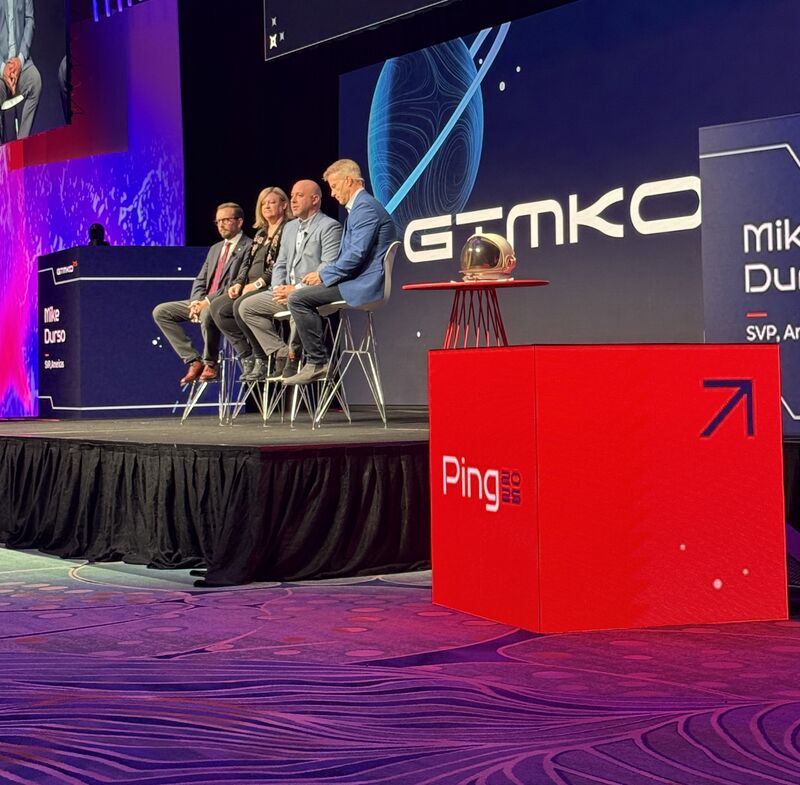
The episode offers a glimpse of her preferred unit of work: not the solitary brand oracle, but a coordinated team. Recommendations on her public professional profile repeatedly describe a leader who can hold the strategic view while staying close to operational detail. She calls herself performance-driven and collaborative. The adjectives can coexist because collaboration, in her telling, is how execution becomes possible at scale.
Her posts from Ping linger on the connective tissue. One kickoff recap celebrated total pipeline creation and enablement sessions, but also named colleagues from sales, strategy and marketing. Her account of PingYOUniverse moved quickly from praise for the event team to customer stories about removing friction, strengthening security and building trust. Even the celebration had an operating model inside it: assemble the people, teach the problem, listen to customers, then leave ready to execute.
There is a managerial generosity in giving logistics equal billing with ideas. Conferences are often remembered through a keynote photograph, although anyone who has produced one knows that the memorable hour rests on hundreds of invisible decisions. Roccasalva's public thanks made that hidden labor visible. It is a small anecdote, but a useful one. Leaders reveal priorities by what they notice after the applause stops.
She has also invested in the profession's next operating questions. In 2024, while at Informatica, she promoted a working session with Wharton and CDM Media that brought chief data officers together around AI and data readiness. At Ping Identity, she argued that AI agents should be treated as identities governed continuously, tied to human delegates and evaluated at the moment they act.
“As the agent economy scales, accountability can't be an afterthought.”Tracy Roccasalva, on AI agent identity
Content earns a new job
Hyland's assignment brings those threads together. Enterprise AI needs usable data, trustworthy identity, clear governance and context rich enough to support an action. Hyland already sits near the documents, records and workflows where that context lives. Roccasalva's job is to turn that position into a category customers can understand and a growth system the company can measure.
The category story
Content becomes active context for AI-driven work, rather than a passive object stored after the fact.
The operating test
Sharper segments receive more relevant messages, sales gets a clearer path and pipeline shows whether the idea traveled.
There is a neat reversal here. For years, content marketing meant the material a company published to attract buyers. At Hyland, Roccasalva is marketing content itself: the governed information an enterprise already owns and wants its software to understand. One content sits in a campaign calendar. The other may decide whether an AI agent completes the right task.
Her language avoids the temptation to place AI in a decorative glass case. Micro-segmentation and relevance at scale are specific uses. So is the insistence on quantifiable outcomes in critical workflows. Each term names a place where the strategy can succeed or embarrass itself. This is healthy. A claim without a failure condition is merely office wallpaper.
Micro-segmentation, in plain English, means refusing to talk to a sprawling market as if it shared one desk. A records manager in government, a claims team in insurance and an administrator in higher education may all touch enterprise content, but they carry different risks, vocabularies and definitions of a good Tuesday. AI can help a marketing team handle that variation, provided the underlying data is clean and the message remains attached to a real problem.
Relevance at scale is the companion challenge. Personalization is easy when it means inserting a first name. Relevance asks whether the next sentence deserves the buyer's time. Roccasalva's emphasis joins the modern tool to an older discipline: understand the audience, choose a useful promise and earn the right to continue. The machine may multiply versions. It cannot rescue a proposition that says nothing.
Her years in security and identity add another important check. At Ping, her public comments on Runtime Identity stressed that AI agents need continuous governance and a connection to a human delegate. That concern travels neatly into the content world. If an agent is going to act on a document, context and authority matter as much as fluency. The message Hyland takes to market therefore has to make intelligence and control sound like partners, because customers will need both.
A marketer's useful theft
The lesson to borrow from Roccasalva is not a particular campaign. It is an architecture for making ambitious ideas behave. Begin with a market shift customers can recognize. Translate the shift into an operational consequence. Build segments around the consequence, not around a spreadsheet's available columns. Give sales language that survives a real conversation. Then instrument the journey well enough to hear reality answer back.
Her education offers a fitting foundation for that combination. She studied at the University of Toronto from 1992 to 1996 and later completed post-graduate marketing communications study at Humber College. The subsequent career has been a long practical seminar in how technical systems become market categories, and how those categories become someone else's quarterly target.
At Hyland, the immediate aspiration is to define enterprise content intelligence in the age of AI. The longer wager is that an old category can acquire a new verb. Content will not only be stored, managed or found. It will help orchestrate work.
Roccasalva now has to make that verb believable across a global market, inside a sales motion and on a dashboard. It is a difficult brief. It is also exactly the kind of brief her career appears to have been assembling, one attribution model, category shift and team kickoff at a time.