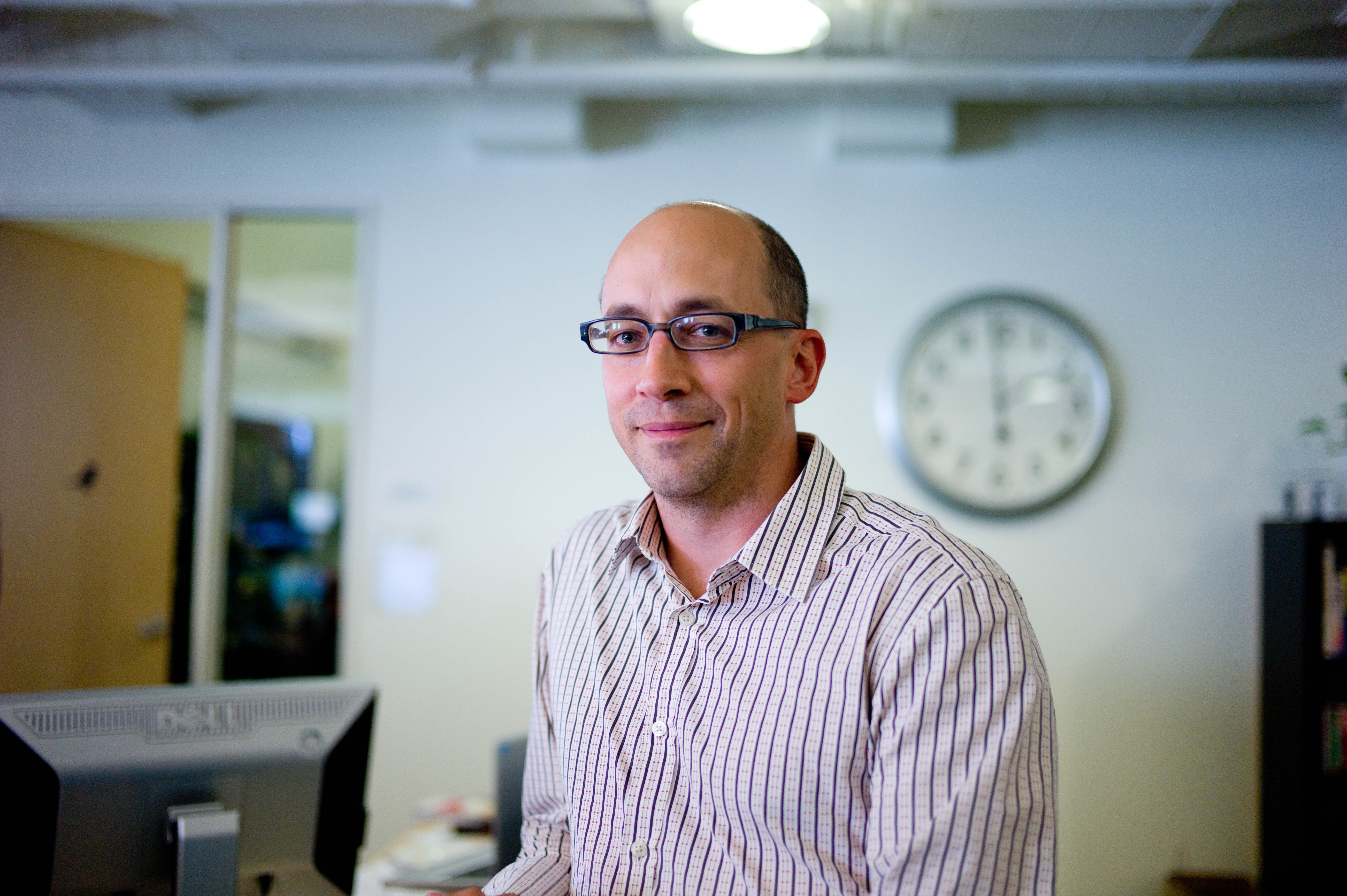
The Improv Kid Who Ran the Internet
In September 2009, Dick Costolo walked into Twitter's San Francisco office to become its Chief Operating Officer. The platform was already famous for one thing besides tweets: going down. The Fail Whale - that cartoon of a whale hoisted by birds that appeared every time the site crashed - had become shorthand for "we're not ready for this." Within months, Costolo made the Fail Whale go extinct. That's how you introduce yourself.
We suck at dealing with abuse and trolls on the platform and we've sucked at it for years. I'm frankly ashamed of how poorly we've dealt with this issue during my tenure as CEO.- Dick Costolo, internal memo, February 2015 (leaked and became national news)
Before any of this, Costolo had graduated from the University of Michigan in 1985 with a computer science degree and immediately used it to wrap flatware and sell place-settings at Crate & Barrel. He turned down silicon valley recruitment offers to move to Chicago and try to get on Saturday Night Live. He ended up at Second City instead. On his first day, his classmate was Steve Carell.
Eight years of improv comedy later - eight years of being, as he says, "extremely poor" - he came back to tech. What the improv stage had given him wasn't a funny bone. It was something more useful: comfort with ambiguity, the muscle for thinking on your feet, and the discipline to build on what someone else just handed you rather than protecting your own idea. These are not common CEO skills.
He co-founded FeedBurner in 2004 with three partners. Google bought it three years later for approximately $100 million. He spent two years at Google as Group Product Manager, then left in July 2009. By September, he was Twitter's COO. By 2010, he was its CEO - and would be for five years running.
Five years sounds modest. In practice, Costolo's tenure was the defining chapter of Twitter's commercial life. He grew revenue from zero to $1.5 billion annually. He grew the team from roughly 300 people to 3,900. He grew shareholder value from approximately $1 billion to $24 billion - a 24x return. And in November 2013, he took the company public on the New York Stock Exchange, where shares debuted at $26 and closed the first day at $44.90.
It was not a frictionless tenure. Twitter's user growth was stuck. Facebook and Instagram were gobbling the mainstream audience Twitter never quite captured. The dual-power arrangement - Costolo as CEO, Jack Dorsey as executive chairman - was an uncomfortable configuration. And in February 2015, an internal memo of Costolo's leaked and turned into a national story. In it, he had written, about Twitter's handling of harassment, exactly what you read above. It is one of the most candid public admissions of failure by a sitting tech CEO on record.
On June 11, 2015, he stepped down. Effective July 1. He called Dorsey "a calm and thoughtful leader" on his way out. He appeared on CNBC and called Dorsey "inspirational." He was 51 years old and worth somewhere in the neighborhood of $300 million.
What Five Years Actually Looks Like
The $920M Firm Where Nobody Gets a Board Seat
After leaving Twitter, Costolo did what other departing platform CEOs rarely do: he tried something small on purpose. Chorus was a fitness accountability app built on the hypothesis that social commitment changes behavior. If you tell a group of people what workouts you plan to do this week, you'll actually do them. Costolo had data on his side. He raised $9 million from Foundry Group and Index Ventures. The app had users.
It didn't survive the psychology. A phenomenon called the "abstinence violation effect" was destroying retention: users who missed one workout felt so guilty about breaking their streak that they quit the app entirely rather than face the group. The product design couldn't solve it. In early 2018, Costolo shut Chorus down. He didn't sell it. He didn't hand it off. He closed it because it wasn't doing what he built it to do.
As a leader, you need to care deeply, deeply about your people while not worrying or really even caring about what they think about you.- Dick Costolo on leadership
What came next was 01 Advisors, co-founded in 2018 with Adam Bain - the former COO and President of Twitter - and later David Fischer, former Chief Revenue Officer of Facebook. The three of them represent more accumulated go-to-market execution at scale than almost any other trio currently writing checks in venture capital.
The firm's model is deliberately unusual. 01A invests at Series B and late Series A - companies that have found product-market fit but need help building out sales, go-to-market, and operational scale. And Costolo specifically does not take board seats. His reasoning is characteristically direct: he can give honest advice to a portfolio founder only if he isn't sitting across the table from them with fiduciary obligation. The candor that made his 2015 memo famous is structural at 01A. It is the product.
Fund I, Fund II, Fund III. By November 2023, 01A closed a $395 million third fund and total AUM hit approximately $920 million. Portfolio companies include Notion, Figma, Databricks, Airtable, and Chime - each a category-defining company. Linear and Baseten Technologies are the declared unicorns in the portfolio as of 2025.