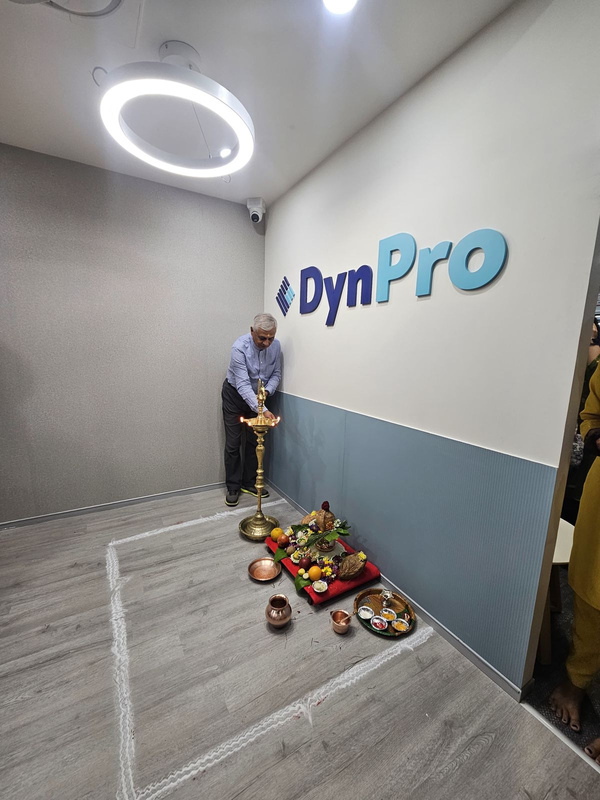
At the opening of a new office in Pune, Dhruv Gupta stood beside a brass ceremonial lamp. Above him, the DynPro name filled a wall. Below it, flowers and offerings occupied a corner of the floor. The photograph catches the co-founder of an enterprise technology company attending to something considerably older than enterprise technology: the business of beginning well.
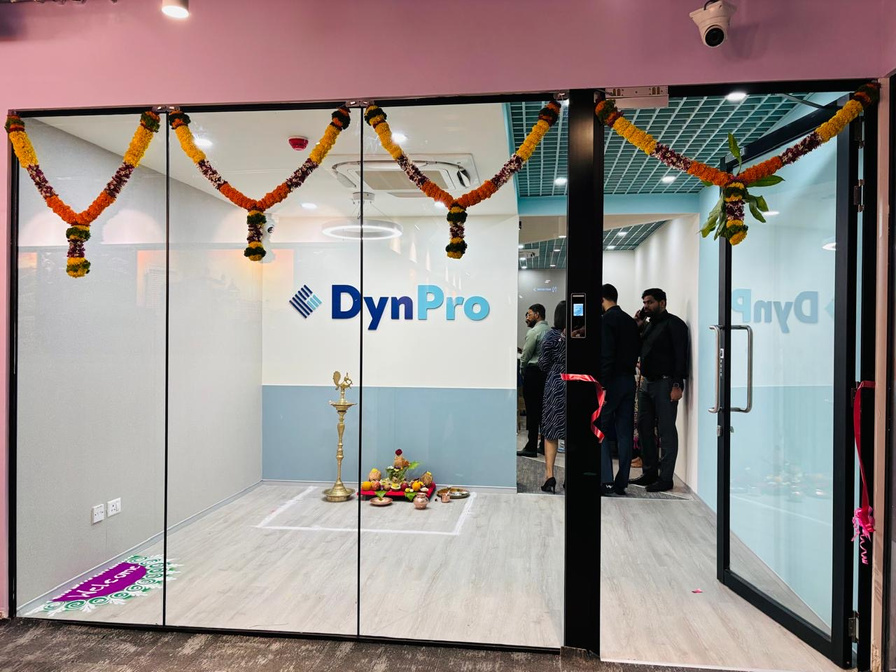
The occasion was the inauguration of DynPro’s Global Delivery Center at Amar Madhuban Tech Park on March 1, 2025. Gupta and Chitra Gupta conducted the pooja; Shivkumar Thiagarajan cut the ribbon. Employees came with their families. For a company whose work is so often expressed in diagrams, platforms and processes, it was a pleasantly physical moment. There was an actual door to open.
Gupta had co-founded DynPro with Sanjay Jain in 1996. Nearly three decades later, he was still present for a new beginning. That span gives his story its particular interest. Founding a technology business is one test of judgment. Continuing to find useful work for it as the vocabulary changes is another.
Before the founder, the systems specialist
Gupta’s education took him through two Indian Institutes of Technology: a bachelor’s degree at IIT Kanpur and a doctorate at IIT Delhi. His professional background includes research, IT management, senior management consulting and work with National Australia Bank, IMI Systems and IBM. His biography also describes a database and systems specialist who has remained involved in overseeing technology solutions.
Those are useful details because they put some working substance behind the executive title. A database is an unforgiving place to develop a habit of wishful thinking. Information must have a structure; a system must do something with it. The boardroom can tolerate a little ambiguity. A query tends to be less accommodating.
His route into entrepreneurship therefore runs through the machinery of large organizations. Banking and enterprise computing involve existing processes, accumulated decisions and people who need their work to continue while something changes around them. That is the setting in which a systems business must earn its place. A presentation can finish on time even when the implementation does not.
Gupta’s continuing technical involvement is especially relevant to the kind of company he helped establish. Consulting sells judgment as well as hours. For a founder with systems experience, there is a practical question underneath the sales language: can the proposed arrangement actually work? It is a question worth keeping within earshot of the chief executive’s office.
1996, and a business with moving parts
DynPro’s work has grown around process transformation, data integration, automation and analytics. Its customers include large enterprises and smaller businesses; its delivery organization extends across international offices. Gupta’s own base is Chapel Hill, North Carolina, while DynPro is headquartered in nearby Raleigh.
The geographical distinction is small. The professional one matters more: Gupta’s career sits in the part of technology that helps organizations put systems to work. Enterprise software arrives with promises. Someone still has to fit it to purchasing, selling, reporting and the unremarkable daily obligations that keep a company operating.
There is a human problem tucked inside that technical assignment. People in different departments may describe the same transaction differently. A sale has a different meaning to the person making it, the person fulfilling it and the person trying to close the accounts. Connecting their software requires attention to those differences. Better cables alone will not settle the argument.
with Sanjay Jain
announced November 30
opens March 1
For the founder, that kind of work carries a particular responsibility. The customer has a business to run while the project proceeds. Decisions about timing, people and oversight belong in the same conversation as the technology. A systems specialist’s experience becomes valuable when it helps a team see those obligations together, before the implementation makes them impossible to ignore.
That context helps explain the continuity in Gupta’s public business decisions. The terminology has moved toward cloud platforms and artificial intelligence, but the recurring concern is how an organization changes the way it operates. The interesting part of a long tenure is watching that concern acquire different tools.
A Salesforce deal with a process attached
On November 30, 2021, DynPro announced its acquisition of Cloudalyze Solutions, a Salesforce systems integrator. Cloudalyze brought implementation and consulting experience across the Salesforce ecosystem, including connections to external back-office systems. The deal added depth in an established platform and in the work around it.
Gupta’s comment on the acquisition put business models at the center of the discussion. He argued that adopting them was essential to changing digital processes. The purchase was a concrete expression of that position: DynPro was adding people and capabilities that could help carry a change through to implementation.
“adopting new business models is the key for digital process transformation”
Dhruv Gupta · November 2021
The distinction is practical. A customer relationship platform may become the place where a sales team works, but its usefulness depends on what happens before and after an entry is made. Orders, financial records and other business systems have their own responsibilities. Cloudalyze’s integration experience addressed that surrounding work.
Reading the acquisition as part of Gupta’s career, the revealing choice is to add capability through another team. Entrepreneurship is often told as a story of personal invention. An acquisition puts the emphasis on recognizing useful expertise elsewhere and making room for it inside an existing organization. That requires a different sort of confidence.
The next move was a platform
A year later, on December 19, 2022, DynPro announced a strategic investment and go-to-market partnership with TechTorch. The software platform was designed to help enterprises build business solutions from concept through execution. The announcement identified packaged solutions as a route to faster implementation.
The initial areas were specific: lead-to-cash, financial planning and analysis, and advanced analytics. These are substantial pieces of everyday corporate life. Lead-to-cash follows the journey from a commercial prospect toward revenue; planning and analysis help a business understand its finances. Neither becomes useful merely because the software has been installed.
Placed beside the Cloudalyze acquisition, the TechTorch investment suggests a consistent direction in Gupta’s leadership. This is an interpretation of the two decisions: one broadened the delivery team’s expertise, while the other introduced a platform for packaging repeatable work. Both addressed the distance between deciding to change and getting the change done.
There is an appealingly ordinary ambition in that. Companies would like fewer reinventions of the wheel, particularly when the wheel is attached to their revenue process. Packaged solutions promise a starting point. The work still has to suit the business that will live with the result.
Trust has a day job
A recommendation on Gupta’s LinkedIn profile offers a more personal view of the executive. Chuck Fennimore describes him as client-oriented, credits his integrity and recalls a manager who trusted employees to work hard while enjoying the work. It is one colleague’s assessment, with the useful specificity that a corporate values page rarely supplies.
Trust in a services company has a daily assignment. The person closest to a customer’s problem often knows something the chief executive does not. An organization has to let that knowledge travel and allow people to act on it. Fennimore’s description places Gupta’s management style in that practical territory.
A recommendation of this kind also brings the story down to the scale of a working relationship. A founder may speak for a company, but colleagues encounter the manager in smaller exchanges: a decision, a responsibility handed over, a response to a customer. Fennimore’s account values both the standard of the work and the experience of doing it. That pairing is a useful detail to carry into the later chapters of Gupta’s career, as the organization considers how to change its methods.
The Pune opening adds another, different detail. The founder participated in the ceremony, another leader handled the ribbon, and employees and families shared the occasion. No elaborate theory of culture is needed to appreciate the scene. Building a delivery center involves people whose working lives will take place inside it.
Thirty years, and another beginning
DynPro’s present leadership includes Gupta as co-founder and CEO, Jain as co-founder, president and CFO, and Thiagarajan as co-CEO. Its current direction centers on AI-led systems integration with human oversight. The company also identifies a Workato partnership and North America SI Partner of the Year recognition for 2024/2025.
For Gupta, this is the next operating chapter of a business he helped start in 1996. The ambition is to bring AI into how work is performed and supervised. It raises familiar questions in a newer form: what should run automatically, who should approve it, and how will an organization know that the result is right?
Longevity makes those questions more interesting. Experience can supply useful judgment, and it can also make an old method feel compulsory. DynPro’s first DynCast episode explores that tension through a discussion of reinvention and unlearning. Its speakers include Thiagarajan and other members of the company; the conversation places the current change in a wider organizational setting.
The Pune photograph supplies a fitting image for Gupta’s story. A founder with decades behind him is helping mark the opening of another workplace. The ceremony is traditional. The business inside will keep changing. Somewhere between those two facts lies the everyday work of staying useful.