Consider a reporting error. In an asset manager’s system, it might begin as an identifier copied incorrectly or a timestamp that fails a check. Individually, these are small mistakes. Collectively, they can turn a routine submission into an investigation. In one published Jean Martin case study, an unnamed U.S. asset manager had reporting errors of 18%. Its information came from several systems. People were doing the joining.
- Jean Martin connects software, business data and financial research.
- Its work spans custom projects, platform implementation and ongoing operations.
- The useful buying question: which handoff will become more reliable?
JMI says it connected order-management, investment-record and custodian data into an automated reporting pipeline, added validation, and built submission dashboards. Errors fell below 2%; reporting cycles became 60% faster. The figures are company-reported, for one client. Still, the mechanism is revealing: the intervention happened between the systems.
The business between the boxes
That is a useful way into Jean Martin. Its list of capabilities can look like an enterprise technology directory: Salesforce, SAP, Dynamics, Snowflake, cloud infrastructure, software testing. Read it as a collection of connections, however, and the business becomes easier to understand. The customer has tools. JMI helps turn them into a working operation.
Established in 1997, the company identifies Shawn Kumar as co-founder and CEO. Before JMI, his biography describes banking and investment-banking implementation work for organizations including Citigroup and Goldman Sachs. His specialties include distributed computing and software re-engineering. These are disciplines concerned with what happens when the application has to live with other applications.

The company’s own description groups its expertise into technology solutions, financial research and analysis, data and analytics, and product development. The combination matters. A financial analyst can explain what a number should mean; a data engineer can establish where it came from; a developer can put it into somebody’s daily workflow.
A valuation model meets a data pipeline
JMI’s financial work includes investment research, valuation, private equity support and portfolio operations. Its JMI AI site describes a private equity fund assessing a digital lender. The assignment went beyond reading financial statements: JMI examined product reviews, acquisition channels and transaction data to understand the business underneath the investment presentation.
According to the case, acquisition costs were 26% above the industry comparison, while 70% of customers arrived through brokers. JMI recommended concentrating digital acquisition on particular age groups and cities. It also describes extending the diligence platform into everyday business intelligence after the evaluation. The analysis could keep working after the deal team finished its presentation.
“do more with less”JMI’s description of its delivery model
The interesting lesson is methodological: connect what customers say with what they cost and how they behave. Favorable reviews alone cannot establish attractive economics. Nor does a statistical model decide an investment. Somebody still has to assess the assumptions, the comparison group and the quality of the underlying records.
The software has to survive Monday
For other buyers, the entry point is more operational. JMI’s Salesforce practice covers consulting, implementation, training and quote-to-cash work. That can mean connecting product configuration, pricing and contracts. Its SAP services span S/4HANA implementation, finance, supply chain and integration. These projects touch the routines by which a business sells, buys, accounts and delivers.
There is a quieter layer beneath them. The Snowflake offering includes assessment, data integration, reporting and maintenance of workloads and pipelines. Managed infrastructure services cover on-premises, cloud and hybrid environments. QA automation adds testing and framework maintenance. Buyers can therefore ask JMI to build something, connect it, or help keep it running. The buyer’s homework is to specify where implementation ends and operating responsibility begins. A successful launch needs an agreed owner for monitoring, incident response and the changes that arrive with the next software release.
This breadth places the firm among systems integrators, specialist platform consultants and outsourced research providers. Its distinguishing proposition is the combination of those capabilities. That is useful when a project crosses departmental boundaries. A tightly defined task in one application may instead suit a specialist or an existing internal team.
AI gets a gatekeeper
The current AI Control Plane offering applies a similar argument to enterprise AI. JMI describes a gateway inside the client’s environment, connecting existing data and systems to different models. Role-based access, audit trails and model routing sit alongside user and departmental spending limits. The product pitch treats the bill and the permission check as part of the engineering.
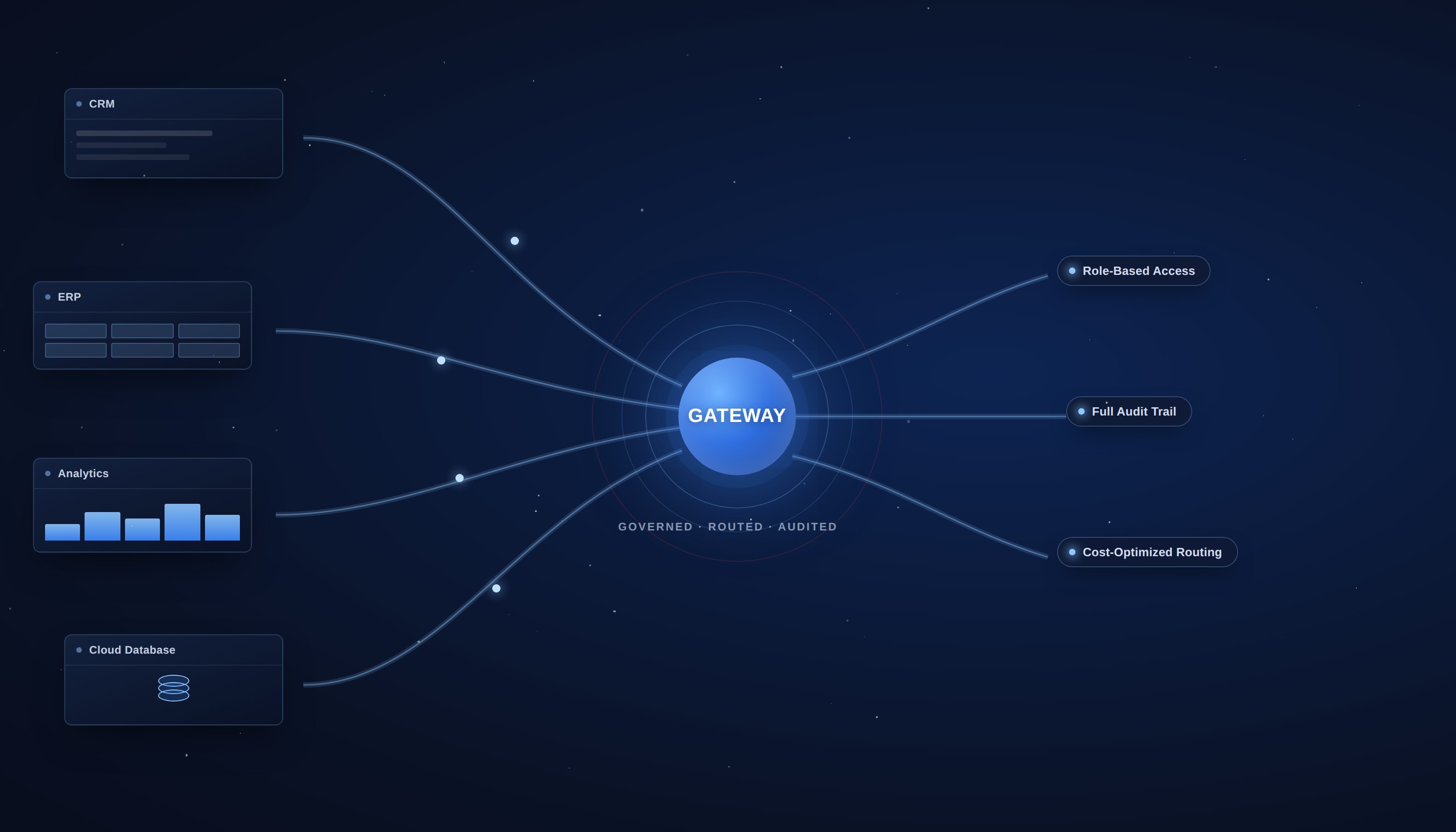
For a buyer, the implication is practical. Define who may query which information, what activity must be recorded and how spending should be limited before widening access. A gateway still depends on sound source data and correctly configured permissions. Connecting a model to an inconsistent dataset gives the inconsistency another route through the organization.
Buy a better handoff
JMI describes its commercial work as managed services, SaaS and bespoke projects. Its hybrid delivery approach combines on-site involvement with offshore teams. In March 2024 it appointed Kaushik Paul chief revenue officer, emphasizing technology and knowledge solutions for financial services. July appointments added Michael Ching’s investment-research experience and M.J. Vaidya’s cybersecurity and risk background to the board.
Cost belongs in the scope of a proposed engagement. The reporting case claims roughly 35% lower reporting costs, which measures an operational outcome rather than the price of hiring JMI. A useful evaluation would include implementation, licensing, migration, internal staff time and continuing support. Savings need a baseline and a measurement period.
The reader can copy something simpler than a consulting practice: choose one unreliable handoff. Identify its inputs, owner, exceptions and cost of correction. Then define what improvement must look like. Where teams cannot agree on ownership, or the underlying records remain unreliable, automation will struggle. Jean Martin’s portfolio makes the handoff worth examining. It is where a surprising amount of the work lives.