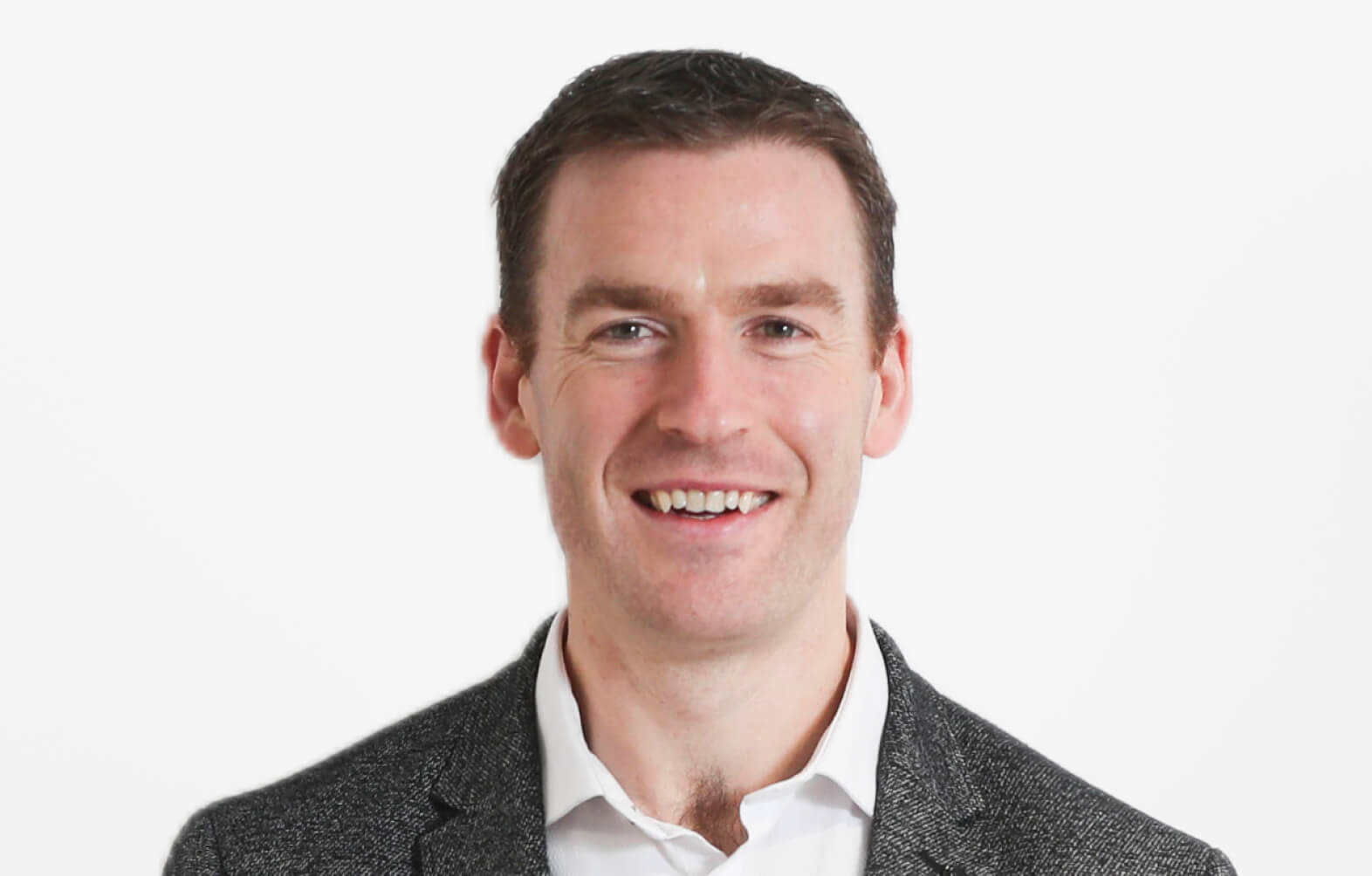
The Man Who Told His Own Company to Evolve or Die
Des Traynor is giving a talk called "The Death of SaaS, The Dawn of Agents." He's giving it in Paris, in Copenhagen, in New York. He's giving it at the company he co-founded - the one that built its entire $240M+ fundraising history on selling subscription software. The irony is not lost on him. It was never meant to be comfortable.
That's the thing about Traynor: he has always been a few conference talks ahead of where the industry is willing to go. In 2016, his talk was "Your product is already obsolete." In 2019, it was "Retention is the new Conversion." In 2025, SaaS itself is the thing being buried. The titles change. The argument doesn't. Companies that fail to cannibalize themselves get cannibalized instead.
As Chief Strategy Officer at Intercom, Traynor oversees the entire R&D organization - Product, Engineering, and Design. He's been doing variations of this job for 15 years, since he and three friends - Eoghan McCabe, Ciaran Lee, and David Barrett - started what would become one of Ireland's most recognizable technology exports. But the version of that job in 2025 looks nothing like the version in 2011. The industry changed. Intercom changed with it, largely because Traynor kept insisting it had to.
Everything Starts With an Amiga 500
He grew up as the youngest of seven children in Ireland, raised by a single mother named Nancy. The specifics of 1980s Dublin - the financial precariousness, the impossible parental arithmetic - are not the kind of thing you romanticize unless you've lived them. Traynor has written about them plainly, without sentimentality, which is exactly what makes the writing hit.
At age five, his mother bought him an Amiga 500. This was not a casual purchase. This was a financial stretch that people in similar circumstances would have declined. He never forgot it. "I swore to myself, that I'd pay my Mam back for that Amiga 500, 1,000 times over."
I swore to myself, that I'd pay my Mam back for that Amiga 500, 1,000 times over.
Des TraynorNancy Traynor died on December 10, 2012 - one year after Intercom launched. Des named his daughter Nancy.
The computer became everything: a gateway to programming, to problem-solving, to the particular type of mind that builds things. The career that followed - co-founding a consultancy, selling a product to Rackspace, co-founding a unicorn, reshaping an industry - traces a direct line back to that single gift from a woman who probably couldn't afford it and bought it anyway.
The entire Irish tech unicorn that is Intercom begins with a single-parent family, a tight budget, and one Amiga 500 computer in 1980s Dublin.
Before Intercom, There Was Exceptional
Most people don't know that Traynor built and sold a company before Intercom. Even fewer remember what it was called. Exceptional was a Ruby exception-tracking tool - the kind of thing developers use to understand when and why their applications are failing. It predated Sentry by the better part of a decade. The team built it as part of Contrast, their Dublin-based software design consultancy.
Rackspace acquired Exceptional. The team took the proceeds and used them as runway for whatever came next. What came next was Intercom.
This matters for a reason that isn't obvious: by the time Intercom launched, Traynor had already done the hard thing once. He knew what it felt like to build something valuable enough that a large company wanted to own it. He knew the difference between a feature and a business. That kind of knowledge doesn't come from reading - it comes from shipping, watching, iterating, and eventually selling something to someone who thought it was worth real money.
Intercom: The Slow Unicorn That Became the Fast One
Intercom started with a simple, powerful idea: instead of sending your customers through ticket queues and email forms, what if software companies could talk to their users the way a shop owner talks to someone walking through the door? Conversational, contextual, human.
The idea was not complicated. Execution was everything. The team spent 2011 to 2014 proving the model worked - seed funding from Biz Stone and David Sacks, a $6M Series A from Social Capital, a $23M Series B from Bessemer. By 2016, Index Ventures led a $50M round that put the valuation north of $1 billion. Intercom was a unicorn.
Through all of it, Traynor's job was to answer the question that kills most fast-growing companies: what is this actually for? Product strategy, not product features. The difference between having opinions about everything and having clarity about the things that matter. He wrote about this obsessively on the Intercom blog, at conferences, in essays - accumulating what became one of the most referenced bodies of thinking in B2B SaaS.
"In the early days of a company, getting product strategy right is way more important than perfecting sales, marketing or any other part of your business. If you get it wrong it will kill you far quicker."
The CSO Who Actually Does Strategy
"Chief Strategy Officer" is one of those titles that often means a lot of things that aren't strategy: executive liaison, conference ambassador, the person who gets credit for other people's work. Traynor's version is different. He runs R&D. He controls the product and engineering roadmap. When Intercom decided to bet the company on AI agents, it was his strategy. When Fin launched - and when Fin 2 achieved what Intercom claims is the best performance of any AI customer service agent in the industry - the trajectory went through his office.
Fin is powered by Anthropic's Claude. It resolves 51% of customer service conversations autonomously, across thousands of Intercom customers and millions of conversations. That number - 51% - is not just a metric. It's a claim. "The best performing AI agent in the industry." Traynor has staked his professional reputation on that claim being true and staying true.
The Systems Thinker Who Reads Poetry
Traynor's Medium account contains almost no tech content. It's poetry. Raymond Carver. Seamus Heaney. Two essays about Alex Ferguson and the 1999 Champions League final. The same person who publishes frameworks for product reviews and questions he'll always ask in a product meeting also writes about grief and beauty and sport with the same precision he applies to strategy.
This isn't an affectation. It's how the thinking works. His essay "The purpose of a system is what it does" - a riff on POSIWID, the systems theory principle - uses Sonos as the case study for how technology companies betray their users through accumulated small decisions, each individually defensible, cumulatively unforgivable. The argument is airtight. The writing is clean. The moral is the kind of thing you'd expect from someone who reads Seamus Heaney for pleasure.
The purpose of a system is what it does. Your intentions don't matter. Your excuses don't matter.
Des Traynor - destraynor.comJust Fucking Run
He runs in Phoenix Park, Dublin. Has for years. There is a story he tells about a recurring encounter with an older runner - faster than him - who appeared three separate times over four years. Each encounter, the advice got shorter. The final version: "Just fucking run, lad."
He wrote about this in an essay called "Just Run." It's about fitness. It's also about everything else - about the gap between the complexity we manufacture and the simplicity available to us, about how much advice is really procrastination wearing nice shoes, about what happens when you stop optimizing and start moving.
The essay resonated with people who had never run a step in their lives, which tells you something about Traynor's range as a writer. He's not giving productivity advice. He's pointing at something human and naming it precisely.
The Talks That Tracked an Industry
If you want to understand where B2B software has been over the last decade, read Traynor's conference talk titles in order. They form a kind of compressed industry history:
Each title is a provocation designed to make someone in the audience uncomfortable. The someone who is uncomfortable is always the person who most needs to hear it. In 2025, that person is anyone running a SaaS business on subscription revenue without an AI agent strategy. Which is most of the industry.
His argument is not that software subscriptions will disappear overnight. It's that the value delivery model is changing faster than most companies are willing to admit. Instead of paying for access to a tool, customers will pay for outcomes. Instead of software that helps humans do tasks, AI agents will do the tasks. The business models built around the old paradigm will need to be rebuilt. Traynor's job is to make sure Intercom has already rebuilt when everyone else is still deciding whether to start.
What He Thinks About, That Isn't Tech
His February 2025 essay on loneliness and population decline has nothing to do with product strategy. It's a worried, careful piece of writing about what happens to societies when people stop forming the kinds of connections that create families and communities. He identifies it as one of the most significant challenges of the current moment. He offers no easy solutions. He just points at the thing clearly and says: this is serious and we are not taking it seriously enough.
This is characteristic Traynor. He extends the same analytical rigor he applies to product decisions to problems well outside his professional domain. The lens is always systems thinking: what is the system actually producing, regardless of what it was designed to produce? What does the output tell us about the real incentives at work?
"Shipping is an act of confidence and humility."
Des Traynor"We are not building a deflection engine. We want Fin to deliver great experiences."
On Fin AI - Intercom Blog"Inside every 80 year old is an 18 year old wondering what the fuck just happened."
Des Traynor - Personal Writing"It is truly better to regret something you did than something you couldn't do."
Des TraynorThe Product Hunt Guy Who Also Runs a $1B Company
All-time #143 on Product Hunt. 11,493 followers. Over 40 products submitted or launched on the platform. These are not the numbers of someone going through the motions of community participation. Traynor has been genuinely engaged with the startup product ecosystem for the entirety of his career - not as a celebrity executive making occasional appearances, but as someone who cares about what gets built and how.
He's also an Arctic Code Vault Contributor, which means his early code has been physically preserved in a vault deep in the Arctic Circle. This is the kind of fact that would be easy to dismiss as a cute trivia item, except that it suggests something real: early in his career, he wrote code worth preserving. Before the speaking circuit, before the CSO title, before the unicorn - there was a programmer in Dublin writing software good enough that future civilizations might want it.
What Comes Next
Intercom in 2025 is a different company from the one that raised $125M from Kleiner Perkins in 2018. The product has changed. The team has changed. The market has changed. The thing that hasn't changed is Traynor's conviction that the companies that win in technology are the ones that are willing to make themselves obsolete before someone else does.
Fin for Sales launched in April 2026, expanding the AI agent model beyond customer service into revenue-generating interactions. The thesis is expanding: not just resolving problems but creating opportunities. Not just reducing cost but driving growth. If the thesis holds, Intercom won't just survive the death of SaaS - it'll be one of the companies that defines what replaces it.
Whether that plays out the way Traynor believes it will, nobody knows. What's clear is that he's made the bet with full awareness of what he's wagering, which is the best you can do when the future is uncertain and standing still is not an option.
The kid from Dublin with the Amiga 500 is still running. Just fucking running.