A label has a peculiar social position. It accompanies the expensive thing, explains the expensive thing and is usually the first part of the expensive thing to be thrown away. Deon Stander has built much of his career around taking that overlooked scrap seriously. His ambition for it is considerable: a physical item should be able to tell a digital system what it is, where it belongs and something useful about its journey.
Since September 1, 2023, Stander has been president and chief executive officer of Avery Dennison, the materials science and digital identification company based in Mentor, Ohio. He arrived at the job through commercial and operating roles, rather than through a founder’s garage. The route matters. Before he was responsible for a global company, he worked in businesses concerned with the everyday difficulty of persuading people to buy things and getting those things into the right hands.
There is a pleasingly practical quality to his chosen subject. A jacket in the wrong stockroom is still a jacket. A loaf that sits unnoticed until its selling window closes is still a loaf. Yet the information attached to either can change its commercial fate. Stander’s public argument begins with that gap between possessing an object and knowing enough about it to make a useful decision.
Beer, a telephone business, then the label
His early résumé contains an unexpected stop for a future packaging executive: beer. He spent more than eight years at Bass PLC, working through commercial and marketing responsibilities that included trading director for factored beers and ciders and regional director for the on-trade business. He also worked as commercial director at Caudwell Communications. These were customer-facing assignments, with products, distribution and buying decisions close at hand.
Stander earned a Bachelor of Commerce in Business at the University of Port Elizabeth in South Africa and an MBA at Lancaster University in the UK. In 2003, he joined Paxar as sales and marketing director in the United Kingdom. General management assignments followed. When he joined Avery Dennison from Paxar in 2007, his remit covered the UK, the Nordic region and South Africa.
Then the geography changed quickly. He moved to Hong Kong in 2008 to lead South China, and to Boston in 2009 to lead the Americas. By 2010, his job covered the global commercial organization in Retail Branding and Information Solutions. The itinerary traces a career moving between the places where goods are made, the brands that commission them and the markets where they are sold.
Read as a sequence, those appointments offer a useful way into his present interests. A label business operates across boundaries: between a retailer and a garment factory, between a brand’s design and a supplier’s production schedule. Stander’s responsibilities grew across those same boundaries. The small object at the center of the business was attached to an increasingly large web of relationships.
- 2003Paxar · UK commercial role
- 2008Hong Kong · South China
- 2009Boston · Americas
- 2015Leadership of RBIS
- 2023President and CEO
The long apprenticeship before the corner office
In June 2015, Stander became vice president and general manager of Retail Branding and Information Solutions, the business now known as Solutions Group. He remained in charge until February 2022. When Avery Dennison promoted him to president and chief operating officer, it credited him with transforming that business and establishing a foundation for profitable growth. His work also extended to the company’s sustainability strategy, which he helped shape across business units.
The next promotion was prepared over time. The board discussed leadership succession during the 18 to 24 months preceding its decision to appoint him CEO. It evaluated a manager it had watched run increasingly broad assignments. Its account of the selection emphasized both the Solutions business and his contribution to the growth of intelligent labels. The technologies that feature in his public vision were already part of the work on which he was being judged.
Mitch Butier, his predecessor as CEO, described Stander as a close partner when the succession was announced in May 2023. Butier continued as executive chairman during the transition. The relationship did not end with the handover: the company later described the mentorship Butier provided during Stander’s first 18 months in the job. It is a more gradual picture of succession than the familiar photograph of a new executive standing alone.
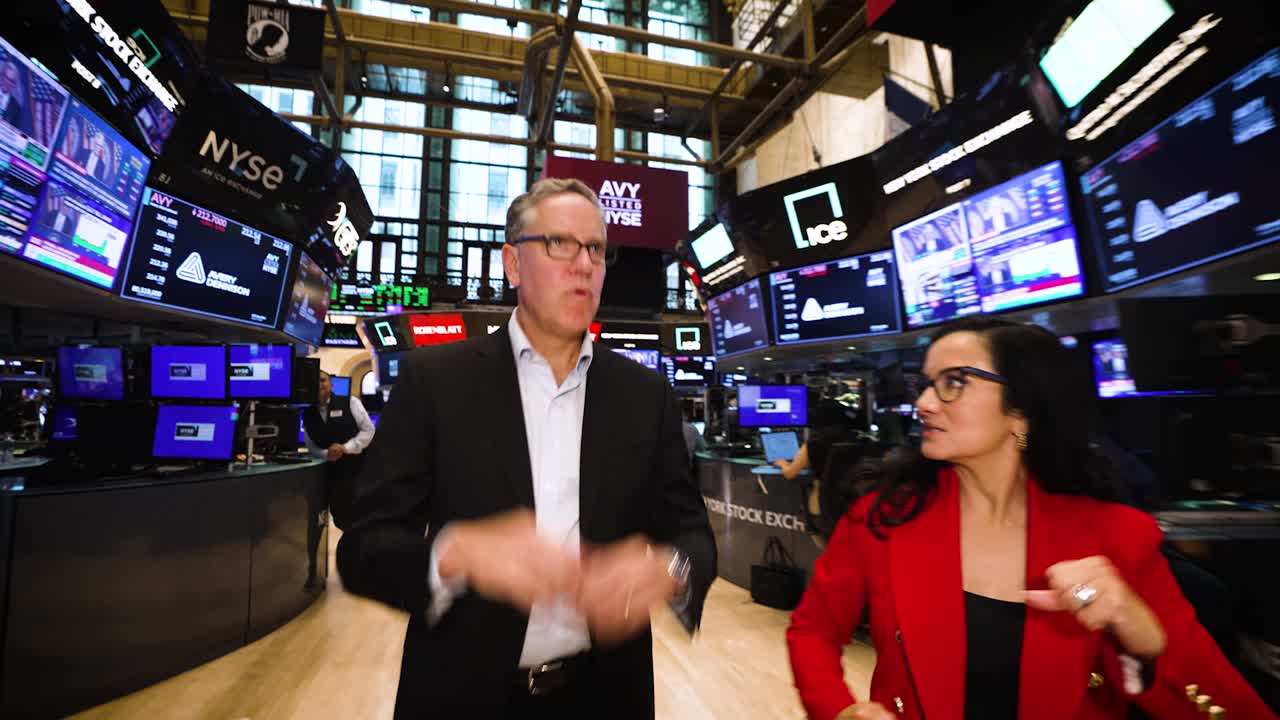
What, exactly, should a shirt know?
Stander’s central proposition is easy to state and harder to execute. In his reflection on his first year as CEO, he wrote that every physical item would eventually have a digital identity, voice and life. He connected that belief to customer problems ranging from supply chain transparency to engagement with consumers. The ambition reaches beyond printing information on a surface. It concerns making individual objects legible to the systems that manage them.
That is why the word “item” matters. A category tells a retailer what kind of thing it sells. An individual identity lets it distinguish one particular thing from another. The value comes from what someone can do with the distinction. Better information can support stock decisions, product movement and the handling of goods across a chain of businesses. A digital identity earns its keep when it changes an action.
Radio-frequency identification, or RFID, is one of the technologies behind this work. Avery Dennison makes the inlays and tags that allow physical goods to be identified electronically, alongside materials and software that help connect the physical and digital. There is an industrial discipline behind the appealing language of connected objects: labels must be designed, manufactured and made useful in the environments where customers actually operate.
“No company stands by itself.”
Deon Stander · 2022
Stander put that dependence plainly in a 2022 discussion of the company’s RFID expansion in Brazil: “No company stands by itself.” The phrase is a useful brake on the idea that a single chief executive can bring a connected world into being. He described an ecosystem of partners. The work extends across manufacturers, brands, technology providers and retailers, each with its own systems and reasons for adopting something new.
The grocery aisle puts the idea to work
Food offers a particularly clear example because its commercial clock keeps running. In October 2025, Walmart and Avery Dennison announced RFID technology for fresh departments, including meat, bakery and deli. The collaboration addressed the difficulty of using the technology in cold environments with high moisture. A broad promise about digital identity had encountered a very specific assignment in a refrigerated case.
The announced uses were equally concrete. Associates could track inventory more quickly and accurately, access digital use-by dates, rotate products and make markdown decisions. Each step concerns an ordinary piece of store work. Taken together, they explain why Stander’s agenda includes waste reduction as well as efficiency. An item that can be found and handled in time has a better chance of being sold.
In January 2026, Stander returned to the subject in an essay about food waste. He drew on Avery Dennison research with the Centre for Economics and Business Research, involving 3,500 leaders across seven markets. The research framed food waste as a projected $540 billion global problem in 2026. That figure describes an estimated industry burden, rather than money already recovered by the company or its customers.
Projected global food waste burden in 2026
His argument was that retailers need to see where loss occurs before they can manage it precisely. He called for collaboration among growers, manufacturers, distributors, retailers and technology partners. It is a commercial case for sustainability, built around inventory that fails to become a sale. The appeal lies in making the cost visible to the people with the power to change a process.
A bigger toolkit, and the arithmetic of running it
Avery Dennison widened that toolkit in April 2026 with a $75 million minority investment in Wiliot. The agreement deepened an existing partnership and made Avery Dennison the preferred partner for inlay design, manufacturing and commercialization. Wiliot’s battery-free Bluetooth sensing technology adds ways to monitor location and condition. The investment also brought Avery Dennison a board seat; it was a company investment, rather than a personal investment attributed to Stander.
Such commitments sit alongside the less glamorous arithmetic of running the business. Avery Dennison reported $8.9 billion in sales for 2025. In the second quarter of 2026, net sales reached $2.5 billion, up 10.9% from a year earlier, with reported earnings per share of $2.67. Stander’s job includes maintaining performance in the business that exists while funding the capabilities he expects customers to need next.
People remain part of that investment. On October 12, 2026, Avery Dennison announced that Helen Sheirbon would become president of Solutions Group on November 3. Stander pointed to her experience in growth, operations and digital innovation at HP. The appointment concerns the business he once ran, now occupying a central place in the company’s attempt to connect physical products with digital information.
What survives ninety years
Asked in 2025 what founder Stan Avery would recognize in the company after 90 years, Stander named four enduring qualities: attention to customers, enthusiasm for innovation, putting the team ahead of oneself and determination to win. His answer joined the company’s present ambitions to its beginnings in self-adhesive labels. The technology had changed substantially; the account he gave of how people should work together was deliberately continuous.
That answer offers a glimpse of his public leadership priorities. So does his first-year reflection, which credited the creativity, service and commitment of the global team. Across these statements, he returns to customers and colleagues even while describing a future full of connected objects. His preferred unit of technological ambition may be the individual item, but the delivery mechanism remains a group of people.
The label is a fitting place for that philosophy to settle. It occupies little space, asks for little attention and travels wherever the product goes. Stander wants it to carry more useful information along the way. After a career spent moving among products, markets and continents, he is working on a modestly sized means of keeping track of things. The scrap we used to throw away has acquired quite a job description.
Follow the conversation
- Deon Stander at Avery Dennison ↗
- Deon Stander on LinkedIn ↗
- His first-year reflection ↗
- His January 2026 essay on food waste ↗
- Watch: NYSE Floor Talk with Judy Khan Shaw ↗
- Listen: The CEO Forum interview ↗
- Watch: FINTECH.TV interview ↗
- Walmart collaboration announcement ↗
- Wiliot investment announcement ↗
- October 2026 leadership announcement ↗