Long before Dennis Wright had a chief marketing officer’s title, he had a financial analyst’s spreadsheet. It is a useful first scene for a career spent around complicated machinery and expensive decisions. Numbers insist on sequence. Inputs arrive before outputs. A claim must eventually meet a cell that either supports it or does not. Wright moved from finance into product management, then product marketing, strategic marketing and executive leadership. The spreadsheet disappeared from the foreground. Its demand for evidence did not.
Today, Wright leads marketing at NuvemRx, a company that combines software, analytics and expert services for community pharmacy operations. It is a category with its own miniature weather system of regulations, reimbursements, integrations and acronyms. A careless marketer could cover the whole thing in a fog of “transformation.” Wright’s public record suggests a more grounded instinct: begin with the operational constraint, explain what changes, and keep the benefit close enough to count.
A career that changed columns
Wright earned a business administration degree from Thiel College in 2005. At MEDRAD, the medical-device company later acquired by Bayer, his progression crossed a boundary that many careers never do. He worked as a financial analyst and senior financial analyst, then moved through associate product manager, product marketing manager and strategic marketing responsibilities. By 2010, he was speaking at an industry meeting as an associate product manager for molecular imaging.
The subject was automated radiotracer dosing. Even then, his explanation followed the pattern that would recur later in pharmacy automation: name the messy manual process, give the acceptable margin, show the tighter result, and connect precision to the moment a clinician needs it. The machine was sophisticated. The argument was plain.
While working in the industry, Wright completed an MBA with a marketing focus at the University of Pittsburgh’s Katz Graduate School of Business from 2010 to 2013. Roles at Bayer HealthCare and ZOLL Medical Corporation followed. Then came Omnicell, where one portion of his work involved IV solutions: robots and services designed for the exacting work of sterile compounding.
The sequence matters because product marketing is often treated as a talent for presentation. Wright’s route suggests something closer to apprenticeship. Finance taught him to examine the business case. Product management put him beside technical constraints and user needs. Strategic marketing widened the frame from a single feature to a market. By the time he was leading portfolios, he had occupied several of the seats whose agreement a launch requires. That range also explains a recurring plainness in his public language. He speaks about accuracy, capacity, time and return on an existing investment. Those are the nouns that survive after the launch event has packed up its screens.
By 2017, Wright was an Omnicell marketing director talking about a problem more human than technical. A disruptive machine does not arrive alone. It brings training, changed routines, capital scrutiny and the low hum of organizational resistance. “When you can assure a pharmacy that they will have a partner in adoption,” he said, “it usually creates some peace of mind.” The line is revealing. Adoption is not a door that technology walks through. Someone has to hold it open.
“When you can assure a pharmacy that they will have a partner in adoption, it usually creates some peace of mind.”Dennis Wright, on introducing IV automation
The robot is the easy character
Machines make vivid copy. They have arms, lights, precise motions and a useful air of the future. Wright’s argument for them was less cinematic. A robot can repeat a task accurately. A pharmacist can then direct attention toward work that requires professional judgment. In his telling, automation was not a shiny replacement for expertise. It was a way to stop spending expertise on repetition.
That distinction carried into his articles and interviews. In 2021, he spoke about automation and technology-enabled services as responses to workload pressure in hospital pharmacy. In 2022, writing about resilient pharmacy operations, he argued for combining automation with data intelligence so pharmacists could work at the top of their license. The phrase “autonomous pharmacy” might suggest an empty room. Wright used it to describe a more connected infrastructure around the people still responsible for the work.
At Omnicell, the scope widened. Wright moved from central pharmacy product marketing to vice president and then global vice president of marketing. He discussed not only new machines but also how to extend the life and value of equipment customers already owned. In a 2024 interview about XT Amplify, his pitch began with restraint: add hardware, software or services to get more value from an existing investment. Hospital buyers did not need to “forklift out” every refrigerator to gain more control over temperature-sensitive inventory. The memorable verb did more work than a slide full of abstractions.
The graph is modest on purpose. Adoption moved from 5 percent in 2019 to 8 percent in 2024, according to figures Wright discussed while at Omnicell. A lesser spokesperson might have polished the slope. Wright explained the drag: constrained budgets, staffing shortages, implementation demands and the unusually high stakes around medication management. Technology in this environment advances at the speed of institutional confidence.
Growth, with the wiring exposed
Public recommendations from colleagues fill in the operator behind the polished explanations. One former collaborator describes Wright as someone able to connect real-time execution with long-term vision. Another credits him with helping an IV automation business grow more than 300 percent in under three years, expanding channel partnerships and contributing to next-generation products. These are testimonials, not audited case studies, but their details agree on a method: work closely with sales, understand the customer problem, and turn strategy into an actionable commercial plan.
There is also evidence of a leader who notices other people’s work. Wright has publicly praised colleagues for empathy, attention to detail and continuous improvement. A testimonial he gave a Pittsburgh design firm is almost comically decisive: “I have the perfect team in front of me. There is nowhere else that I need to go.” It is an extravagant sentence attached to a practical virtue, trust in collaborators. Outside work, his LinkedIn profile lists volunteer service as a local All Pro Dad team captain, leading conversations and activities designed to strengthen relationships between fathers and children.
“I have the perfect team in front of me. There is nowhere else that I need to go.”Dennis Wright, on a design partner
A new name for a wider brief
NuvemRx announced Wright as chief marketing officer in July 2025. The role brought him from enterprise medication automation into the specialized world of community-provider pharmacy operations and 340B. It also presented the sort of translation problem his career had been rehearsing for: a technical company with several capabilities needed to describe itself as one coherent partner.
Later that year, Wright introduced a refreshed NuvemRx brand and website. His explanation placed the substance before the wardrobe. The identity needed to reflect a company offering software, intelligence and expert services, with pharmacy occupying a larger role in community health. At the same time, NuvemRx launched a Community Health Provider Advisory Council. The pairing gave the announcement credibility. A brand declares how a company wants to be understood; an advisory council gives customers a regular opportunity to correct the declaration.
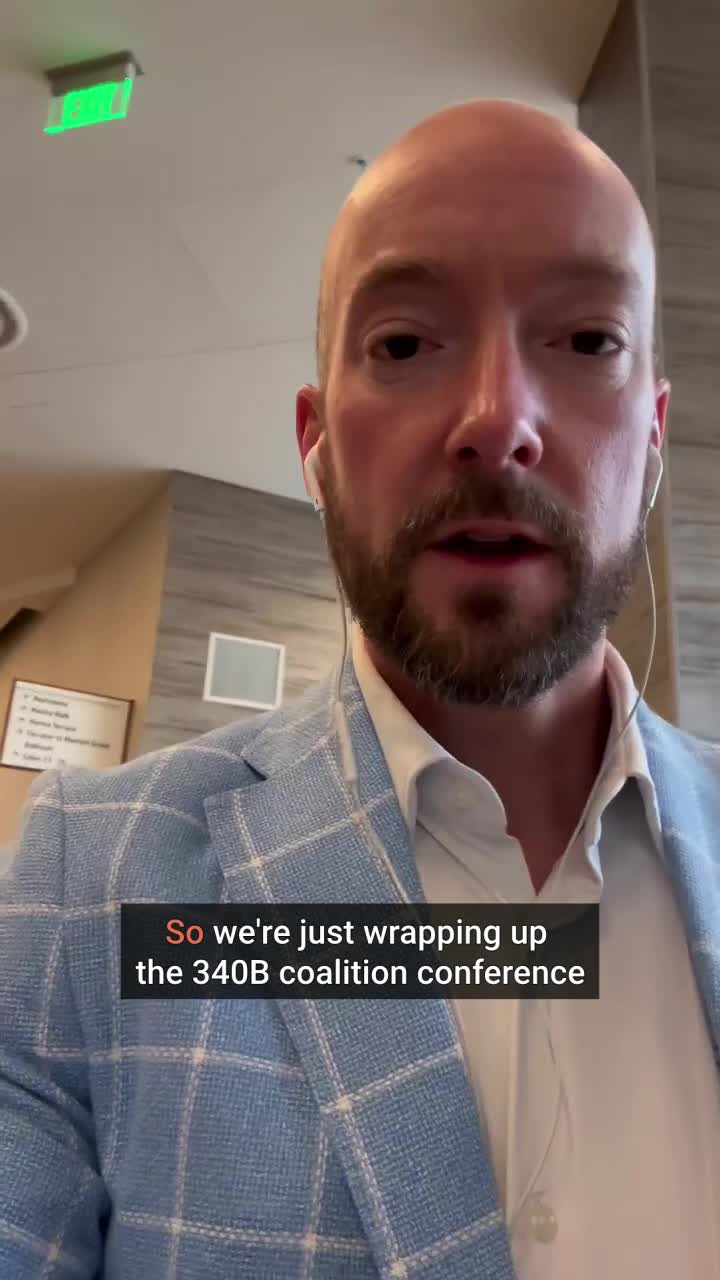
By 2026, Wright’s public updates showed a CMO working the conference floor and the briefing calendar. After a 340B Coalition gathering, he recorded a vertical video about recurring themes he had heard from covered entities. In July, he promoted the first Mission Control Monthly, a short standing briefing intended to convert rule changes and program data into concrete next moves. The format is the strategy in miniature: listen across many operators, identify the pattern, and send back something usable.
The useful sentence
Wright describes himself as a passionate evangelist, marketing leader, problem solver and storyteller. The order probably changes with the meeting. His career offers a more precise description: he is a translator with an operator’s respect for consequences. The technology may be a radiotracer injector, an IV compounding robot, a dispensing cabinet or a platform that watches claims. His recurring questions remain stable. What difficult work is happening now? What can the system handle? What do the people gain? What evidence makes the change defensible?
This form of marketing is relatively quiet. It is particularly suited to rooms where the audience has a budget, a workflow and a long memory. In those rooms, novelty is only the opening argument. The useful sentence is the one that survives procurement, implementation and Tuesday afternoon.
Wright’s two decades in healthcare technology trace the slow conversion of physical machines into connected systems and services. They also trace his conversion from analyst to executive. Yet the analyst never quite left. Somewhere inside the story is still a spreadsheet asking the brand to show its work.