An empty battery room is an unlikely place to look for a business idea. It has none of the usual attractions. No customers. No handsome product display. At FreezPak Logistics, however, removing the batteries meant gaining something David Saoud could sell: room for somebody else’s goods. In a refrigerated warehouse, a space that stops being a charging station can start earning its keep.
That exchange offers a useful way into Saoud’s working life. He co-founded FreezPak with his brother Michael in 2001. Since then, his responsibilities have stretched from sales and transportation to choosing sites and shaping buildings. A customer’s promise of delivery eventually becomes a physical question: where does the truck stop, where does the pallet go, and how quickly can it leave again?
The brothers have spent years connecting those questions. Their company has moved beyond its New Jersey beginnings into a national network serving American port markets. Yet the more revealing story sits inside that expansion: a family business learning how to remove delays, then building the places where that work happens.
The first landlord was Dad
David and Michael grew up working in their father’s food-distribution business, Saoud Enterprises. While they were in college, their father suggested frozen storage as an opportunity. They began with 10,000 square feet leased inside one of his facilities. When they outgrew it, they bought a building in Paterson, New Jersey.
There is an appealing lack of ceremony to that beginning. The new venture had a landlord who knew the family, customers with practical requirements, and a product that occupied actual floor space. Growth meant finding somewhere to put the next shipment. The business could get bigger only if the premises could keep up.
David studied business management at Seton Hall University and graduated cum laude. His career joined that formal education to the family’s experience of moving food. The combination matters because his later job would require both conversations: the commercial discussion about what a customer needs, and the operating discussion about what a warehouse can deliver.
The family’s food-trade history reaches back to 1961. FreezPak’s own founding belongs to 2001. Keeping those dates distinct helps explain the enterprise: the brothers started a new logistics business with a much older store of family experience behind it.
“We are hands on, and we are the face of the business.”
David Saoud, 2020
The sales desk reaches the building site
Saoud’s remit is unusually physical for someone responsible for sales. He oversees the strategic direction of sales operations and transportation, while also directing site selection and building design. That puts him close to the point where a customer’s request becomes a decision that concrete, steel and refrigeration must accommodate.
Consider the services FreezPak brings together: storage, container unloading, transportation, repacking and fulfillment. They belong to different stages of a shipment’s journey. For a customer, arranging them separately means coordinating several tasks and several conversations. FreezPak’s proposition is to handle more of those tasks within one business.
This is where David’s commercial and development responsibilities meet. Selling additional services has consequences for the building: places to receive goods, move them, hold them and prepare them for dispatch. A warehouse designed around those movements can support the promise made at the sales desk. A badly matched building leaves operations to improvise.
- 01Port arrival
- 02Unload & inspect
- 03Store & prepare
- 04Deliver onward
A simplified view of FreezPak’s combined handling, storage and transportation services.
A forklift has a vote
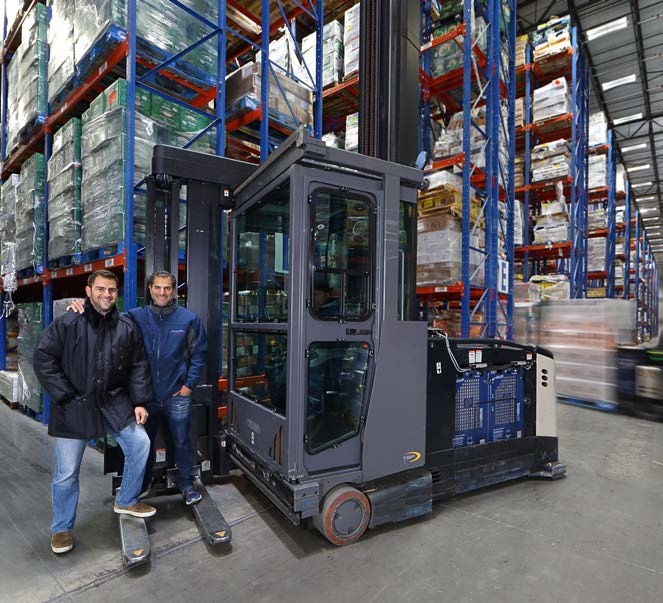
By 2015, FreezPak was operating its new Carteret facility with hydrogen fuel cells powering lift equipment. The change addressed a stubborn operating problem. Batteries needed charging, and charging interrupted the work. A warehouse could have customers, inventory and employees ready to go while the machine needed to move the goods was unavailable.
A historical supplier case study recorded roughly an hour per shift spent on battery charging, compared with about two minutes for hydrogen refueling. Operations manager Phil DeMedici reported a 40 percent increase in volume moved during a nine-hour shift. Those were reported results from that installation, rather than a promise about every warehouse.
The space mattered too. Charging infrastructure took up room that could otherwise serve the business. Replacing it changed the use of the floor, alongside the way equipment was powered. In David’s world, the machine and the building were participating in the same commercial calculation.
Historical per-shift charging comparison reported in Plug Power’s FreezPak case study. Times describe the reported installation.
The brothers also appeared at Plug’s 2022 symposium, discussing their experience as customers. David described recovering warehouse space previously occupied by batteries and stressed how expensive refrigerated real estate was relative to a dry warehouse. For him, the appeal of the technology included an ordinary landlord’s concern: making usable space productive.
There is a pleasing correction here to the grand language that often surrounds new technology. The practical test was whether work could continue and floor space could be put to better use. The freezer supplied a fairly demanding examination room. The forklift, apparently, had strong opinions about the syllabus.
The comparison also shows why David’s work resists a neat division between sales and operations. Time recovered from equipment charging matters to the customer only when it helps the warehouse complete the job. Space recovered from a charging room matters commercially when it accommodates inventory. The benefit must pass through the operation before it reaches the person buying the service. That is a useful discipline for an expanding company: the impressive part of a new facility still has to show up in the ordinary work of receiving, storing and shipping goods.
The building is part of the service
Saoud Development, established in 2020, gives the expansion a dedicated real-estate arm. Its role is to develop facilities for FreezPak’s operations. David’s emphasis on site selection and design therefore has an organizational home as well as a place in his job description.
In 2024, he described the company’s growth as largely coming through ground-up developments aimed at port markets. That approach allows the logistics business to specify the kind of facility it expects to operate. It also keeps construction tied to an operating plan, rather than assuming that available warehouse space will suit the work.
The Houston project illustrates how that ambition gets financed and built. In October 2023, a $75.9 million construction loan was reported for the first phase of a cold-storage development near Houston. David was identified as a managing member of BGFP International, the venture involving FreezPak and BG Capital.
At the time, he described a goal of reaching every major domestic port by 2030, with facilities built to suit the operator’s requirements. That remains a stated ambition with a deadline. The distinction matters: a plan identifies where the founders want to go; an operating facility shows what has actually been delivered.
A national map, with New Jersey still on it
The map has continued to fill in. FreezPak’s first West Coast facility was announced in the Los Angeles area in early 2025, with 150,000 square feet of space. The location put the company near the ports of Los Angeles and Long Beach, extending its port-oriented approach across the country.
In April 2025, FreezPak announced the opening of its Jacksonville facility. The company described 272,000 square feet, more than 50,000 frozen and cooler pallet positions, and 32 dock doors. These are the dimensions of the service promise: capacity to hold goods and enough points of entry and exit to move them.
More recently, its Fall River announcement added a Massachusetts location serving New England, with up to 12,789,000 cubic feet of temperature-controlled capacity. The geography has a consistent logic. Each additional site needs to work locally while contributing to a broader network customers can use.
Expansion has also returned to familiar territory. In 2026, FreezPak announced another Elizabeth facility, its seventh in New Jersey, developed by Saoud Development. The company specified up to 9,849,000 cubic feet of capacity within five miles of APM Terminals. The home state remains a working part of the national plan.
That announcement brings David’s overlapping roles into focus again. He is a co-owner of the logistics operator and its development arm. The customer, the site and the building are linked decisions. Distance from a port is something a sales discussion can turn into a development requirement.
Recognition shared by two brothers
In June 2023, David and Michael were named EY Entrepreneur Of The Year New Jersey award winners. Later that year, David wrote that they had finished as national finalists. He thanked FreezPak’s employees and named colleagues who had helped them along the way.
His public congratulations to the Chicago team on its first anniversary offered a smaller example of the same habit. He connected customers’ satisfaction to employees who cared about the work, and framed their effort as a continuation of the family’s service tradition. The language stayed close to the relationship between staff and customers.
For a business spreading across several states, that relationship becomes a practical management question. The founders can share a title and choose a site together. They still depend on people in individual facilities to receive the freight, prepare the order and make the promised service happen. A national network needs local competence every day.
David’s career keeps returning to that connection between a commercial promise and the arrangements that make it possible. A new port market adds customers to pursue. A purpose-built warehouse gives the operation somewhere to serve them. And somewhere inside it, a room once reserved for batteries can become space for the next customer’s shipment.