A frozen box is a remarkably impatient customer. It cannot be persuaded to wait, impressed by a funding announcement or distracted with a discount code. Somewhere between the warehouse and the front door, the temperature has to stay right. Juan Camilo Meisel spent six years at ButcherBox learning how many decisions sit inside that apparently simple requirement. Then he founded Grip, a company built around making those decisions for other people.
There is a familiar way to tell a startup story: an idea arrives, a founder acts, a business follows. Meisel’s version has considerably more cardboard. He came to the problem through the work itself, with a family background in distribution and an early role at a company selling meat online. The opportunity became visible when other brands began asking how he had handled the very difficulties they were now encountering.
A warehouse before a business school
Meisel grew up in Colombia, around a family distribution business with a history stretching across generations. His father, Federico, runs Meico. In 2022, when the company celebrated its centenary, Meisel posted about his father’s first appearance in a corporate video. He sounded amused that anyone had managed to get him in front of a camera. He finished by wondering whether he should get his father onto LinkedIn.
The affection in that small story matters. Meisel credited his father with teaching him the relationship between work and success. Business, in this telling, is something you watch somebody do over many years. A company turning a hundred has an unusual sort of classroom: its lessons have survived more than one economic fashion. Boxes still need packing when the fashionable language changes.
He graduated from Karl C. Parrish School in 2013 and attended Bentley University from 2013 to 2017, studying business management. His early interests already included building businesses, rather than simply studying them. In his own account of the years around graduation from high school, he tried an ambitious online retail venture in Colombia, then shut it down and went to college in the United States.
That decision gives his later advice some weight. Continuing is one entrepreneurial skill; stopping is another. An early venture can provide an education even when it does not become the enduring business its founder imagined. Meisel carried his interest in e-commerce to Boston, where the next company would give him a much more specific problem to study.
When selling the box became delivering the box
At ButcherBox, he joined the early team and eventually led logistics. In the beginning, the question was how to get people to buy meat online. As subscriptions arrived, the question changed: how to get the meat to them. Success at acquiring customers created a fresh obligation in the warehouse. The sales graph could climb faster than the operation beneath it.
Meisel helped the team build the logistics infrastructure through six years of growth, as ButcherBox reached roughly $600 million in annual revenue. That number belongs to a company and its team, rather than to one person’s résumé. His place within it was nevertheless unusually useful preparation: he had to understand what happened after a customer clicked the button.
The problems were expensive and repetitive. A delayed shipment could mean lost food, wasted transportation and a customer whose plans had been interrupted. Systems had to account for changing conditions, yet much of the work depended on spreadsheets. Each spreadsheet might solve an immediate issue. Taken together, they also revealed how much coordination the business required.
Other brands were wrestling with the same questions. Meisel began advising companies that approached him, and the pattern widened beyond the needs of his employer. If several businesses keep rebuilding a similar solution, someone may have an opportunity to make that solution available to all of them. The demand was arriving as a request for help.

Grip was founded in 2022. Jimmy Cooper, another ButcherBox alumnus, became co-founder and chief technology officer. The pairing put operational knowledge and technical work around a problem both founders had encountered. By 2024, Meisel was discussing Grip across e-commerce podcasts, explaining why a brand should be able to use shared shipping infrastructure rather than assemble every part itself.
The forecast goes inside the parcel
Consider two orders for the same frozen product. One has a short journey in mild weather. Another faces a longer route with hotter conditions. Identical packaging and shipping choices would be convenient for the person writing the rule. They would not necessarily be convenient for the product, or for the person paying the invoice. Uniformity can conceal a surprisingly expensive guess.
Grip’s approach takes changing information into account: weather, transit times, carrier performance and the requirements of the shipment. Those inputs inform choices about packaging, refrigerant and service. Meisel’s argument is that brands can be more precise about what each box needs. Adding more coolant to everything may feel reassuring. It also means buying reassurance for boxes that do not require it.
Route
Carrier performance
Refrigerant
Shipping service
Transit
Front door
There is an appealing modesty to the actual task. The output may be a different service level or a different quantity of refrigerant. Nobody receiving dinner is likely to applaud the optimization. They open the box, put the food away and carry on. The invisible decisions have done their work when the visible experience feels ordinary.
In conversations about product development, Meisel also emphasizes involving customers and improving quickly. That is a sensible discipline for this kind of company. A brand’s shipping problem comes with particulars: its products, its customers, its economics and its existing operation. Listening to those particulars gives a shipping platform something more useful than an abstract description of the market.
His discussion of customer referrals follows the same logic. A delivery business earns a recommendation through repeated execution. The customer can explain the result to another brand because the result has shown up at somebody’s doorstep. The pitch gets easier to understand when there is a box to point to.
The person who walks into the meeting
Meisel’s account of meeting John Hummel is a miniature portrait of what he notices in people. During his ButcherBox years, he was helping establish a fulfillment facility in Wisconsin with a partner. The team was in a long meeting, going back and forth over things that needed fixing, when Hummel walked in. Meisel remembered an immediate change in the room’s energy.
“He was there to get shit done.”Juan Camilo Meisel, recalling his first meeting with John Hummel
In 2026, Hummel joined Grip as president of Grip Fulfillment, bringing nearly four decades of industry experience. The earlier encounter had evidently stayed with Meisel. Hiring someone years after watching them work offers a different kind of evidence from a polished interview. He had already seen the moment when talk needed to turn into action.
Relationships recur in his account of education, too. Asked about his school experience, he stressed community and the ability to build connections. Asked what students should do if they wanted to follow a similar path, he suggested joining an early-stage startup led by a founder they admire, learning there and then building their own business.
“Experience is an unfair advantage, so use it.”Juan Camilo Meisel, in his Karl C. Parrish alumni interview
The recommendation is practical enough to resist the usual graduation-speech fog. It names an environment, a person to learn from and a sequence. You can admire a founder from a distance; working with one lets you see the decisions that never make it into the anniversary post. Meisel’s own apprenticeship included both the appeal of growth and the work growth demanded.
Reno, and the distance still to travel
By 2026, Grip’s progress had acquired public markers. It ranked No. 6 on the Inc. 5000, which listed three-year revenue growth of 29,398 percent. The ranking measures growth over a defined period. It provides a striking number, while the operation still has to answer a more immediate question each day: which boxes need to leave, and how?
Grip’s national ranking
29,398% listed three-year revenue growth
On September 1, Grip announced the opening of a 150,000-square-foot facility in Reno, described as its sixth nationwide hub. The company said it created more than 60 jobs and placed the network within one-day ground shipping reach of about 60 million people across 11 Western states. The figures describe potential reach, rather than a count of customers or a promise that every order takes one day.
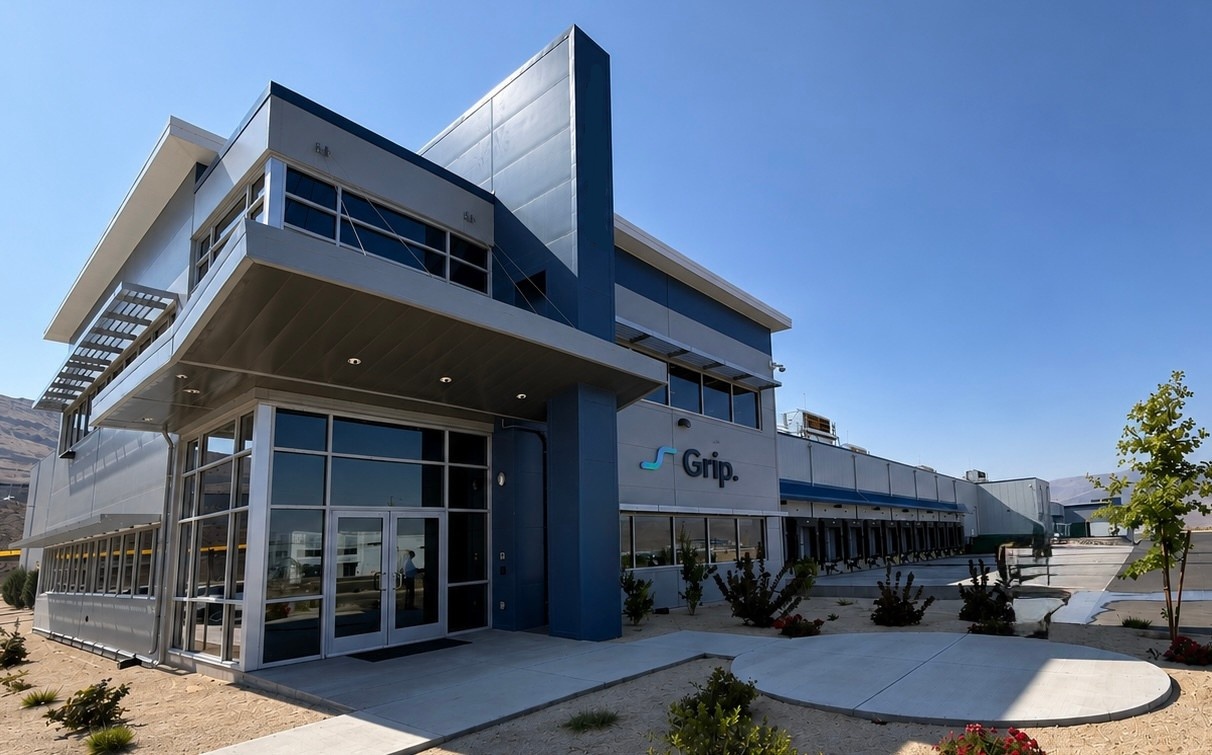
Meisel said Reno had been on his mind for more than three years. That is a useful detail beside the growth percentage. A facility opening has a date; the thinking behind its location can have a much longer calendar. Software can recommend a better route, but the building has to exist where the recommendation needs it.
His stated ambition remains tied to the customer’s division of labor. Brands should be able to concentrate on their products and their customers, with Grip handling the logistics complexity behind the order. From family distribution to ButcherBox to a network of fulfillment facilities, his work has kept returning to the same practical obligation. Someone makes the promise. Someone gets the box there. Dinner would prefer those people to stay in touch.