At nine years old, David Neeleman needed a crate to reach the cash register at his grandfather’s grocery store in Salt Lake City. He was learning a business in which a customer could ask for something, receive it, and leave happy. Decades later, he would attempt this arrangement with airplanes. The customer’s wishes were much the same. The machinery had become considerably less cooperative.
His grandfather, John, treated a missing item as a problem to solve. If the store did not have what a customer wanted, he might buy it elsewhere and deliver it. That is an expensive habit if you count only the errand. It becomes more interesting if you count the person who comes back.
Neeleman’s career has repeatedly returned to that calculation. He has helped start five airlines, including JetBlue, whose founding promise was to bring humanity back to air travel. He has also lost a travel business, been dismissed from Southwest, and been replaced as JetBlue’s chief executive. Starting again has required more than a fresh coat of blue paint.
A cash register before a cockpit
Born in São Paulo in 1959, Neeleman moved to the United States as a child and grew up in Utah. Brazil remained part of his life. His father worked there as a journalist; Neeleman later returned as a Latter-day Saint missionary and learned to speak Portuguese. His eventual Brazilian airline would have roots considerably deeper than a market study.
The airplanes had arrived early in his imagination. In a 2025 interview, he recalled a family scrapbook his mother gave to JetBlue’s public-relations team. There, on his third-birthday cake, was an airplane. Childhood decorations rarely provide a business plan, but this one turned out to have a longer useful life than the cake.
His early business was closer to a holiday brochure. While attending the University of Utah, he built a company selling Hawaii trips, combining accommodation with discounted airline seats. It grew large enough for him to leave college before completing his accounting degree. Then an airline supplying those seats went out of business. His promising enterprise went down with it.
A travel package is a collection of other people’s promises. The customer buys one holiday; the operator inherits every dependency. Neeleman learned that distinction while young, with a family to support. He went back to work, including at his grandfather’s store. A cash register, unlike a startup valuation, tells you exactly what you have.
June Morris, the Utah travel-agency owner, brought him back into the business. Together they developed Morris Air, beginning in 1984. She supplied an opportunity and a working partnership when his own first attempt had come apart. The origin of his airline career includes someone willing to make that call.
A ticket you could leave at home
At Morris Air, Neeleman helped introduce electronic ticketing and a reservations operation staffed by people working from home. Both ideas addressed ordinary nuisances. Paper tickets could be forgotten. A reservation agent did not necessarily need a central office to answer a telephone. An airline could reconsider the things everyone else regarded as furniture.
These were service decisions with an operating logic. Removing paper could simplify a transaction; changing where reservations were handled could alter the cost of taking bookings. Neeleman’s interest in the passenger experience came with an interest in what happened behind the passenger’s back.
Southwest acquired Morris Air in 1993 for approximately $130 million. Neeleman joined Southwest, then lasted only months. He admired Herb Kelleher and had borrowed ideas from the airline. Admiration, it turned out, was insufficient preparation for becoming an employee inside someone else’s creation.
A noncompete agreement constrained his next American airline venture. He worked on Open Skies reservation software and helped develop WestJet in Canada, where the airline began flying in 1996. The detour gave his career an unusual shape: airline operations, software, another country, then a return to the United States with another proposal.
- Morris Air1984 · United States
- WestJet1996 launch · Canada
- JetBlue2000 first flight · United States
- Azul2008 · Brazil
- Breeze2021 first flight · United States
Milestones mark the start of Morris Air and Azul, and first flights for the other carriers. Neeleman’s roles varied: founder, co-founder and startup adviser.
Something good in coach
JetBlue was incorporated in 1998 and began revenue service on February 11, 2000, flying between New York’s JFK Airport and Fort Lauderdale. Its proposition was legible from a passenger seat: low fares, a comfortable cabin and live television. An inexpensive ticket could come with something people actually enjoyed.
The television mattered because flying involves surrendering control of your time. A screen could give some of that time back. The passenger could choose a channel while the airline dealt with the altitude. It was a modest form of agency, but anyone who has examined an airline seat pocket for entertainment understands its appeal.
By its third birthday, JetBlue had flown its ten millionth customer and was introducing its thirty-eighth aircraft. Those milestones gave substance to the idea that service and low fares could coexist. A pleasant detail in the cabin was attached to a business people were repeatedly choosing to use.
Dave Barger, who joined in 1998 as president and chief operating officer, was central to that business. The founder could articulate what a different airline ought to feel like. Someone also had to make the operation deliver it. Their working relationship would become especially consequential when JetBlue’s promise met a week its systems could not handle.
When the promise froze
On Valentine’s Day in 2007, an ice storm brought JetBlue’s operation into crisis. Aircraft and passengers were stranded. In his later congressional testimony, Neeleman described inaccurate weather forecasts, departures that did not leave as planned, arriving planes that needed occupied gates, and deicing that took longer than expected. One failure complicated the next.
That account is a reminder of how many people must cooperate before an airline can appear effortless. A seatback television is visible. The capacity to recover a broken schedule is harder to admire until you need it. For passengers waiting on the ground, the distinction was painfully practical.
Neeleman apologized publicly. JetBlue introduced a customer bill of rights in February, offering compensation for specified disruptions. The promise now had consequences beyond an unhappy review. In May, Barger became CEO, and Neeleman moved to the non-executive chairmanship.
The episode resists a tidy redemption line. Passengers endured a failure, the airline had to repair its operation, and its founder lost the job most closely associated with his name. A career profile that skips this part mistakes a route map for a flight record.
Another home, another departure
The following year brought Azul. Founded in January 2008, it began commercial operations on December 15 with services linking Campinas to Salvador and Porto Alegre. Neeleman had returned to his birthplace carrying years of experience, a network of collaborators and a conviction that more Brazilians would fly if the journey became affordable and useful.
“Having been born in Brazil, it’s so exciting to be able to start a new airline in my other home.”
David Neeleman · Azul launch, December 2008
Azul’s launch aircraft were Embraer jets with two seats on each side of the aisle. No middle seat is a selling point that requires very little translation. The smaller aircraft also supported the business argument: serve markets where larger planes and circuitous journeys left room for another approach.
His relationship with Brazil gave the venture a personal dimension, though affection could never fill an airplane by itself. Azul needed routes, crews and customers. Its network developed around Campinas, and the company later went public in 2017. The earlier experience of losing a business had not led Neeleman toward a quieter industry.
Leaving university had also left a connection intact. In 2013, the University of Utah’s business school reported his $250,000 donation toward a classroom in its new building. He had gone elsewhere to build companies, then helped pay for a place where other people could study them. The former accounting student still had a use for a classroom.
In January 2019, another connection resurfaced. Traveling on JetBlue, he received a warm note from the crew and shared it on Instagram. More than a decade after his removal as CEO, people inside the airline still wanted to acknowledge him. A founder can leave the organization chart without disappearing from the organization’s memory.
The empty space on the map
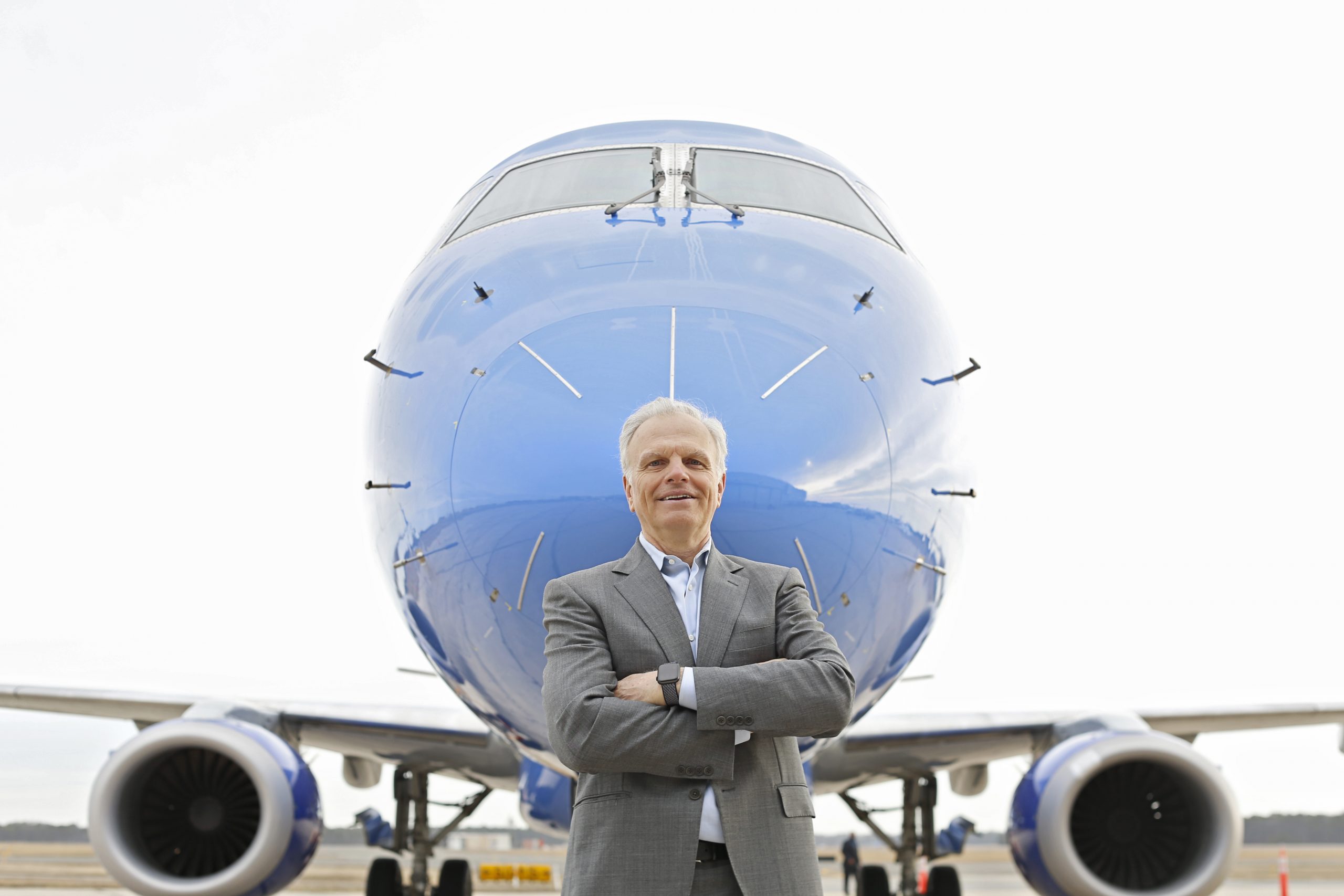
Breeze’s inaugural flight left Tampa for Charleston on May 27, 2021. Its announced opening network comprised 39 nonstop routes between 16 cities. Ninety-five percent had no existing nonstop service. The pitch placed a familiar annoyance at the center of the business: going somewhere else first in order to get where you actually wanted to go.
A connection is measured in a timetable, but experienced in an afternoon. It may mean an earlier alarm, another queue, or a meal purchased because there is nothing else to do. The opening for Breeze was to make some of those journeys direct. Smaller markets could have enough passengers for a useful route without resembling New York.
Neeleman still talks about kindness, but he also talks about communication. At a 2024 industry conference, he described regular calls with operating teams and the need to keep explaining the company’s vision. Culture requires repetition, particularly when the employees making it real are scattered across airports and aircraft.
His ambitions remain specific enough to put on a departure board. On October 3, 2026, Breeze launched nonstop Tampa–San José service. Ten days later, Tampa’s airport announced a Santo Domingo route scheduled to begin June 18, 2027. An airline that began with overlooked domestic journeys was extending the idea across borders.
At the grocery counter, a customer’s request could send his grandfather down the street. Neeleman’s version involves aircraft orders, regulators and an intimidating quantity of fuel. The useful part of the family lesson survives the change in scale: pay attention when somebody asks for a journey that ought to be easier.
Further departures
Follow the work, hear the conversations, or revisit the history.