Brian Beutler brought a climbing story to a room full of telephone people. In the summer of 2026, he had climbed the Grand Teton with his two older sons, taking the Exum Ridge. By September, the excursion had supplied a name for Alianza’s new platform: Crux, the climber’s term for a route’s hardest section. It was an unusually candid product name. Most technology branding promises to remove difficulty. This one pointed straight at it.
The choice suits a founder whose career has involved persuading an old industry to change its habits while keeping everyone’s calls connected. Beutler runs Alianza, the Utah company that bought Metaswitch from Microsoft and now works with more than 1,000 communications service providers. His customers have networks to maintain, subscribers to retain and a reasonable aversion to experiments that might interrupt either. He wants them to see artificial intelligence as a reason to rebuild their businesses.
There is something pleasantly inconvenient about his argument. After years spent making the case for cloud communications, he is asking the industry to prepare for another transition. The summit, in telecom, appears to have excellent views of the next mountain.
The business after the business
His own account of Alianza’s beginning starts with a sale. In December 2008, Beutler completed the sale of GetFon to AT&T/Alestra. A month later, he began Alianza. The interval between finishing one company and starting the next was short enough to make retirement seem like a clerical oversight.
GetFon had helped businesses replace their in-house telephone systems with a hosted service. That experience gave him a practical understanding of what customers would pay to escape: maintaining equipment, managing complexity and committing capital before they could get on with their actual work. A cloud service could change those economics.
At Alianza, he moved the same question up a level. Instead of serving a business with a few dozen telephone lines, he would serve the companies supplying those lines to entire communities. The operator would keep its customer relationship; Alianza would take on the underlying communications platform. That change in customer made the ambition much larger, and the consequences of getting it wrong much less forgiving.
The early customers included wireless broadband providers working over WiFi, WiMAX and satellite connections. In other words, Beutler’s team learned its trade where the network did not always offer ideal conditions. A sales presentation can assume a perfect connection. A telephone business has to accommodate the one that actually exists.
A company measured in years
By Alianza’s tenth anniversary in 2019, Beutler could describe a substantial business: the previous year, it had announced more than 60 service providers and over 300,000 end users across the United States and Canada. He also acknowledged stretches when he had doubted the company would survive. The anniversary letter contained gratitude, but very little suggestion that the preceding decade had obeyed a tidy business plan.
He was especially taken with the anonymity of the work. People making calls over the platform generally had no idea Alianza existed. They were arranging interviews, taking orders, checking on admissions and talking to people they cared about. That is a peculiar reward for a technology founder: when the product works, the person using it can remain magnificently uninterested in the company behind it.
In a later founder questionnaire, he described raising more than $100 million from venture investors. Yet the accomplishment he singled out was enduring more than a decade of difficult periods. His account of progress makes room for repetition, persistence and people who continue turning up. Those qualities rarely look dramatic on a slide. They become rather more interesting when the slide deck has stopped persuading anyone.
Buying more of the conversation
Alianza’s acquisitions show how Beutler widened the job. In 2021, it completed the purchase of CounterPath, the Vancouver company behind Bria softphones and collaboration technology. Calls were becoming part of a larger collection of tools: video meetings, messaging, mobile applications and desktop software. The purchase gave Alianza more of what people actually touch when they communicate.
Beutler described the resulting business as a full-stack cloud communications platform. Beneath the phrase was a straightforward commercial idea. A service provider could obtain the customer-facing applications, management tools and underlying platform from the same company. The provider would have a broader service to sell and fewer separate pieces to assemble.
His positioning also involved a promise about relationships. Alianza said it would avoid selling directly to the small businesses and enterprises its service-provider customers wanted to serve. In a market where a supplier can become a competitor, choosing where to stop selling is part of the product. Beutler was asking operators to trust him with their infrastructure; giving them another rival for their customers would have been an awkward opening gesture.
By November 2023, Alianza had announced a multiyear strategic collaboration with Amazon Web Services. Its deployed customers included Lumen, Brightspeed, Bluepeak, Xplore and Viasat. The cloud argument had acquired recognizable names. For Beutler, this was evidence that the approach could travel beyond the smaller providers that had helped establish it.
The Microsoft deal, and the listening afterwards
Then came Metaswitch. Alianza announced its agreement to acquire the business from Microsoft in December 2024 and completed the transaction on March 4, 2025. The combined customer base exceeded 1,000 service providers, including 19 of the top 20 global operators. An entrepreneur who had started by helping businesses replace their telephone systems was now responsible for a company supplying some of the operators behind the world’s telephone traffic.
Buying a business of that reach created a different kind of assignment. Alianza committed to supporting existing Metaswitch products while bringing its cloud technology into a unified portfolio. Customers needed a path forward that respected the systems they already depended on. The transaction brought opportunity, along with the unglamorous obligation to make the pieces work together.
Beutler’s immediate description of the work was strikingly ordinary. He called it the “One Company” phase. The priorities were integrating colleagues, aligning teams and listening to customers. In March 2025, he said the company would speak with more than 150 of its top customers over the coming weeks, with the longer-term intention of engaging every customer. Scale had enlarged the listening list.
He also distinguished building applications from delivering them. Operators might not create every new communications application themselves, he argued, but their existing relationships gave them a role in getting those applications to customers. It is an argument for making established companies useful in a changed market. They already know the subscriber. Beutler wants that familiarity to count for something.
The difficult section gets a name
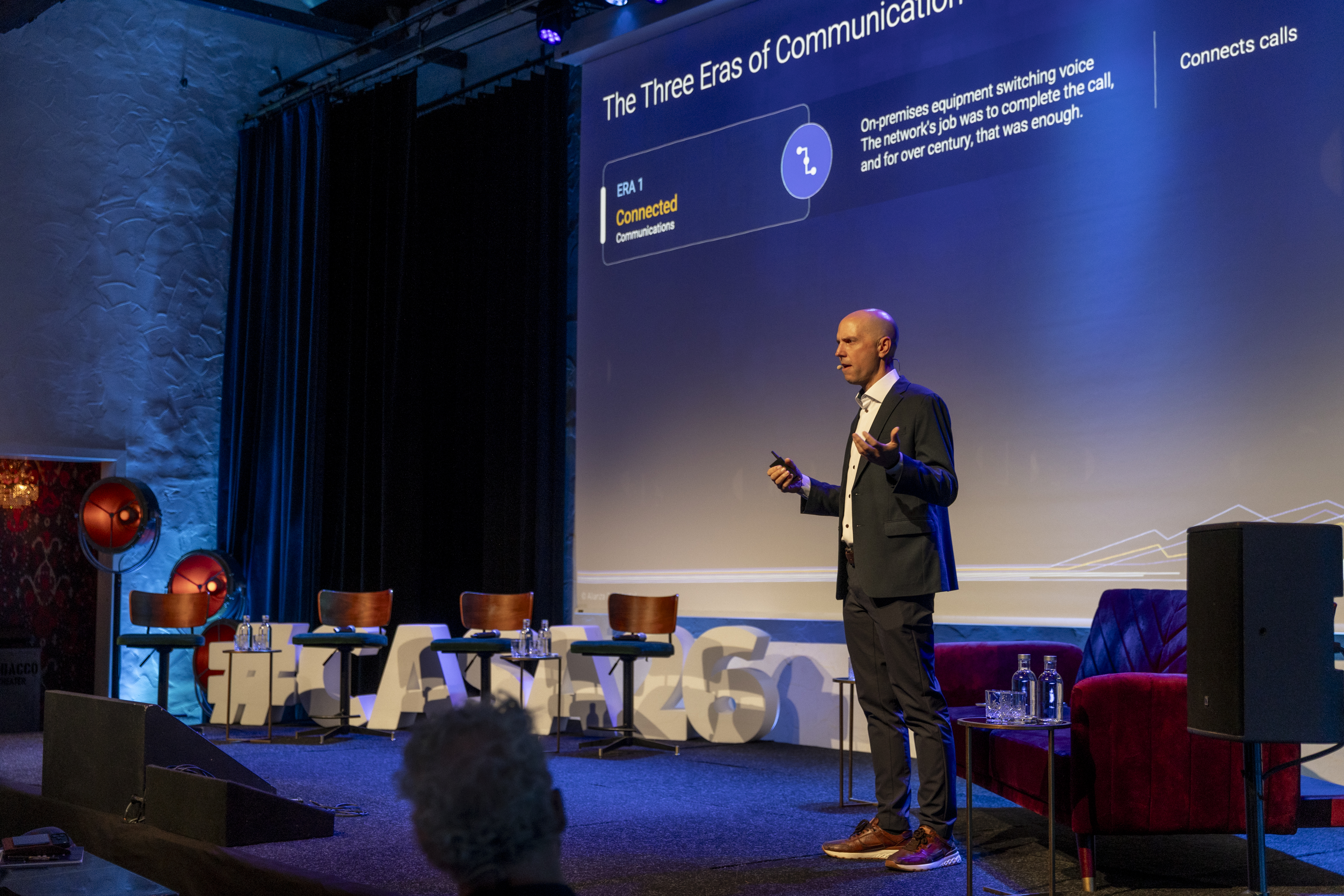
Crux, introduced in September 2026, advances that argument into AI. The platform is designed to coordinate communications networks, applications, identity, consent and policy within the same conversation. Rather than making each developer build a separate path into each operator, Alianza proposes a shared place where the two can meet.
The aspiration is specific: several intelligent services could participate in a call, with the network retaining the context and controls needed to manage them. Alianza launched Crux in controlled availability, with broader commercial availability planned for the first half of 2027. Those dates matter. Beutler is describing a product being introduced and developed with partners, with a larger commercial test still ahead.
networks
orchestration
applications
Identity · Consent · Policy · Conversation context
The following day, Alianza announced its acquisition of Skribby, whose meeting-bot and transcription technology would extend the plan into Microsoft Teams, Google Meet and Zoom. Its founder, Pieter Jan Pollie, would join Alianza. Integration was expected in the first quarter of 2027. The move extends a familiar pattern in Beutler’s career: make communications easier to use by taking on more of the machinery underneath.
There is demanding work ahead. Operators have to adopt the model, and developers have to see a reason to build around it. Beutler has acknowledged that some developers he meets have never heard of Alianza. Anonymity is an elegant quality in the infrastructure behind a call; it is a less convenient starting point when recruiting a software ecosystem.
Coming back to the mountain
Outside the company, Beutler hikes, mountain bikes and snowboards. He also volunteers with the Utah County Sheriff’s Office Search and Rescue team. A maxim he brings from that work favors a deliberate pace, one that avoids mistakes and unnecessary rework. It is compact enough to survive a management meeting, and practical enough to apply as Alianza grows.
“Slow is smooth, and smooth is fast.”
Brian Beutler, on a lesson from search and rescue
The public recognition has followed. Utah Business included him among its 2025 CEO of the Year honorees, and in June 2026 he won EY’s Mountain West Entrepreneur Of The Year award. By October, Alianza had also announced that GFiber had selected Alianza One to power its phone service. The old job of connecting calls continued alongside the new one of figuring out what could happen within them.
That coexistence gives Beutler’s story its tension. He has built a career around changing the telephone business without abandoning the people already using it. Now he is asking customers to attempt another difficult section. The mountain vocabulary feels earned: preparation, patience, partners, and the knowledge that naming the hard part is only the beginning of getting through it.