Breaking - Voximplant crosses 2.5 billion calls a yearHyundai doubles test drive conversions with a robotAvatar product turns IVR into actual conversation$30M Series C closes - 202130,000+ developers and countingJavaScript runs the phone network nowBreaking - Voximplant crosses 2.5 billion calls a yearHyundai doubles test drive conversions with a robotAvatar product turns IVR into actual conversation$30M Series C closes - 202130,000+ developers and countingJavaScript runs the phone network now
Voximplant - the bird in the wires
YesPress / Company File No. 042
The cloud that taught phone calls to think.
Voximplant is the serverless voice-AI platform humming under 2.5 billion conversations a year. You have probably talked to it. You just didn't know.
It is a Tuesday in Seoul. A shopper fills out a test-drive request on Hyundai's website. Sixty seconds later, the phone rings. The voice on the other end is calm, fluent, weirdly patient. It asks two questions and books a slot. It is not a person. It is not, technically, a robot either. It is a script running somewhere in California - on a serverless cloud built by a company most people who use it have never heard of.
That company is Voximplant. Headquarters: a low-key office on East Bayshore Road in Palo Alto. Headcount: around 210. Annual revenue: a polite $20.7 million. The thing they sell is invisible: the plumbing that lets software make phone calls, video calls, send messages, and - increasingly - hold actual conversations. They are the parrot in the wires.
"Voice is the most natural interface humans have. Until recently, it was also the most unprogrammable."
— Voximplant founding thesis, restated often
The problem they saw, in 2010
Telecom, for most of its life, was a guild. To make a phone call from your website, you needed carrier contracts, a SIP stack, a data center, lawyers and a hardware vendor that wanted to sell you a forklift. Developers, who had been merrily turning everything else into APIs since 2006, looked at this and went elsewhere.
In 2010, a small team in Russia - Alexey Aylarov, Andrey Kovalenko and Sergey Poroshin - launched a click-to-call widget called Zingaya. The premise was simple, almost rude in its simplicity: paste a line of JavaScript on your site, and visitors could ring you from the browser. No phone, no plug-in, no install. (Well - Flash. It was 2010.) The widget worked. Customers used it. The founders also realized they had accidentally built the harder, more interesting thing: the underlying voice cloud.
"We made the first browser-to-phone call in 2007. It felt like science fiction at the time. We just kept walking in that direction."
— Alexey Aylarov, CEO, in interviews
In 2013, they pivoted. Zingaya became Voximplant: a programmable cloud where developers write JavaScript to control phone calls, video sessions, conference rooms, SMS, push notifications. Telecom, but with a package manager. The forklift was retired.
The founders' bet
Most CPaaS companies of that era - the Twilios and Plivos of the world - bet that voice would become a commodity utility, billed by the minute and forgotten. Voximplant made a stranger bet: that voice was a programming problem. Their core product is, essentially, a runtime. You write a JavaScript scenario - VoxEngine.callPSTN(), attach a recognizer, branch on the result - and the platform executes it inside the carrier network, in real time, with sub-second latency.
The bet has aged well. Once your call logic is code, you can do things that the old guild simply could not. You can A/B test a script. You can roll back a bad IVR like you would roll back a bad deploy. You can drop a large language model into the conversation and see what happens.
2.5B+calls / year
30,000+customers
50+countries
"Telecom that ships on a Friday afternoon. Not a sentence anyone expected to write."
— YesPress field notes
The product, in plain English
Voximplant is really three things wearing the same hoodie.
Platform
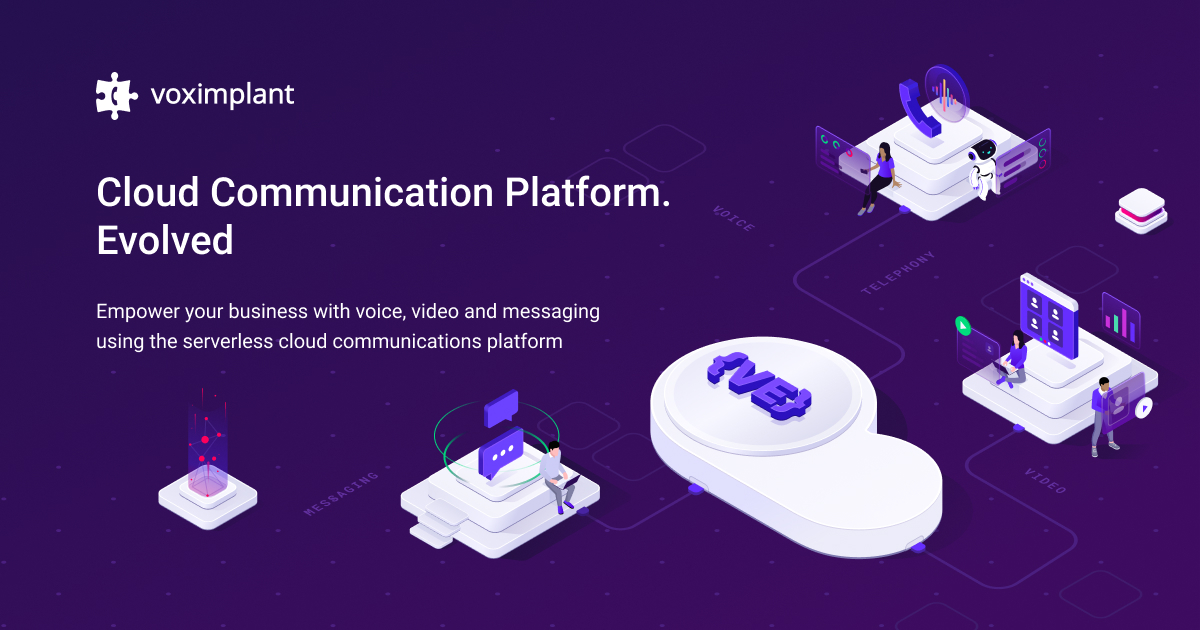
The serverless CPaaS. Voice, video, messaging, WebRTC, SIP trunking, phone numbers. JavaScript scenarios run inside the call.
Kit
A no-code cloud contact center that sits on top of the platform. Smart IVR, predictive dialer, omnichannel inbox, transcripts.
Avatar
The conversation orchestrator. NLP plus Dialogflow plus their own runtime. Bots that sound less like bots.
SDKs
Web, iOS, Android, React Native, Flutter. The same call runs from a browser tab or a kiosk in an airport.
You can use one piece. You can use all of them. The pricing is usage-based; the developer tier is free until you start hurting someone's margins. The architecture is opinionated in a way that engineers either love immediately or politely sidestep - and the ones who love it tend to stay for years.
"Avatar is what happens when an IVR stops apologizing for itself."
— A product reviewer, paraphrased
The proof
The customer roster reads like a tour through industries that survive or die on response time: Hyundai, Burger King, KFC, Glovo, Rappi. Hyundai's published case study is the canonical one. Drop a request on the website; within sixty seconds a voice bot calls, qualifies the lead and pushes it into the CRM. Test-drive conversions doubled. The dealer stopped chasing wrong numbers. The robot was politer than the salespeople, which is either reassuring or alarming depending on your mood.
Where the conversations live
Approximate share of Voximplant Kit deployments, by use case (illustrative)
A separate enterprise documented in Voximplant Kit case studies automated 20,000 outbound calls a month and reported a 17% average bump in call volume. That is not a number that sets the tech press on fire. It is a number a CFO highlights in green.
The partnerships round out the picture. Google Cloud has Voximplant on its customer page and supplies the underlying Dialogflow that Avatar leans on. Genesys handles the SIP interop. HubSpot lists Voximplant Kit in its app marketplace, which is how a lot of mid-market sales teams find out about it - by accident, while looking for something else.
"We don't sell a phone system. We sell the ability to never think about one again."
— Paraphrasing the Voximplant sales deck
The mission, said simply
Voximplant's mission, scraped of marketing varnish, is this: make voice fully programmable, then teach it to understand. The first half is solved. The second half is the entire next decade. The company calls the new posture Voice AI Orchestration - a slightly clumsy phrase that means "an LLM should not have to learn how phone networks work, and a phone network should not have to learn how an LLM works, and somebody should sit in the middle."
That somebody, in increasing numbers of deployments, is Voximplant.
The company is profitable-ish, raised roughly $42M lifetime, employs ~210 people across a remote-first footprint, and has the unusual luxury - in a hype-soaked sector - of being older than the hype. They were doing voice AI before the acronym existed. They will, in all likelihood, be doing it after the acronym is embarrassing.
Why it matters tomorrow
Two trends are colliding. The first is that voice is, again, becoming the dominant interface - through smart speakers, through cars, through the soft return of the actual phone call as a customer-service channel. The second is that AI models can now hold a real conversation, in real time, with acceptable latency. The seam where those two trends meet is approximately the size of Voximplant's product roadmap.
This is not glamorous infrastructure. Nobody is going to write a movie about a serverless SIP gateway. But the next time you call your bank, your airline, your dealership - and the voice on the other end answers your unscripted question without escalating - it is increasingly likely that something like Voximplant is doing the actual lifting. The guild is gone. The forklift, mercifully, is gone. What is left is a JavaScript function and a phone that, finally, listens.
"The most interesting infrastructure is the kind nobody notices. Voximplant has been quietly mastering that art for thirteen years."
— YesPress, closing argument
Back to the Tuesday in Seoul
The phone rings. The shopper picks up. The voice books the test drive in under a minute. The dealer sees a confirmed slot drop into the CRM before the kettle has boiled. Nobody, on either end of the line, thinks about telecom infrastructure. Nobody thinks about JavaScript scenarios, SIP trunks, NLP models or serverless runtimes.
Which is exactly the point. Voximplant has built the rarest kind of company - the kind whose success looks, from the outside, like nothing happened at all.