Before Clive Beddoe helped start an airline, he had a commuting problem. His business interests required trips between Calgary and Vancouver, and the fares irritated him. He already flew for pleasure. Buying an aircraft of his own offered a practical, if unusually elaborate, response to the price of getting to work.
It was an eight-seater. There were seats he did not need, and other people who might pay to occupy them. Most commuters confronted with an expensive journey grumble and keep the receipt. Beddoe began looking at the unoccupied upholstery. The gap between those two responses contains a fair amount of the WestJet story.
“Where there is pain there is opportunity,” he said in 2008. The irritation had given him something useful: a customer's view of a market whose arrangements seemed unnecessarily expensive. Owning a small aircraft would solve his particular problem. An airline could make the same question available to a much larger audience.
His route into that business had passed through property and plastics. There was no inevitable progression from a surveyor's training to running jets. That is part of what makes his career interesting. He came to commercial aviation with money, experience in other businesses, and a hobby that had become rather difficult to keep within hobby-sized boundaries.
What if more people could afford to fly?
Calgary → Vancouver → a different way to run an airlineA surveyor with a flying habit
Beddoe grew up in Surrey, England, and attended Epsom College. The school's air cadet corps gave him the chance to fly a glider. His father had served as a navigator and bomb aimer in the Royal Air Force during the Second World War. Flight was already present in the family story before it became the son's recreation.
He emigrated to Canada in 1970 and settled in Calgary. He worked for Marathon Realty and the Cascade Group before establishing Hanover Management later that decade. Even the company name carried a small piece of England: Hanover Square in London, where he had once worked. The address travelled better than his patience with the old country's constraints.
Flying continued alongside the property work. He joined a Calgary gliding club and developed a collection of qualifications that included multi-engine flying and helicopters. The aircraft he owned included Cessnas; he also held an interest in a Decathlon aerobatic aircraft. This was sustained involvement with machines and flying, extending well beyond an executive's occasional ride in the front seat.
The purchase of a plastics business in 1994 made travel to its operations a recurring expense. His eight-seat Cessna 421 Golden Eagle brought the economics into focus. Once you are paying to move an aircraft, unused capacity invites a question. Beddoe was in the unusual position of being able to ask it as both the businessman buying the journey and the pilot making it.
Three aircraft, and a very public experiment
WestJet was incorporated in 1994. Beddoe built it with fellow founders Mark Hill, Don Bell and Tim Morgan. The airline began flying on February 29, 1996, with three Boeing 737-200 aircraft and 220 employees. For an enterprise built around movement, it chose a birthday that would prove inconvenient for annual celebrations.
The first year supplied an early lesson in the distance between having aircraft and operating an airline. WestJet stopped flying during a dispute over maintenance requirements. Pilots and cabin crew helped with the paperwork, and service resumed after roughly two weeks. A young company's collective spirit had encountered a task considerably less photogenic than a ribbon cutting.
Expansion followed. In July 1999, WestJet listed on the Toronto Stock Exchange. In 2000 it extended its network into Eastern Canada, with Hamilton serving as its eastern hub. A business that began with a western Canadian problem was acquiring a much larger geography. Every addition brought the same practical demands: aircraft, people, schedules, money and customers prepared to return.
Beddoe's part in this was more complicated than providing the founding cheque. He became the public leader of the venture, an entrepreneur explaining his proposition to employees, investors and travellers. The habit of bringing people into an idea was central to the job. Selling seats required first persuading a substantial number of people to believe the airline would be there.
- 1970England to Calgary
- 1994WestJet incorporated
- 1996First flight, February 29
- 2007CEO handover to Durfy
- 2019A Dreamliner bears his name
Put the ownership where the work is
An airline can describe employees as a family with very little difficulty. Issuing a financial stake takes more commitment. WestJet's employee share purchase arrangements and profit sharing made ownership part of the employment proposition. Customer service and cost control could affect something more personal than a distant shareholder's return.
The arithmetic was explicit. Its 2006 annual report described a profit share ranging from 10 to 20 per cent of earnings before employee profit share and income taxes, subject to board approval. This gave the cultural argument a place in the accounts. When the company earned money, eligible employees had a defined way to participate.
Beddoe also paid attention to the daily business of recognition: letters of praise displayed, shared with managers and placed in employees' files. His account of building a culture was full of such ordinary mechanisms. A company could tell people to care, then repeatedly acknowledge the occasions when they did. The repetition was part of the work.
The scale eventually became striking. By the time WestJet agreed to its acquisition by Onex in 2019, it employed about 14,000 people, and 90 per cent were shareholders. Those figures describe a particular moment in the airline's history. They also explain why Beddoe's legacy is often discussed in terms of ownership as much as cheap fares.
The approach had an appealing practical logic. An airline depends on countless decisions made away from the boardroom. Passengers experience the accumulated result. Giving employees a share of the outcome made Beddoe's beliefs about participation tangible, although the existence of an ownership scheme could never settle every question about how a company behaved.
of WestJet’s roughly 14,000 employees were shareholders when the Onex acquisition was agreed.
The apology belongs in the story
In May 2006, WestJet settled its dispute with Air Canada over the unauthorized acquisition of commercially sensitive information from a protected employee website. WestJet acknowledged the misconduct and apologized. The settlement provided C$5.5 million for Air Canada's investigation and litigation costs and C$10 million for children's charities in the two airlines' names.
Beddoe was leading WestJet during this period and was among the defendants named in the litigation. The company's admission concerned conduct undertaken with the knowledge and direction of its highest management levels. Air Canada withdrew its claims, and the proceedings ended. The agreement was a settlement, and should be described with that precision.
For a business closely associated with its culture, the episode has particular weight. A reputation for friendly service and employee participation did not remove the company's responsibility for its competitive conduct. Any account of Beddoe's achievement has to accommodate both the financial participation he encouraged and the corporate failure that occurred during his leadership.
Knowing when to leave the cockpit
On September 4, 2007, Sean Durfy succeeded Beddoe as chief executive. Beddoe remained executive chairman. The transition had been developing for months, with Durfy and the executive team taking on more responsibility. WestJet's reported revenue for 2006 had reached C$1.8 billion; the operation now demanded a different kind of attention from the venture that had started with three aircraft.
There was a human connection behind the succession. Durfy had been working in Alberta's energy industry and considering a hotel business in the Caribbean when a friend suggested meeting Beddoe. That introduction led him into WestJet. A founder's network had once again supplied someone who would help determine the company's direction.
Beddoe later explained that he had told the board he intended to step back when the business reached C$2 billion in revenue. He considered his strengths entrepreneurial and accepted the limits of his appetite for administration. Choosing a successor meant assessing his own suitability as well as the next person's. Founders receive plenty of encouragement to persist; departing requires another sort of judgment.
In February 2009 he relinquished the executive part of his chairmanship. He continued as board chair through 2019. The sequence matters: he did not disappear when he stopped being chief executive, and the title that once described him should not be mistaken for his present job. His involvement changed as the business grew.
“I think curiosity is the most valuable asset that you have.”
Clive Beddoe · 2019 interview
His name, written rather large
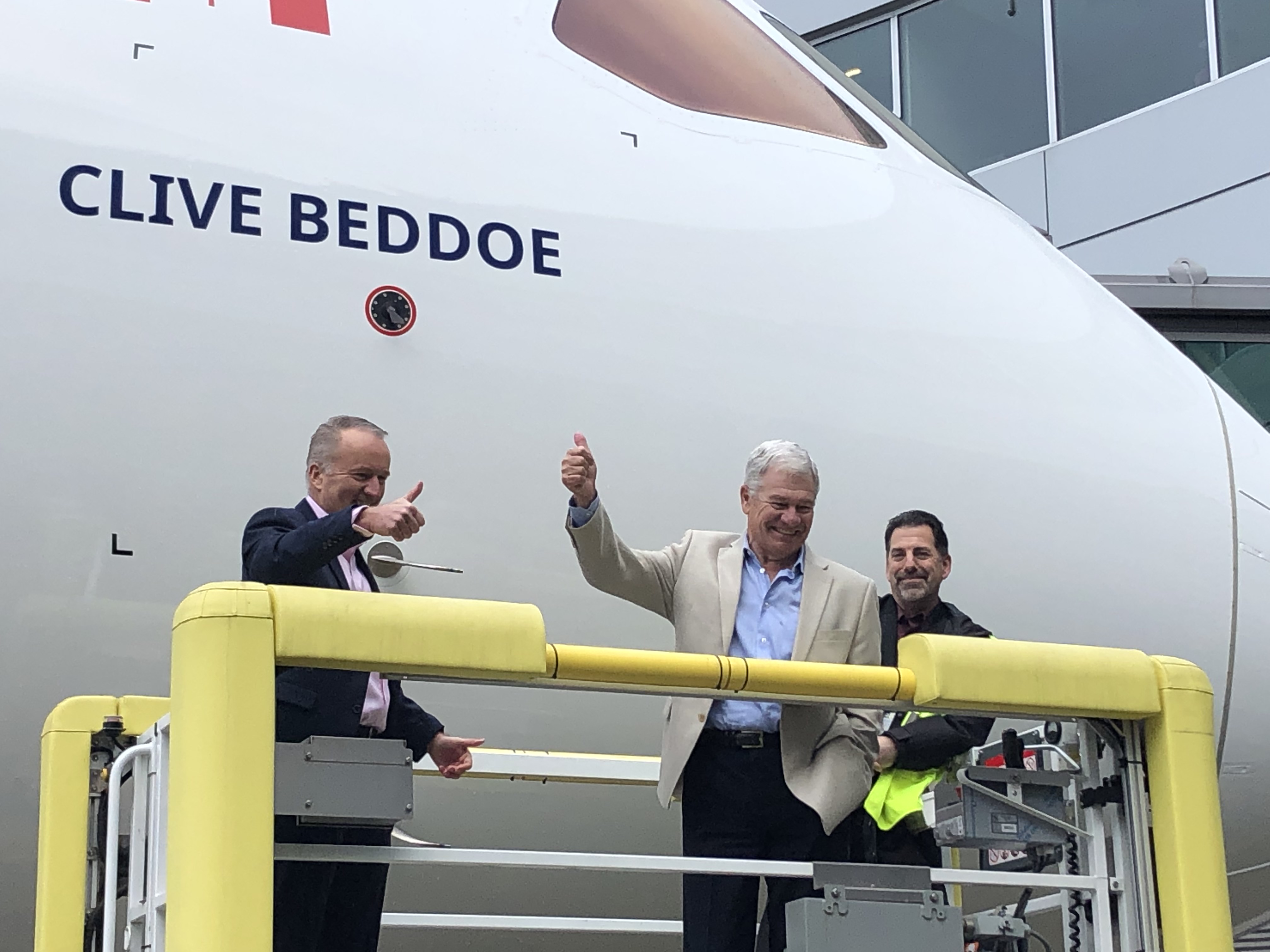
In January 2019, WestJet received its first Boeing 787 Dreamliner. The name painted on the aircraft was Clive Beddoe. He attended the delivery celebration, standing beside an aircraft that made the distance from his small Cessna rather easy to see. The airline had found an exceptionally large surface on which to write a thank-you note.
That April, he travelled with his family on the aircraft's first transatlantic service to London Gatwick. The Dreamliner carried 320 guests, including its namesake. The route joined his adopted home to the country he had left almost five decades earlier. A life in aviation had acquired a satisfying geographical loop.
Away from aircraft, he had also taken on an Atlantic crossing by sail. In 2007 he participated in the Atlantic Rally for Cruisers from the Canary Islands to St. Lucia. His interests allowed for both the speed of a jet and the rather different timetable imposed by an ocean.
His business interests have continued through the Calgary-based Hanover Group of Companies. The family investment firm describes a remit spanning public securities, private equity, real estate and outside investment managers, with a focus on preserving and growing capital over time. It is a quieter setting for a career that became associated with an airline's public personality.
In 2026, Beddoe was named an Alberta Order of Excellence inductee. He also joined Don Bell and early employees at WestJet's thirtieth-anniversary celebrations. The occasion brought the founder back among people who had taken a chance on the same young company. After the aircraft names and the formal honours, that gathering offers a particularly apt picture of his working life: a pilot with an idea, surrounded by the people who helped it fly.