On its first night, Federal Express had 14 aircraft, 389 employees and 186 packages. There were more people working on the promise than parcels benefiting from it. On April 17, 1973, Frederick W. Smith’s future arrived in Memphis looking rather underbooked.
It is an awkward opening for a business legend. A fleet costs money whether its holds are full or nearly empty. An overnight delivery network must exist before customers can trust it. Smith had built something that needed scale, and then had to survive long enough to find it. The useful question about his career is how he crossed that gap.
His answer began with a small observation: an inexpensive component can become immensely valuable when a machine is waiting for it. The price of the part matters less than the price of the delay. Smith spent his working life building an organization around that difference, with Memphis as its nightly meeting place.
A national promise, still waiting for a national crowd.
A whole airplane for one small part
Smith was born in Marks, Mississippi, on August 11, 1944, and grew up in Memphis. Transportation already ran through the family business: his father had built a regional bus company. His father died when Fred was four. Years later, his stepfather, an Air Force general, taught him to fly.
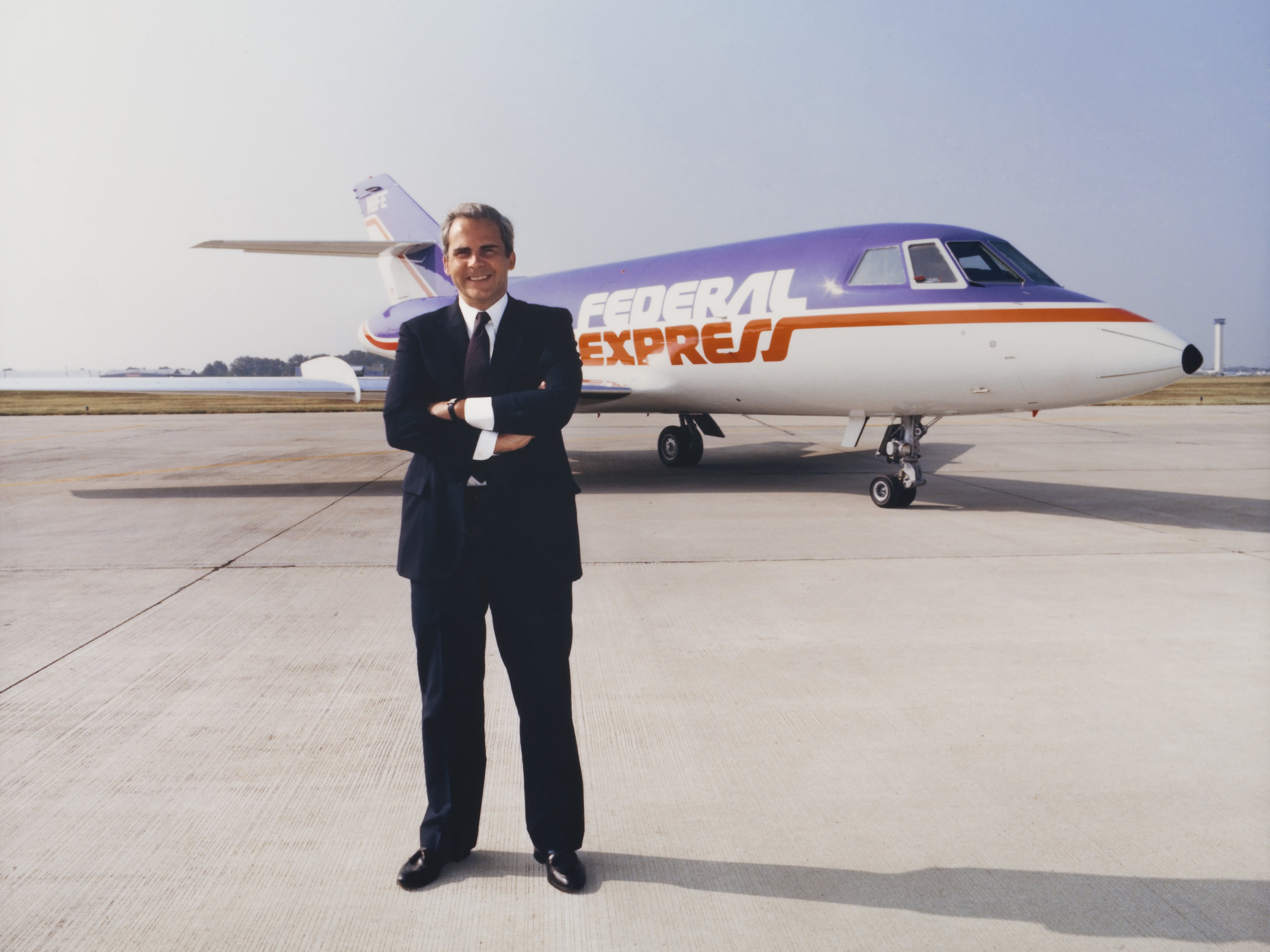
At Yale, where he arrived in 1962, Smith helped revive the flying club. Flying provided an education beyond the classroom. Alongside passenger trips, he carried small industrial parts between cities in the northeastern United States. Companies were willing to hire an entire airplane to transport something that occupied very little of it.
That apparent extravagance contained a business proposition. Automation made factories and offices dependent on equipment. When equipment stopped, somebody wanted a replacement part immediately. A shipping service could sell access to working time. Smith was watching a market emerge from the pilot’s seat, one inconveniently urgent object at a time.
The college paper followed. So did a story that became almost as durable as the company: a professor supposedly gave his idea a C. Smith later said he did not remember the grade. He also explained that the paper concerned the demand created by automation, rather than a finished blueprint for Federal Express. Even a founder’s origin story can acquire excessive packaging.
The detour that made the route
After graduating from Yale in 1966, Smith served in the Marine Corps, including two tours in Vietnam. His assignments spanned ground operations and aviation. He received the Silver Star and Bronze Star. The experience gave him a practical education in coordinating people, equipment and decisions under pressure.
He later traced the management principles of FedEx directly to that service. Keep people informed. Make the mission clear. Look after the people carrying it out. He wrote the original version of the company’s manager’s guide, and described its debt to Marine Corps teaching without much interest in dressing it up as a novel management theory.
One detail is particularly revealing. FedEx adopted the naval signal Bravo Zulu, meaning well done, as a way of recognizing employees. Recognition could take the form of a voucher, a dinner or a lapel pin. In an organization full of expensive machinery, Smith paid attention to the comparatively inexpensive act of noticing when somebody had done a good job.
The reasoning was practical. A service business has to perform again every morning, in fresh weather and traffic, with a fresh set of problems. A manual can describe yesterday’s difficulty. A capable person on the ground has to solve today’s. Smith’s interest in leadership followed from the kind of product he had chosen to sell.
“Praise in public and counsel in private.”
Frederick W. Smith, on lessons carried into FedEx
Why the packages went to Memphis
Smith founded Federal Express in Little Rock in 1971. Operations began in Memphis two years later. The location had several attractions: a central position in the country, an airport that rarely closed because of bad weather, available hangar space and a willingness to improve facilities for the new business.
The underlying arrangement was simple enough to draw on a napkin. Packages from different cities would converge on a central hub, be sorted, then leave for their destinations. Pickup vehicles, airplanes, sorting and delivery belonged to one coordinated service. A customer bought the arrival, rather than a collection of separate transport arrangements.
For an individual parcel, a trip through Memphis might appear peculiar. Why send something away from its destination before bringing it back toward it? Across a network, consolidation changes the calculation. Each city gains access to the others through the hub. The extra distance can purchase a more workable set of connections.
There was an expensive catch. The connections had to be available before the traffic justified them. Smith could scarcely demonstrate overnight delivery with a promise to buy the airplane after enough orders arrived. The first night’s 186 packages were therefore both evidence that the operation worked and a reminder of how much business it still needed.
The cost of getting to tomorrow
Federal Express lost $27 million in its first two years. Smith renegotiated bank loans to keep it operating. The early business had put investors’ money and family capital at risk. A clever diagram offered little comfort when the bills arrived.
By 1977, a very different picture was emerging. The previous fiscal year had produced $75 million in revenue and $3.6 million in profit. Getting there involved other people’s operational work as well as Smith’s conviction. Arthur Bass, an experienced aviation executive, helped improve the delivery schedules while financial backers waited for the proposition to prove itself.
The pressure also came from regulation. Small Falcon jets let the company operate within a regulatory exemption for aircraft below a particular payload threshold. Moving into larger aircraft required a different framework. The business had to navigate rules as well as runways; demand alone could not give it permission to expand.
The chronology matters because later success can make an early decision look inevitable. It was possible to understand the customer’s problem and still run out of money solving it. Smith’s achievement included keeping the organization alive while schedules, financing and demand slowly caught up with the original ambition.
A parcel needs a second journey
Alongside the physical shipment, Smith paid attention to the movement of information. Where had the parcel started? Where was it now? When would it arrive? A customer waiting for a component needed those answers too. The package could be out of sight without becoming an administrative mystery.
FedEx introduced its COSMOS computerized tracking system in 1979. In 1986 came the SuperTracker, a handheld barcode scanner. Online package tracking followed in 1994. These were successive ways of making a moving object legible to the people who depended on it. The delivery network acquired a second set of connections, carrying information about the first.
That changed what a shipper could plan. Inventory in transit became something that could be followed, rather than simply hoped for. Tracking is now an ordinary expectation, which makes its earlier absence easy to forget. Smith’s company helped teach customers to ask where their package was and expect a useful answer.
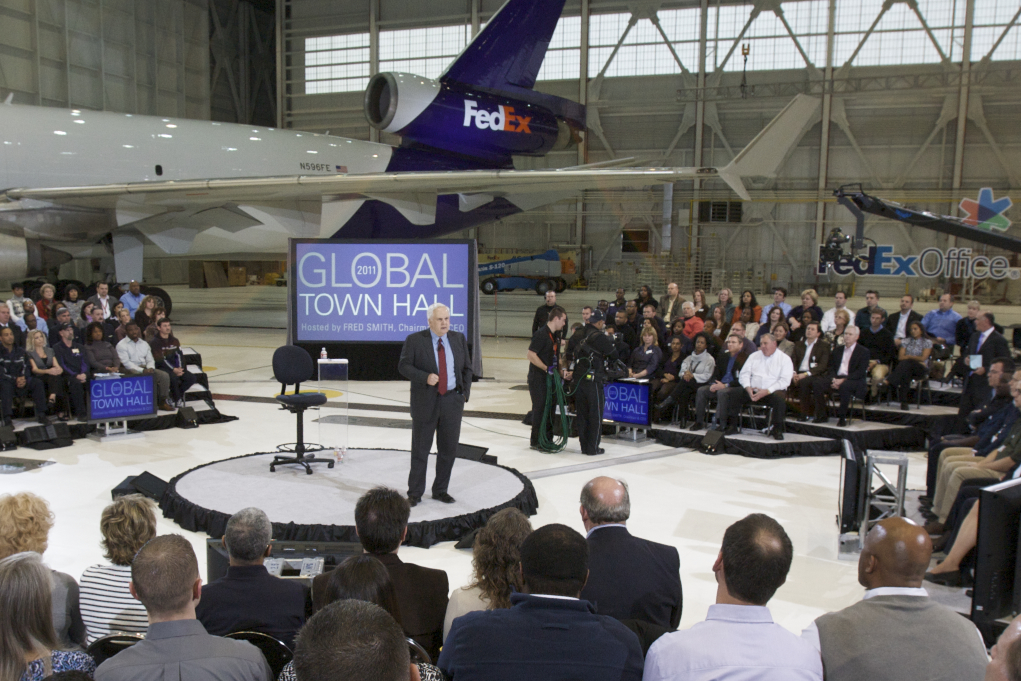
By fiscal 2024, FedEx reported $87.7 billion in revenue. At Smith’s death the following year, the company connected more than 220 countries and territories. The little Memphis operation had become infrastructure for customers far beyond its original map. A shipment could cross borders, change aircraft and continue by road while its sender followed the progress on a screen.
Room for the unusual employee
By the time Smith visited MIT in January 2023, he had been explaining his business for half a century. Asked about innovation, he emphasized the need to tolerate unusual people and unsuccessful attempts. He could acknowledge the strangeness of an idea without treating that strangeness as a reason to dismiss it.
“You’ve got to be able to tolerate characters,” he said. He also stressed being able to tolerate failure. Those are demanding instructions inside an operation built around reliable delivery. An experiment needs room to go wrong; a customer’s promised arrival still needs to go right. Both obligations have to fit in the same company.
His formal philosophy placed people before service and profit. In that sequence, employees able to do their jobs well create the service that produces the financial result. It is an idea easy to print on a wall. Its harder test arrives when managers must spend money or surrender convenience to support the people facing customers.
In June 2022, Smith handed the chief executive’s job to Raj Subramaniam and became executive chairman. The transition gave him a remit covering governance, innovation, sustainability and public policy. The company he had started would now have to keep changing under somebody else’s daily command.
An airport, and work still in motion
His later interests stretched beyond deliveries. A $100 million gift from FedEx helped establish Yale’s Center for Natural Carbon Capture in 2021. Its research explored how natural systems could remove atmospheric carbon. For an aviation business pursuing carbon neutral operations by 2040, supporting that work connected a distant target to scientific questions still needing answers.
Smith also financed Devotion, the film about naval aviators Jesse Brown and Tom Hudner, and linked the project to support for military families’ education. His daughters Molly and Rachel were accomplished film producers. He had already appeared briefly in Cast Away, giving a delivery executive a small place in a film about a delivery that went spectacularly astray.
Smith died on June 21, 2025, aged 80. On August 11, 2026, Memphis celebrated the airport’s renaming in his honor, alongside the first FedEx FWS Day of Service. A ceremonial FedEx 777 arrived as Flight 1944, his birth year. The aircraft carried the name Rosie, after a granddaughter.
The dedication brought the story back to the place that made the original idea practical. For Smith, Memphis had supplied the space, connections and conditions to attempt an unfamiliar business. Now the airport carried his name while the sorting continued. After all the speeches, another night’s packages still needed to get somewhere by morning.
Keep following the route
- MIT: a conversation about 50 years of innovation ↗
- Watch Smith’s full Academy of Achievement interview ↗
- Smith and David Solomon on building FedEx ↗
- Read the official FedEx biography ↗
- Explore the Federal Express chronology ↗
- Yale’s natural carbon capture project ↗
- The airport dedication and day of service ↗
- The film and the scholarship fund ↗